


Religion (4 of 4)
Later into the 19th century, some authors notice an evolution towards a relative religious freedom, recognised in the Constitution after the end of the 1st Carlist war. During his 1844 visit, Francis Trench notices that the influence of the defenders of religion was not so pervasive, although certain repression still existed that unsettled the travellers:
The priesthood, at the present moment, is by no means dominant—at least, for such a country as Spain; and though at this time it is not the policy of the government to exercise very strong measures of any description, especially against principles and treatises in accordance with constitutional liberty, yet still it is sufficiently strong to repress in a certain degree, that lawlessness and disorder which in Spain are always accompanied with insecurity to travellers. There is notwithstanding an absolute impossibility to foresee what a “day may bring forth,” and therefore the louder the call for immediate endeavors to circulate the word of God and edifying tracts, wherever the blessed work can be carried on in this land (21).
Similarly, Terence Hughes also observes an increase in secularisation. In his 1845 account, he alludes to old convent gardens that were removed from town centres and converted into new public spaces, such as the recently created Plaza de la Constitución in Madrid. This, and other signs represent the gradual secularisation of Spain, Hughes declares:
In modern Spain, what is called “the Stone of the Constitution,” in every town plays a conspicuous part. This stone is placed in the principal square, the name of which has in all cases been altered to that of “Plaza de la Constitucion.” Thus, in Spain even saints have been deposed. These squares, under the new régime, have been commonly obtained by throwing open the abolished convent gardens. In Cadiz this is the case with nearly every one of the public squares, and the effect in such a confined and crowded city is very admirable (Vol. I, 218).
For Louisa Tenison, the Spanish are very ceremonious in their religious rituals and traditions. However, she considers that devotion among the middle and upper classes was almost dead around the mid-19th century when she visited the country. Many Spaniards regard religion with indifference as the influence of the clergy is something of the past. The author believes that this has occurred in part because of the sometimes intolerant and reprehensible actions of certain sections of the clergy (160).
In 1873, Augustus Hare opines that worshipping the saints is in decline due to the advance of Protestantism. He also tells some strange stories to portray an almost ridiculous picture of Catholicism in Spain. During his visit to Madrid, he provides the following anecdote about Queen Isabel II and one of her ladies in waiting:
When Queen Isabel came to pray by it, one of her maids of honour, pretending to kiss his toes, bit one of them off, feeling sure that her health would be benefited by swallowing so great a relic; but she instantly became dumb, and did not recover her speech till she was able to vomit forth the delicious morsel (218).
Lastly, several reflections by these writers on religious customs related to death are reviewed. A curious aspect that surprises early travellers are the burial customs. They find it strange that the deceased are buried in a priest’s habit, something that does not happen in their countries and which is noted, among others, by John Armstrong and John Carr. It also explains why the monks scare parishioners by saying that no one can enter heaven unless they are dressed in the habit of their order. Another detail on burials is provided by Carr in his 1809 work. He notes that the practice follows the Muslim system of burying the deceased within less than twenty-four hours. The author also remarks, satirically, that in Valladolid and Salamanca people are afraid of oversleeping in case “someone goes and buries them” (40-41).
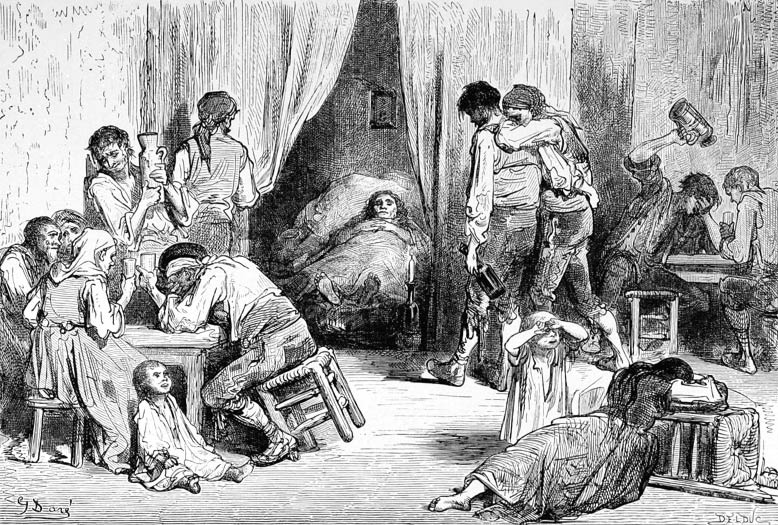
GYPSY MOURNING, TRIANA. L’Espagne, by Baron Charles d’Avillier. Illustration by Gustave Doré.
Decades later, in 1928, V. Prichett also stresses this special predilection for death among Spaniards. The author asserts that no other people love death more than the Spanish (23). He made this statement on Good Friday, so his opinion may be partly explained by what the author saw on this key date on the Catholic calendar. Later in his work, Prichett says that the taste among Spaniards for blood and suffering can be observed in the images, processions and bullfighting (191-195).
«(…) and no people love death as the Spaniards love it»
V. Prichett (Marching Spain, 1928)


