6. Traditions
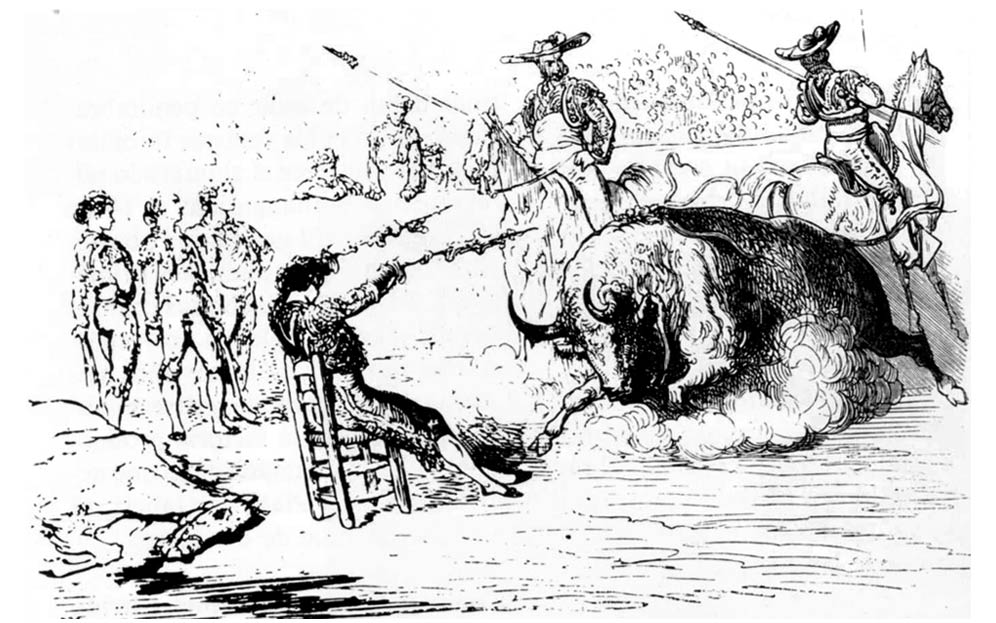
EL GORDITO, A BANDERILLERO. L’Espagne, by Baron Charles d’Avillier. Illustration by Gustave Doré.
«No one breaks bread in the presence of another, whatever the difference of rank, without an invitation to partake»
David Urquhart (The pillars of Hercules or a narrative of travels in Spain and Morocco in 1848, 1850)
Preliminary.
This section presents the main customs and habits of the Spanish people as portrayed in this collection of travel books. These authors’ accounts are an excellent source of information, documenting the Spanish way of life of times past and provide an exceptional anthropological documentary record. In general, Spain fascinates travellers because of its diversity and its unique traditions. Its cuisine does not leave them indifferent: they either love its flavours or they criticise it scathingly. Many pages are filled with descriptions and anecdotes about olive oil and garlic. Moreover, Spaniards are portrayed as people with healthy habits and good manners, as observed by David Urquhart in 1850:
Civility and ceremony do not belong to particular classes. There is not a refined and a vulgar class. The humblest address each other with the forms of the highest. Two human beings do not require an introduction to know each other; they never pass without salutation. No one breaks bread in the presence of another, whatever the difference of rank, without an invitation to partake (174-175).
Religious customs are widespread, with people habitually attending mass and taking part in religious festivities. Most of the authors, who were from Protestant countries, are impressed by the catholic rituals and their expression through processions and pilgrimages. Religious beliefs embedded in popular culture inspire them to write in an effort to comprehend where devotion begins and pagan customs end. For example, Ellen Hope-Edwardes is surprised to observe more enthusiasm than solemnity among the faithful on the streets during Easter Week. This British writer opines that there should be more restraint and less passion (189).
Other national pastimes recorded in most of the texts include bullfighting, flamenco and the popular festivals. Another frequent feature of these texts and of many of the illustrations are the peculiarities of Spanish clothing, beautiful women wearing hair combs and mantillas and the flamboyant regional costumes. The tradition of the evening stroll, the enjoyment of people watching and being seen, as well as interacting and talking to others, is a custom they find attractive. Some habits, such as the siesta, became stereotypes of Spanishness and are addressed in the CLICHÉS chapter. Referring to the most popular celebrations, bullfighting and dancing, L. Higgin states:
No one can travel through Spain, or spend any time there, without becoming aware that, however many other forms of recreation there may be, two are universal and all-absorbing in their hold on the widely differing provinces— dancing and the bull-ring (111).
Many authors are fascinated by the outdoor community life of Spaniards, in the courtyards, squares or in other shared spaces. It is a custom they are not accustomed to in their home countries. Louisa Tenison was delighted to observe how in Seville, people live more in the public sphere than in the private one, sharing their lives in their courtyards, their windows open, and engaging in friendly exchanges every day. The author describes life on the streets and explains how the gate that separates the public realm from the private one is also a point of interaction, with social relations revolving around it. In Tenison’s opinion, it is the fruit of our country’s eastern heritage. George Borrow is fascinated by the custom of socialising in the courtyards during the summer and the surprising natural ventilation these patios provide. He recounts his experience in southern Spain and in Toledo as follows:
(…) during the summer months, descend to the ground-floor, and live under the shade of the awning, amid the fountains and the flowers of their patios, where they shut themselves up all day long, only going out when the night is far advanced to enjoy the cool air (514).
«(…) however many other forms of recreation there may be, two are universal and all-absorbing in their hold on the widely differing provinces— dancing and the bull-ring»
L. Higgin (Spanish life in town and country, 1902)
Another topic of note is the tension that exists between traditional Spanish customs and the encroaching modernity. The authors extol Spain’s unique past and regret the loss of its autochthonous idiosyncrasy with the arrival of imported customs. Yet, paradoxically, these same writers who lament Spain losing its traditional customs and adopting modern values are the same ones who claim that Spain should modernise in certain aspects such as its hotels and transport. The section on “Tradition and Modernity” in the CLICHÉS chapter examines this striking contradiction in more depth.
Nevertheless, several authors embrace Spanish customs, accepting them and enjoying them. Others, on the other hand, assume a high-handed attitude and do not engage at all in the daily life of the country. Elizabeth Murray criticises her fellow countrymen for not adapting to local customs and for considering their own culture to be superior. She remarks that their overwhelming sense of superiority and excessive patriotism prevents them from fully appreciating what they are experiencing. It seems to her that they only wish to return to their own country and are constantly comparing the culture they are visiting with their own. Here is what Murray recounts during her visit to Seville cathedral:
Here there are, at this time, several of them, some mingling with the crowd near the altar, others meditating, or noting down their observations, in the more silent and retired recesses, but the majority walking about without any other consideration than that of “doing” the cathedral as quickly as they can, and then taking their departure to “do” some other equally remarkable sight. Strongly convinced of their superiority to every other nation they regard with contempt every custom that differs from their own acquired habits, neither can nor will accommodate themselves to the manners of the people among whom they are, and when they take their departure, generally leave behind them much dislike and a considerable amount of money, which it is considered quite fair to extract from them by doubtful dealing when it cannot otherwise be obtained by the honest processes of trade (169).