


Charity (2 of 2)
«We fell in with a large gang of galley-slaves, with fetters round their ancles, engaged in mending the road. They were like a band of savages, with long matted hair and beards, almost naked, and nearly as black as negroes»
George Dennis (A Summer in Andalucia: two volumes in one, 1839)
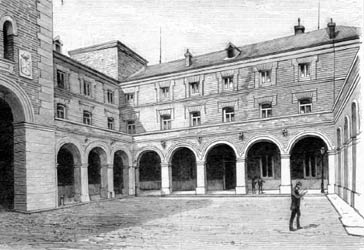
PRISON COURTYARD IN MADRID. Engraving from the Ilustración Española y Americana, 1880.
Prisoners and prisons are also mentioned in these texts. George Dennis meets a group of convicts doing work for the state on a road. They are chained, almost naked, sunburnt, and they approach Dennis to ask him for something:
We fell in with a large gang of galley-slaves, with fetters round their ancles, engaged in mending the road. They were like a band of savages, with long matted hair and beards, almost naked, and nearly as black as negroes— so much had exposure to the sun and dust darkened their originally dusky skins. A few soldiers with muskets were their overseers. Notwithstanding this surveillance, many left their work, and approached my calesa to beg, which they did in a fierce imperative tone, the effect probably of old habits, as though their demand could admit of no refusal (Vol. I, 142-143).
George Borrow devotes an entire chapter to healthcare in Spain. The writer visits a hospital for lepers, which is in poor condition. There were still many lepers in Galicia in the mid-19th century, given that it was one of the most underdeveloped regions in Spain:
Accompanied by the bookseller, I visited this hospital, in which, however, I did not remain long, the wretchedness and uncleanliness which I observed speedily driving me away. Saint James, indeed, is the grand lazar-house for all the rest of Galicia, which accounts for the prodigious number of horrible objects to be seen in its streets, who have for the most part arrived in the hope of procuring medical assistance, which, from what I could learn, is very scantily and inefficiently administered. Amongst these unhappy wretches I occasionally observed the terrible leper, and instantly fled from him with a “God help thee” (389).
Richard Ford comments that while hospitals have improved, medical knowledge has not. Ford claims that Spaniards are not as good at constructive scientific advances as they are at destructive ones. In a peculiar and symbolic paragraph, the English writer asserts that the poor quality of medicine in Spain is in stark contrast with the excellent quality of the knives from Albacete. In other words, the country seems more devoted to cutting with knives than to healing with medicine (A Handbook for Travellers in Spain. Vol. II, 712). Continuing with this reasoning, he argues that the lack of focus on physical ailments in Spain has been balanced by the significant attention paid to matters of the soul. To support this idea, he points to the proliferation of churches and convents across the territory. The author contrasts Spain with England in this regard, depicting England as a land of science and reason, and Spain as a nation steeped in religion and superstition:
However, by the way of compensation, by saving the soul has been made just as primary a consideration in Spain as the curing the body has been in England. Here charms and amulets represented our patent medicines; and the wonder is how any one in Great Britain can be condemned to death in this world, or how any one in the Peninsula can be doomed to perdition in the next; possibly the panaceas are in neither case quite specific. Be that as it may, how numerous and well appointed were the churches and convents here compared to the hospitals, how amply provided the Relicarios compared to the Boticas and anatomical museums! Again, what a flock of holy practitioners came forth after a Castellano rancio has been stabbed, starved, or executed, not one of whom would have stirred a step for any number of his countrymen when alive; and what coppers are not now collected to pay masses to get his soul out of purgatory! (Manual para viajeros por España. Vol. II, 712).
«Here charms and amulets represented our patent medicines; and the wonder is how any one in Great Britain can be condemned to death in this world, or how any one in the Peninsula can be doomed to perdition in the next»
Richard Ford (Manual para viajeros por España, 1845)


