


Mantilla shawls and peinetas (hair combs)
Many authors find mantilla shawls and fans to be fascinating objects that lend an exotic air to Spanish women. Julia Byrne writes that they are “graceful accessories” that the ladies in this country would never be without (210). What strikes the author most when she arrives at the door of a church is that young girls wear this magnificent innovation on their heads (169).
David Urquhart was also perplexed by mantillas when he arrived in Spain in 1850. He considered it to be most beautiful feminine item of clothing in Europe without a doubt: “While the Spanish female costume is unquestionably the most beautiful in Europe, it would thus appear to be at the same time a valuable historical monument” (160).
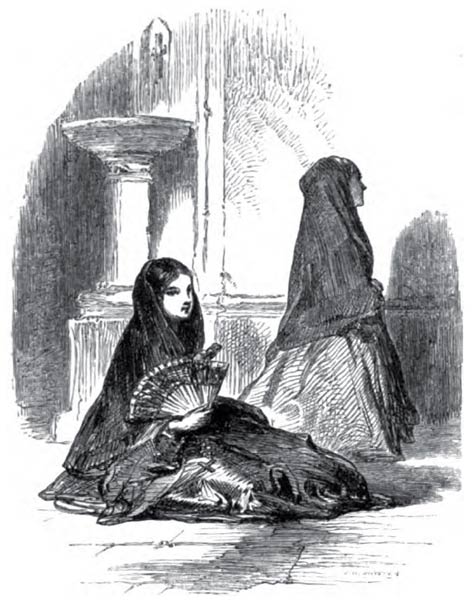
WOMEN IN CHURCH. Castile and Andalucia, by Lady Louisa Tenison (1853).
The appeal of these garments to foreigners is already described in 18th century texts. Philip Thicknesse notes, during his 1798 trip, that the women of Barcelona wear beautiful black and white mantilla shawls, richly adorned with lace. For this English writer, it is the item which most distinguishes the Spanish woman. According to the American traveller Alexander Mackenzie, both the mantilla for women and the cape for men are indicators of distinction and high birth (345).
George Dennis describes the women of Cadiz and their clothing during the Corpus Christi festival. He asserts that much of their attraction lies with the use of this garment, as when they remove it, they are much less interesting physically, unlike English women:
Yet their persons do not constitute the sum total of their attractions, for, without the mysterious mantilla, and ever-fluttering fan, they would be shorn of many of their charms. Nay, even within doors, where the mantilla is laid aside, though the fan is usually retained, they appear by no means so engaging; and in this respect, they differ from the English belles, who are seen to more advantage without their bonnets— for the mantilla, which supplies the place, enhances every charm, improves the character of the whole face and person, and gives an air of dignified grace, even to an insignificant figure (Vol. I, 58)
«(…) without the mysterious mantilla, and ever-fluttering fan, they would be shorn of many of their charms»
George Dennis (A Summer in Andalucia, 1839)
Some of the authors are surprised to learn that such Spanish items as the mantilla and velvet hats are an Arab legacy. The mantilla is said to originate with the Islamic veil, and the hat was adapted from the Middle Eastern turban.
The introduction of changes to the mantilla and its less frequent use in favour of the trend for French fashion is lamented and rejected by all the authors. Enchanted by the elegance of the Spanish mantilla, they defend its use to the hilt, disparaging other “false modernities.” In the words of Samuel Widdrington:
The bad effect of this bastard mantilla is increased by many ladies having adopted the shawls in the French fashion, not for use, but as they conceive for ornament ; when this is the case, between the new covering of the head, the shawl, a long and very loose skirt or basquiña, the figure is as completely disguised as in the East (Vol. II, 17).
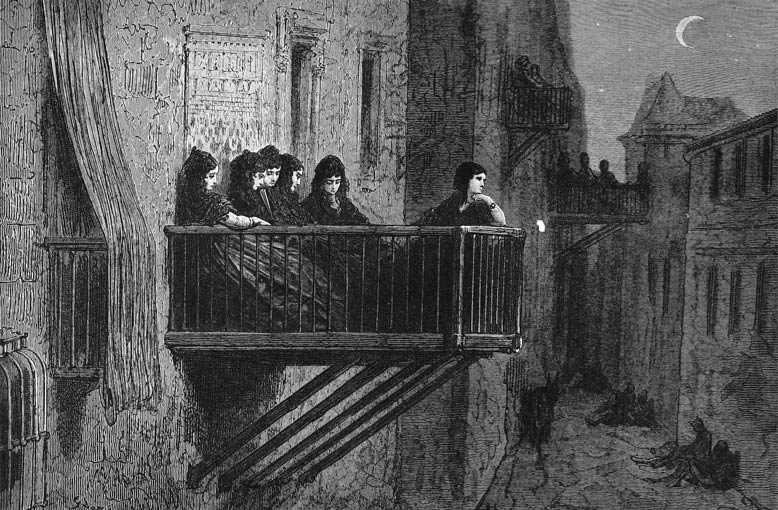
BALCONIES IN VITORIA. L’Espagne, by Baron Charles d’Avillier. Illustration by Gustave Doré.
«The daily afternoon diversion is the drive on the Prado; amusing from the crowd, perhaps, but where, with the exception of the nurses, all national costume has disappeared»
Mary Herbert (Impressions of Spain in 1866, 1867)
The mantilla and other typically Spanish customs are dying out according to Mary Herbert in her 1866 work. She laments the modernisation of the customs:
But apart from its galleries, Madrid is a disappointment; there is no antiquity or interest attached to any of its churches or public buildings. The daily afternoon diversion is the drive on the Prado; amusing from the crowd, perhaps, but where, with the exception of the nurses, all national costume has disappeared. There are scarcely any mantillas; but Faubourg St.-Germain bonnets, in badly assorted colours, and horrible and exaggerated crinolines, replacing the soft, black, flowing dresses of the south (27-28).
In the 20th century, countless authors complain about the loss of traditional elements in favour of the Francisation of fashion. Thomas Ewing Moore comments that female attire is unfortunately influenced too much by foreign fashions, observing that mantillas are worn less, and hats are worn more. For him, this is a negative trend because some of the essence of the nation is lost. Moore is pleased that, fortunately, this process is slower than in other countries due to the difficulties these fashions have in being accepted in Spain (62-64). The conflict between imported fashion and the authentic Spanish traditions of the past is discussed in detail in the “Tradition and modernity” section of the CLICHÉS chapter.
Some authors, fascinated with Spanish fashion, dress in the typical regional costumes, which has been reflected in prints and paintings. For example, Matilda Betham-Edwards, decided to wear a mantilla. Her aim was to pass herself off as a Cordoban woman to avoid being harassed by the beggars. She used to wear a hat, and every time she arrived anywhere, beggars would notice her from afar, and at the cry of "hat," she would be besieged within seconds by dozens of beggars. Her strategy of dressing like a Spanish women seemed to be more successful. Ellen Hope-Edwards tells us a similar story, explaining that being tall and blonde made it more difficult for her to go unnoticed, resulting in her being surrounded by all kinds of street sellers. Faced with this, she invented several tricks, including trying to pass for a Spaniard by dressing in traditional attire (130) Richard Ford also writes about how he enjoyed dressing as a typical Spaniard.


