


Religion (2 of 4)
«How paramount in Spain is the feeling of fraternity which binds the professors of a common religion!»
Alexander Mackenzie (Spain revisited, 1836)
The culture shock is evident in many travellers’ descriptions of their impressions of the depictions of Christ and the Virgin in the churches. During her visit to Burgos cathedral, Mary Elizabeth Herbert is disturbed by the amount of blood and the grotesque appearance of some of the images (12-13). The excess of dramatic devices, the decoration of the religious figures and their exaggerated costumes contrast with the sobriety of Protestant places of worship. What is interesting about her text is that she ultimately admits that all forms of religious devotion are based upon a religion that is construed. The way of understanding devotion to images in her country is as cultural and arbitrary as it is in Spain. Nevertheless, the author still criticises Catholic habits on occasion:
Less pleasing to English eyes, in spite of their wonderful splendour, were digitized by those of the Blessed Virgin, decked out in gorgeous velvet robes, embroidered in gold, and covered with jewels, with lace pocket-handkerchiefs in the hand, and all the paraphernalia of a fine lady of the nineteenth century! It is contrary to our purer taste, which thinks of her as represented in one of Raphael’s chaste and modest pictures, with the simple robe and headdress of her land and people; or else in the glistening white marble, chosen by our late beloved Cardinal as the fittest material for a representation of her in his ‘Ex Voto,’ and which speaks of the spotless purity of her holy life (112-113).
The close relationship between religiosity and social relations is an aspect that is noticed by Alexander Mackenzie. In a story that takes place in Hernani, as the writer enters a church in the town, a parishioner offers to pour holy water on him. Mackenzie provides an intriguing observation on kindness and the concept of sharing among professing Catholics, something that does not exist in his own country:
I chanced to come opposite the fount of holy water without the door, just as a young woman had dipped her finger into it to cross herself, and who, seeing me next her, turned to offer it to me from her finger. I at once received a portion of it on mine with a bow of courtesy, and followed her devout example in crossing myself. How paramount in Spain is the feeling of fraternity which binds the professors of a common religion! How little thought is there given to the petty and factitious proprieties, which elsewhere separate far from each other the fellow-members of the family of Christ! (Vol. II, 358).
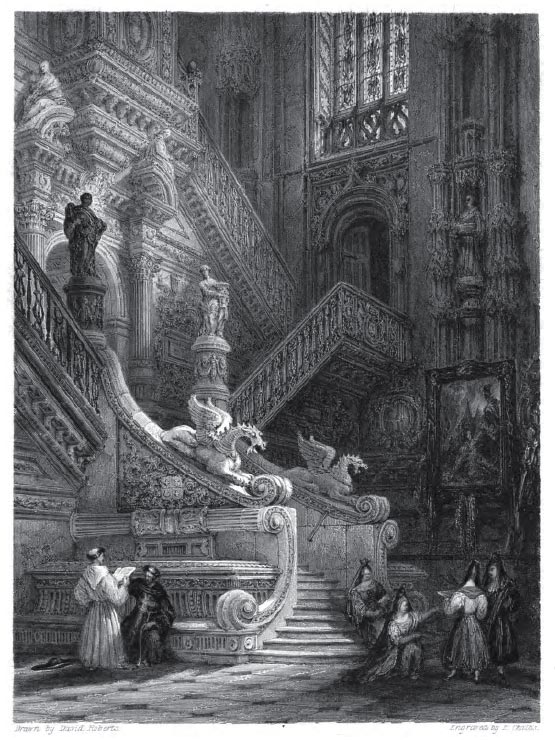
STAIRCASE IN THE NORTH TRANSEPT, BURGOS CATHEDRAL. The tourist in Spain: Biscay and the Castiles, by Thomas Roscoe (1837).
On the relationship between religion and sexuality, George Dennis provides a curious observation in his 1839 text. One of the English writer’s interlocutors, don Jaime, laments the decline of religious sentiment in Spain, the consequence of which, he says, is the corruption of public morals. When Dennis asks him if he is referring to sex, don Jaime says he isn’t, as sex follows other rules: “men will feel like making love and women will hear them (sic).” Dennis notes that these “immoralities” are not unapproved of in Spain and appears to insinuate that he is surprised that sex is punished less than robbery or contraband:
“The public morality is consequently deteriorated.”
“Do you speak of sexual morals?”
“Oh, as to the matter of gallantries, we are just where we were, and where we ever shall be. Men will make love, and women will listen to them.”
And here, I may remark, that the Spaniards hardly regard these faux pas as immoralities, viewing them with far more lenient eyes than robbery, smuggling, or other offences punishable by law (Vol. I, 103).
«Many were the morning salutations, the Ave Marias, and “Go with the saints!” and “a whole neck!” that we received; the Catholics of our party as regularly to each Ave Maria purissima! replying with the sin peccado concebida! the favourite mode of welcome in arriving or departing— even knocking at a man’s door, and with the people, indeed, on most occasions of life»
Thomas Roscoe (The Tourist in Spain and Morocco, 1838)
They are also struck by the abundance of religious expressions in the language, no matter the context. On the subject, Thomas Roscoe states: “Many were the morning salutations, the Ave Marias, and ‘Go with the saints!’ […] that we received; the Catholics of our party as regularly to each Ave Maria purisima! replying with the ‘sin pecado concebida!,’ the favourite mode of welcome in arriving or departing” (23).
As for critical attitudes, we find many examples of these, even going back as far as the oldest texts. One such text denounces the bad influence of the Church in matters of ethics and customs across the country. In his 1756 work, John Armstrong laments that there are so many holidays for religious reasons. The British writer and military officer complains that people are forced to observe these holidays, making them unproductive (248). A century later, Terence Hughes establishes a curious causal relationship between religion and laziness. The Irish author remarks that the processions, pilgrimages and rosaries would be an admirable practice if they didn’t encourage indolence (367). Hughes also establishes a direct link between religion and festivities when he emphasises the festive character of these celebrations. He declares that the celebrations that follow mass in the form of pageants, vulgarise and distort the original meaning of the event and give importance only to the recreational part, referring to the fact that people drink, eat or dance on the occasion of such events (370).
According to Philip Thicknesse, Spaniards are intolerant of other beliefs, and everyone wants to give the impression that they are good Catholics. For this reason, the author always carries several crucifixes, a rosary and a few holy images of saints, which he shows whenever he can. Reason and philosophy have been slow to arrive in Spain, and rituals and symbols count for more than other values that he believes should be recognised by Catholics:
However, I was convinced, before I went into Spain this time, from what I remembered formerly, that it was so necessary to appear a good Catholic, that I always carried a little crucifix or two, some beads, and other accidental marks of my faith; and where I stayed any time, or, indeed, where I slept upon the road, I took occasion to let some of those powerful protectors be seen, as it were, by chance; -it is very necessary to avail one’s self of such innocent frauds, in a country where innocence itself may not be sufficient to shield you from the fury of religious bigotry, where people think they are serving God, by destroying men: the best method to save yourself, is by serving God in the same manner they do, till you are out of their power. I really thought, that philosophy and reason entered into Spain at the same gates at which the Jesuits were turned out of the kingdom; and, I suppose, some did; but it must be many years before it is sufficiently diffused over the whole nation, to render it a country like France (…) (314-315).


