


Religion (3 of 4)
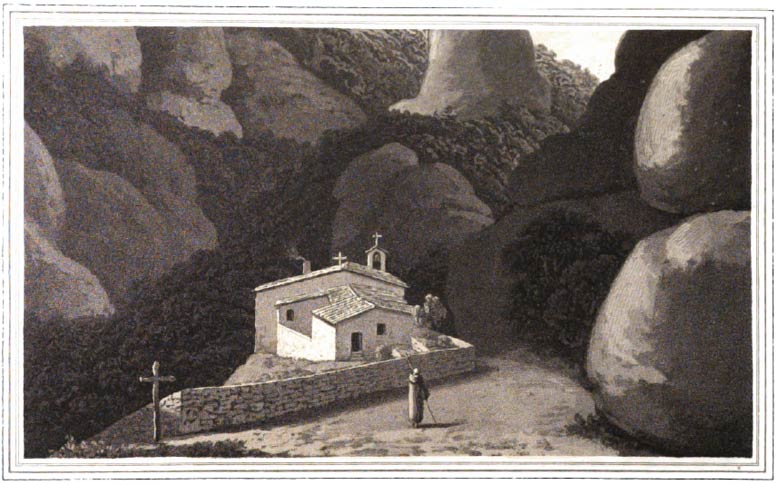
HERMITAGE OF SANTA ANA DE MONTSERRAT. Descriptive travels in the Southern and Eastern parts of Spain and the Balearic Isles, in the year 1809, by Sir John Carr (1811).
On his 1831 visit, Arthur Brook characterised the demonstrations of public religiosity in Cordoba, such as the altars across the city on religious holidays, as fanaticism. (Vol. II. 261).
Similarly, George Clark is perplexed by the rituals of some devotees and considers them to be more akin to superstition than true faith. This is his account of a visit to a church in Granada in 1849:
(…) there was one miserable-looking man on his knees, creeping round to each altar in succession, muttering unintelligible prayers, and between each rubbing the floor with his forehead. To do the Spaniards justice, I never saw any young man performing these ceremonies of mortification; penance is all that is left to those who are too old and hardened for repentance (122).
Authors from the early 20th century, like Albert Calvert, present instances of popular devotion that they view as superstitious. Calvert tells of his experience of his visit to the Virgin of Montserrat in 1910 in this way:
There are plenty of people in Cataluña still who believe in the wonder-working properties of the Virgin of Montserrat, and newly married couples come up by the funicular railway to spend a night on the mountain, in the hope of thereby assuring themselves of a numerous family (78).
John Carr also criticises the collection of jewels and riches for images, using the Virgin of Montserrat as an example, claiming that her wealth would be better spent on education and charity. George Dennis compares the superstition he observed in Spain with that he witnessed during his trip to India. According to the author, although there are differences in creed, the human attitude towards the supernatural is the same outside England.
«To this day the people of the different parishes rival one another in the pride they take in their respective pasos»
Thomas Ewing Moore (In the heart of Spain, 1927)
Many travellers do not understand the rivalry between neighbouring villages over religious matters, such as the confrontations between groups over their sacred advocations and patron saints. During his trip in 1927, Thomas Ewing Moore describes the rivalry between brotherhoods over the beauty of their images:
To this day the people of the different parishes rival one another in the pride they take in their respective pasos, and the women of the lower class are ever ready to contend with their gossips of another parish in vaunting the perfections of their own particular and beloved Lady; they are ready even to do battle in maintaining her superior beauty! (87).
However, some authors believe that this superstitious and antiquated aspect of religion is dying out. After hearing several stories recounting miracles, George Dennis states that blind faith in these kinds of stories is diminishing and the country is moving towards a new more enlightened type of thought:
When we reflect, however, that such gross credulity, such abject blindness to priestcraft, was, at no distant period, almost universal in Spain, we cannot but rejoice at the present altered state of things, and hail any events that are likely to induce a still further enlightenment of the minds of the people, and to pave the way for their reception of a purer faith (Vol. I, 175-176).
Against this criticism of Spain as a superstitious and fanatical country, a person knowledgeable about national religiosity, George Borrow, contradicts this recurrent idea in the following terms:
Strange as it may sound, Spain is not a fanatic country. I know something about her, and declare that she is not, nor has ever been: Spain never changes. It is true that, for nearly two centuries, she was the she-butcher, La Verduga of malignant Rome; the chosen instrument for carrying into effect the atrocious projects of that power; yet fanaticism was not the spring which impelled her to the work of butchery: another feeling, in her the predominant one, was worked upon —her fatal pride (viii).
With regard to the process of secularisation of Spanish society, George Dennis illustrates the weakening of religiosity with a peculiar anecdote he experienced in the boarding house where he stayed in Granada, where an old holy water font had been emptied and whitewashed to be used as a storage place for castanets:
The cross which at one time was placed over the head of every bed, is now rarely seen. A small basin imbedded in the staircase wall of my lodgings, surmounted by a tiny wooden cross, is now dry and white-washed; and though in the time of more holy tenants, it used to offer its little fund of “blessed water” to those who ascended or descended, it is now converted into a depository for castanets (Vol. II, 182).


