


Food (4 of 4)
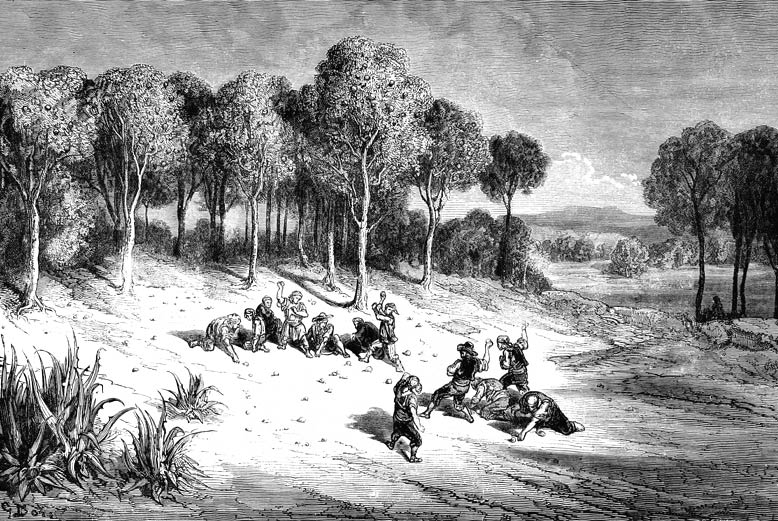
ORANGES IN CARCAGENTE. L’Espagne, by Baron Charles d’Avillier. Illustration by Gustave Doré.
«And proposes improvements, “a little vinegar”»
Ellen Hope-Edwardes (Azahar: extracts from a journal in Spain in 1881-82, 1883)
Food related stories often offer plenty of interesting anecdotes. Nathaniel Wells tells a charming story in 1846 about an unusual breakfast. The lady running the boarding house serves him an egg for breakfast, which Wells notices to be off. When he tells the lady, she goes to the wastebin to retrieve the eggshells and shows them to him, staring at him defiantly. She tells him that it is his fault because he cracked the eggs open from the wrong end (175-178). Susan Hale shares another incident about travelling by stagecoach with her party to Madrid and having the chicken she was carrying in the lunch basket stolen. On returning to the carriage, the writer recounts in an understated way, her surprise at the theft: “while we were away, someone went through the lunch basket, from which pieces of the chicken we were carrying disappeared” (268).
Criticism is also quite prevalent in the writings of the travellers. Ellen Hope-Edwardes finds Spanish cuisine enjoyable if it weren’t for the overuse of sauces and paprika in everything. If there is something they do not care for, the owner of the guesthouse says “vinegar, vinegar, that fixes everything” (112). The author makes another ironic comment about butter, which according to her, is non-existent in Spain because it is something “foreign” for them (113). The English writer describes how the butter that the English are so fond of spreading on their bread is replaced here by quince paste (211).
Many of them commend the quality of Spanish bread, which is better than that made in London, according to Josep Quin (46), although this author is astonished to see people using wooden cutlery to eat with (56). According to John Campion’s 1879 travel reports, the use of wooden spoons and forks is widespread and so is the sharing of them at mealtimes. They would only find metal cutlery in “first class hotels and luxury restaurants” (201).
Spanish people consume a lot of fruit, and several authors appreciate its natural, more intense flavour. Fruit and their wonderful scents, such as orange blossom and many other flowers are everywhere. For Ellen Hope-Edwardes, Spain is all oranges, which inspired the title of her book Azahar: Extracts from Spain 1881-1882. The author revels in the world of citrus fruits: there are donkeys with saddlebags laden with oranges, travellers who enthuse about the beauty of the orange flower, farmers who set the ideal age of the tree for its production at 20 years, and an exhaustive list of orange-related facts (136).
A few of the authors complain that salad is served with water and a lot of vinegar and describe it as being like a soup. Despite this, Arthur Brook writes that the rabbit stew and the two bottles of Sanlúcar wine left him completely satisfied during his 1831 trip. Samuel Widdrington was delighted with the watery salad, however, and he also enjoyed the Andalusian goat’s cheese, and naturally, drinking wine from a wineskin, which became an essential item in his luggage.
(…) we had lived a good deal in the Spanish manner and with great temperance. We drank little wine and abundance of goats’ milk, that is not only the best in the world (…) Another article strongly to be recommended is a water salad, the lettuce, which is deliciously crisp and tender, is mixed in the usual way with oil and vinegar and then put in a bowl that is filled with water, so that you sup the liquid (…) I had entirely abandoned the bota that was formerly a constant part of my travelling equipage (…) (Vol. I, 236-237).
C.L. Freeston very much enjoyed the breakfasts during his 1936 journey. In his opinion, Spanish jams, toasts, biscuits and fruit are superior to the French ones (45). Freeston is curious about serrano ham, like many of his English compatriots, which he described as raw, tough and difficult to chew. During his stay in Mérida, he was offered a banquet at dinner time of ham, soup, lobster, partridges and desserts. Afterwards, he observes that it is curious that in a small Spanish town, one finishes dinner later than in a luxury hotel in the most expensive part of London (116-117).
«A blessing on Spanish chocolate, Mexico’s best gift to Spain»
John Campion (On foot in Spain: a walk from the Bay of Biscay to the Mediterranean, 1879)
George Cayley enjoyed a particularly good breakfast as a guest in Puerto de Santa María. When he had finished, he was offered a glass of wine, as is the national custom. Cayley described it as “the best sherry I have ever tasted” (66). On another occasion, also at breakfast, he was served sardines, olives and the excellent bread that is always found in Spain, once again accompanied by wine.
Lastly, many travellers mention the hot chocolate as something exceptional. It is served in Spain as an afternoon snack and a revitalising drink. As many authors attested, the Spaniards are the experts in this art. As opposed to the European habit of consuming it in solid form, Nathaniel West and the writer Mrs Willian Tolemache are delighted with this custom. According to the latter, Spanish chocolate is a delicious liquid, as thick as Turkish coffee, and describes it as a gift from Spain to Europe (3). George Ticknor, exaggerating somewhat, notes that the chocolate served in Spain is so thick that it can be eaten with a fork (187). They believe it should be available in their countries because of its great taste and energy value that make it almost a “complete meal” in itself. John Campion declared, “Blessed be Spanish chocolate, Mexico’s best gift to Spain, better than all its gold and silver.” He added, that generally speaking, the English haven’t the remotest idea of what a good cup of chocolate is (51).
Susan Hale also praises the chocolate, although the first time she was offered it for breakfast, she describes it as a substance that was as thick as mud. She and her companions liked it so much that they decided to adopt this comforting and healthy Spanish custom. Unlike other travellers, Hale wished to try everything new and thus discover as much as she could about Spain, noting that since this was the typical Spanish breakfast, her group was determined to join in with this local custom (35).
Overseas travellers also found churros quite strange, since they were not accustomed to their shape or taste. However, they eventually grew to love them after trying them for breakfast and merienda (mid-afternoon snack). V. Prichett mentions that a lady came to the door of his inn at dawn and sold these snake-like spirals by the yard: “The reek of such pleasant frying woke up the little man who went out and bought a yard or two of churros for my breakfast. They were cut into little coils like brown serpents, and were hung on a thread of straw. ‘Patience! Patience!,’ said he” (38-39).


