


Food (2 of 4)
«(…) and the sooner the traveller puts himself on an intimate footing with the olla the better; for he will find it welcome him on every table»
Louisa Tenison (Castile and Andalucia, 1853)
Tenison humorously criticises some culinary habits. For example, she complains about the ever-present pot of chickpeas and that they sometime serve soups with old chicken meat (419). Yet, the author always adds a positive note with a comment about something she has enjoyed, whether it is the bread, which is always hearty and freshly baked, or afternoon snacks of hot chocolate, which she describes as a delicious habit. Referring to the famous Spanish hotpot, she explains:
At the diligence-dinners some of the dishes may always be managed, and the sooner the traveller puts himself on an intimate footing with the olla the better; for he will find it welcome him on every table, from one end of Spain to the other. It introduces itself to his notice at the commencement of every dinner, with its small piece of beef done to rags ; its attendant morsel of fat bacon and red sausage, which the traveller had better look upon with distrust, unless he has resolved before he enters Spain to count garlic among one of his favourite condiments ; and surrounded by its coronet of vegetables and garbanzos, that tough pea, which forms the delight of every Spaniard. A good olla well cooked is not a dish to be disdained, but in general it is so stringy that it is hardly eatable (Vol. II, 419).
The most typical dish of the 19th century seems to be the hotpot. In his book Gatherings from Spain, Richard Ford states that it is the Spanish meal par excellence, which many other travellers talk about. For Alexander Mackenzie, the hotpot or stew is a kind of ark where animals of different species congregate (82). Ford describes it as follows: “The pot, or olla, has accordingly become a synonym for the dinner of Spaniards, just as beefsteaks or frogs are vulgarly supposed to constitute the whole bill of fare of two other mighty nations” (132).
Leonard Williams does not find Spanish cooking to be particularly good, and the meat even less so. This is his opinion about a sumptuous meal he attends in the Alcázar in Toledo in 1903:
Then came the meat, which appeared to the countess to be far from good. This is credible, since Spaniards, even at the present day, are infamous cooks where flesh is concerned, preferring to serve it up completely dry; nor have they learned to improve its tenderness by hanging; so that between toughness and dryness it is commonly intolerable to foreign palates (9).
Fish and seafood capture the interest of many travellers, recognising their importance in the Mediterranean diet, as opposed to meat, which is the staple food in their home country of England. As early as the mid-18th century, we find evidence of this interest, provided by John Armstrong, who describes the seafood that is eaten in the Balearic Islands:
The oyster-Cove lies almost opposite to Bloody-Island on the Mahon side, where the Spaniards dive for that delicious shell-fish (…) the diving for oysters can only be practiced in Summer Time, the oysters are eaten to great disadvantage; yet though they are not so fat and well fed as some of ours are in England, they have a pleasant flavour that highly recommends them (20-21).
The quantity of fish consumed piques the interest of travellers, who look for a potential explanation. Richard Ford believes that could be linked to the Catholic religion’s prohibitions and abstentions. He gives the example of salt cod, which is frequently used in Andalusian and Spanish cuisine. Despite its delicious taste, Ford cautions against eating it because it leads to thirst and poor digestion. He also dedicates a section to the culinary habits of the poor and states that they too, eat a lot of fish (A Handbook for Travellers in Spain, Vol. I, 209).
Another peculiarity of the Spanish dining table is that, according to George Dennis, many inns do not have knives, thus each diner must bring their own. The same occurs with the dishes; everyone eats directly from the pot with a wooden spoon, with the exception of the author, who is served a plate because he is an outsider. He notices that the other diners pierce the meat with the tip of their knife and eat it in this manner. Neither are there enough glasses for everyone, so they either share them or drink from the bota (wineskin) (343-344).
«(…) I noticed in other posadas our food was always “alive” when we ordered it»
Edward Penfield (Spanish sketches, 1911)
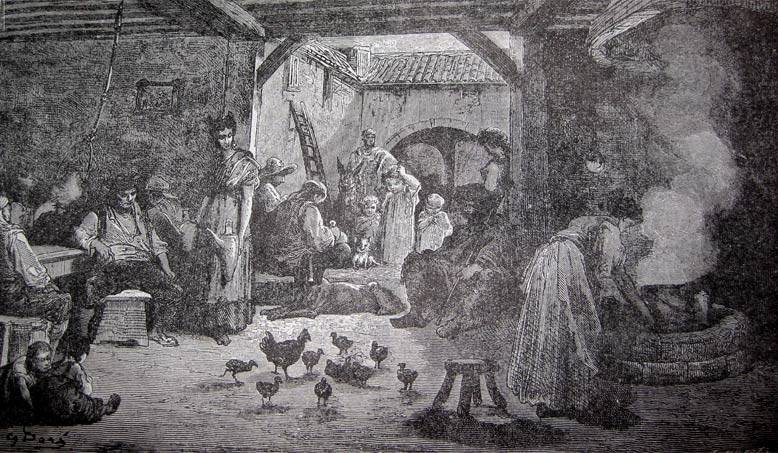
AN INN INTERIOR, EXTREMADURA. Illustration by Gustave Doré.
The various ways in which a dish is eaten give rise to some amusing scenes. One instance was the occasion when Charles Lauffman and his companions were served fried eggs. They ate them with a knife and fork, unlike their Spanish fellow diners, who used bread to mop up the yolk: “Using a knife and fork, a waiter looking at me inquired cynically: ‘Are there no eggs in your country?’ ‘Oh, yes.’ ‘I thought there were not, by the mess you are making of that one’” (97).
Edward Penfield humorously assures us that the food served is always fresh. In a rural inn where he spent the night, the author enjoyed an excellent dinner of rabbit stew, and in describing its preparation, he writes that "the meal was alive when we ordered it:"
Señor could have anything he preferred, but after a deal of hunting about for chickens, the larder narrowed down to rabbit stew; so two rabbits were killed and prepared before us (I noticed in other posadas our food was always “alive” when we ordered it) and placed in a large bowl in the center of the table, out of which we helped ourselves (42).


