


Food (3 of 4)
Julia Byrne also writes about the freshness of the ingredients, vegetables and meat, which they buy expressly for each meal. The author is surprised to discover that they do not keep the bare minimum of provisions in their homes or hostels. During her stay in a hostel in La Mancha, the owner asks her what she would like for dinner that evening, so she could go to the market and buy the necessary ingredients. The English traveller remarked that the wife had not considered keeping a few provisions at home (264).
In the early 19th century, accommodation in Spain was not adequately prepared, and the traveller Robert Sample notes that the guests at an inn had to buy their own food and take it to the inn to be cooked for them: “When the posadas are in towns, many Spanish travellers go out and purchase their bread, fruit, meat, and vegetables, which they procure to be cooked according to their fancy” (203). Arthur Brook even went as far as to claim that his food was running around the yard when he arrived.
(…) and found, as is usually the case in Spain, that the only provisions she had were alive and running about in the poultry yard, in the shape of sundry cocks and hens. We accordingly proceeded thither, and having soon fixed upon a fine capon that was strutting about, we pointed him out to the good dame, who, by the help of an ingenious little instrument, loaded with two balls at the ends, which she threw like a lasso, soon hampered the legs of the unfortunate bird, and being caught, it was carried off to the pot (107).
Another comical episode is witnessed by John Campion who wasn’t too keen on the stew they had prepared for him in Aragón, as he thought he was being served cat meat. His story begins when the inn owner shows him the cooking pot in which she is cooking the dinner:
She lifted the lid of a stew-pan to put in some seasoning, and I noticed it contained te joints and pieces of some small animal, but not its head, and immediately had my suspicions. Thinking to ascertain the truth by a ruse, I rubbed my hands together, as if in satisfaction, and cheerfully exclaimed: “Ah! We are going to have stewed cat.” “Cat, indeed! It is a rabbit. Does your worship think I would cook a cat?” “Where is its head?” “Oh, I gave it to the dog. A rabbit’s head is not worth cooking.” (…) Whether it were rabbit or cat I did not know, never shall know; but I did most certainly know it was miserable trash as I ever tried to eat. If it was a fair sample of cat, then no more cat do I want while I live (124).
Andrew Blayney dislikes the Spanish custom of paying a visit around suppertime. During his 1814 trip, the English military officer notes that just as they sit down at the table, the countess of such-and-such or the lady of so-and-so appears to make one of the many unwanted visits that prevent him from dining in peace (Vol. I, 163).
The Levante region’s rice dishes and paellas are well-known, with mentions dating back to the 18th century. In 1811, John Carr describes the magnificent rice and fish dish they were served in Valencia, as well as a poultry and ham meal in the Albufera. He also mentions the region’s distinctive refreshing beverage, horchata, which is new to him. A few years later, V. Prichett recalls the exquisite paella prepared for them in Badajoz:
Paella was brought. The youth came round with the long, fuming dish on his arm, a mountain range of rice, shellfish, bits of veal, chicken, pork, peppers hot as a volcano, yellow as mustard, dense with oil. ‘More, more,’ cried the frog-like man (113).
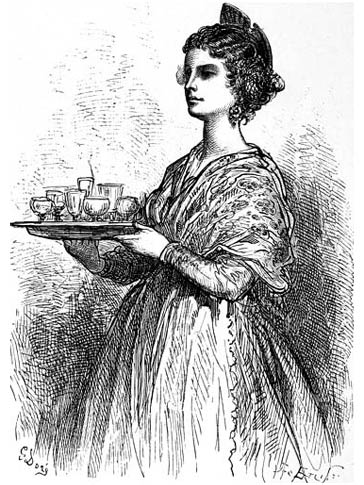
VALENCIAN WAITRESS. L’Espagne, by Baron Charles d’Avillier. Illustration by Gustave Doré.
«Spain still retains universally the excellent and healthful habit of dining early»
Terence Hughes (Revelations of Spain in 1845, 1845)
As the century progresses, the visitors appear to become more satisfied with the food and all the paraphernalia that surrounds it. John Campion describes his magnificent culinary experience in 1879:
Table covered with a clean white cloth; a ditto napkin; and a roll of fresh bread before each person. In the centre of the table a handsome bouquet of natural cut flowers—heliotropes, roses, carnations, &c. &c.—all grown out of doors. Set around, are little plates containing cheese—a sort of gruyere; fresh butter—very good; excellent grapes, apples, walnuts, and other fruit. A neat, clean servant girl goes round and pours out a large goblet of wine and a tumbler of water for each person, and the following courses are handed round: a beetroot salad, omelettes, sausages on toast, mutton chops and fried potatoes, pastry, black coffee, and cigarios. During the meal, wine glasses are refilled by the servant as often as emptied (30-31).
Alexander Mackenzie commends the meats of Burgos and is astonished by the quality of the produce he sees at the food market in Vitoria.
Mealtimes in the 19th century were similar to those in northern Europe and differed quite significantly from mealtimes today. In 1845, Terence Hughes comments on the dining routines of Spaniards. Supper is eaten early, around five o’clock, which he considers to be a healthy habit:
Spain still retains universally the excellent and healthful habit of dining early; and even the Queen’s state banquets take place for the most part no later than five o’clock. It is thus possible to attend a theatre as well as dine, and suppers are not an invasion on the breakfast hour. The Spaniards eat light breakfasts —a cup of coffee and a little toast, or in the season a bunch of grapes with dry bread, and no accompanying beverage— for those who take wine at breakfast are the smaller number; and the dinner follows for the most part at two or three o’clock. The first meal is almost strictly the Roman jentaculum (Vol. II, 7).


