


Bullfighting (3 of 3)
«Certainly there is no spectacle in Spain so well worth seeing as a good bull-fight»
Andrew Blayney (Narrative of a forced journey through Spain and France, as a prisioner of war, in the years 1810 to 1814, 1814)
Similarly, Leonard Williams, contrary to the opinions of most writers, believes it is a supreme spectacle:
The spectacle of these fiestas de toros, considered merely as an entertainment, and not as an indexo f the nacional nacional sanity, was undoubtedly superb. The sumptuous court and gala dresses; the flaming jewels in the hair and ears of the ladies; the Guardia Amarilla, or Yellow Guard, with flashing arms, and scarlet and yellow uniforms; the gorgeous hangings, contrasting with the black and gold railings of the balconies; the trappings of the horses; and, above all, the gathering of so animated and vast a multitude within so confined a space, would form an incomparable panorama (132).
Josep Quin attends a bullfight in 1823, where despite feeling somewhat unsettled by the blood, admits that they have a special attraction:
Shocking as this national amusement is at first to a foreigner, there is something always attractive in a numerous assembly of people, particularly when arranged on the seats of such a large and handsome amphitheater as this of Seville (211).
Andrew Blayney considers it to be the best entertainment that Spain offers to a foreigner:
The matadore is however stimulated, by the knowledge that his courage and success will gain him the plaudits of the fair sex, who contend for the preference in his good graces. Certainly there is no spectacle in Spain so well worth seeing as a good hull-fight. The pleasure derived from it must, however, he allowed to be at the expence of humanity, for men, as well as horses and bulls, often lose their lives in this sport. These fights had been discontinued for some years, hut on the arrival of the French were permitted to be renewed (Vol. I. 301-302).
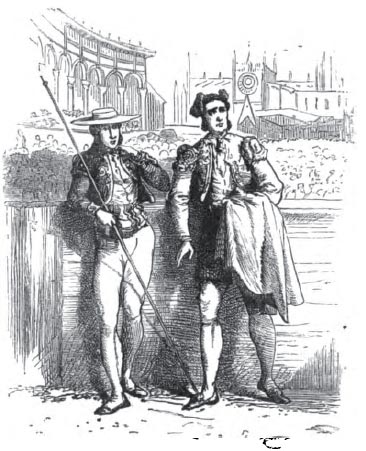
BULLFIGHTERS. Spanish pictures drawn with pen and pencil, by Samuel Manning (1870).
Edward Penfield writes some fine lines about bullfighting and its significance in Spain. Despite not being happy about the tradition, the author concludes with a moving dissertation about everything he had just observed. He remarks that neither football nor baseball in his country can match what is experienced in the bullring on a Sunday afternoon. The spectacle has an indescribable grandeur and a deep-rooted place in Spanish tradition:
We have our foot-ball contests and our base-ball games with. their adherents, the well-known “fans”; but neither of them gives the spectacle that the bull ring offers, nowhere is there a contest where courage, grace, and unfaltering calculation play so important a part, or where the people unite as if all were brothers in supporting and criticizing the play. From the Spanish child’s nursery days he plays at bull-fighting. A light wicker bull’s head is worn by a boy who charges his companions with capes waving before them. Every day the press recounts deeds of charity, heroism, and honesty performed by the toreador in his daily life, and he is the idol of the people. Bull-fighting is part of them: which may explain the failure of the many efforts to drive the sport from Spain (145-146).
Matilda Betham-Edwards attends a bullfight at a cortijo and appears to blame the bull more than the matador for the violence (150). Bart Kennedy also loves bullfighting, telling his guide Campitos on his 1903 visit that he admires the skill and courage. His guide responds by saying that bullfighting should be exported to London (40).
One of the most anti-bullfighting critics is Mary Herbert, in her 1866 work. She could perhaps accept bullfighting if the bull weren’t killed, as occurs in Portugal. She also states that bullfighting brutalises the spectators, making them insensitive to the suffering of others. Nevertheless, this spectacle is still going strong and is not about to disappear:
If the sport could be conducted, as it is said to be in Salamanca and in Portugal, without injury to the horses, the intense interest caused by a combat where the skill, intelligence, and agility of the man is pitted against the instinct, quickness, and force of the bull, would make it perhaps a legitimate as well as a most exciting amusement ; but as it is at present conducted, it is simply horrible, and inexcusably cruel and revolting. It is difficult to understand how any woman can go to it a second time. The effect on the people must be brutalising to a frightful extent, and accounts in a great measure for their utter absence of feeling for animals, especially horses and mules, which they ill-use in a manner perfectly shocking to an Englishman, and apparently without the slightest sense of shame. But there is no indication of this sport becoming less popular in Spain (150).
«Every day the press recounts deeds of charity, heroism, and honesty performed by the toreador in his daily life, and he is the idol of the people»
Edward Penfield (Spanish sketches, 1911)


