


Bullfighting (2 of 3)
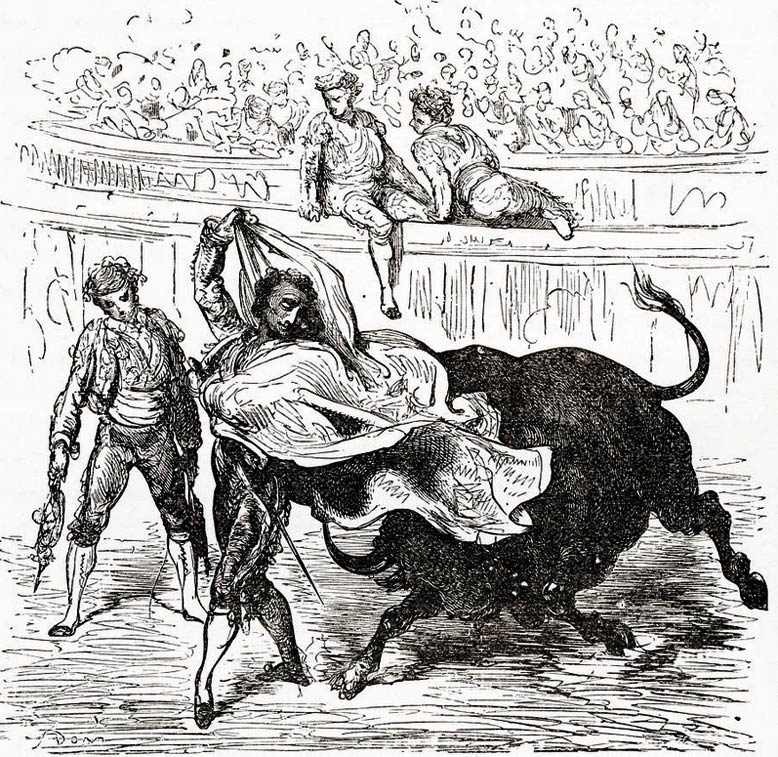
THE BULLFIGHT. Spanish pictures drawn with pen and pencil, by Samuel Manning (1870). Illustration by Gustave Doré.
According to Henry Blackburn, these customs and their uniqueness are what distinguishes Spain, and they are traditions to be admired regardless of how different they are. The author finds many things in Spain to be both strange, yet appealing, such as coming across bulls running through the streets, or that one could be thrown off a stagecoach with no explanation, or simply the meals, the ingredients of which are impossible to guess. All of this is part of the “surprise attraction” of this country.
(…) to experience ‘shaves’ when an overladen and rickety diligence is careering down hill; to meet two or three young bulls in a narrow street followed by a hundred delighted boys, — are merely ‘Cosas de España’ and part of the fun of the country’ (176).
Other positive aspects of bullfighting culture, rarely covered by most authors, are highlighted by L. Higgin. They include the social work and the selfless contribution made by the bullfighters:
They are always known for their generosity, not only to injured comrades, but to any of the poor in need. Is there a disaster by which many are injured—-flood, tempest, or railway accident? Immediately a bull-fight is arranged for the sufferers, and the whole cuadrilla will give their earnings to the cause. Not only so, but the private charities of these popular favourites are immense, and quite unheard of by the public. They adopt orphans, pay regular incomes to widows, as mere parts of every-day work. They are, one and all, religious men; the last thing they do, before entering the arena with their life in their hands, is to confess and receive absolution in the little chapel in the Bull-Ring, spending some time in silent prayer before the altar, while the wife at home is burning candles to the Virgin, and offering her prayers for his safety during the whole time that the corrida lasts (121-122).
This author also eschews commonplaces about violence and blood in the ring to cover other topics such as the self-sacrifice of bullfighters’ wives and their important role as a distinctive element of Spanish culture: “The wives of the toreros are generally celebrated for their beauty, their wit, and their devotion to their husbands, indeed, the men have a large choice before them when choosing their helpmates for life” (124).
«They are, one and all, religious men; the last thing they do, before entering the arena with their life in their hands, is to confess and receive absolution in the little chapel in the Bull-Ring»
L. Higgin (Spanish life in town and country, 1902)
Richard Ford considers the spectacle to be a sublime cruelty and describes the matador as an executor and man of death. However, in Gatherings from Spain, he contrasts the foreigner’s eye, which focuses on the cruel side and the blood, with the eye of the Spaniard, which appreciates the skill, the courage and the beauty of sacrifice.
John Carr describes bullfighters as good soldiers in his 1809 account. Such is his desire to see a bullfight that he decides to take a boat to Puerto de Santa María to attend one in this town, as they had been temporarily forbidden in the rest of Spain. On the one hand, he criticises the cruelty of the event, but he also exalts the bravery of the bullfighters and the admiration displayed by the women. He is treated as a special guest and he is allowed to enter the restricted areas of the bullring, where the matadors prepare for the fight and where the bulls are kept. He tells of how much matadors and the other members of his entourage are paid, noting that once all expenses have been covered, the rest of the profits are given to worthy causes: “And thus is even cruelty made ministerial to humanity and civilization” (64). Carr also cites the fact that the men who distinguished themselves in the battle of Bailén became picadors (53-66).
«The wives of the toreros are generally celebrated for their beauty, their wit, and their devotion to their husbands»
L. Higgin (Spanish life in town and country, 1902)


