


Entertainment (3 of 3)
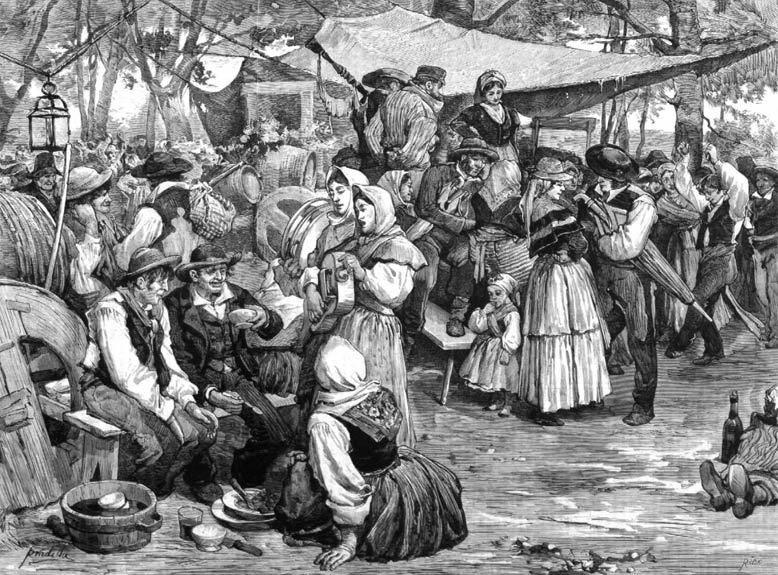
GALICIA. SAN COSME PILGRIMAGE IN BAYONNE. Print from Ilustración Española y Americana, 1875. Composition and sketch by D. F. Pradilla.
Another custom the authors find very appealing is that of the village and town festivals held all over Spain. In addition to describing the traditional costumes, the human interactions and the opportunity for social bonding they provide, many authors remark upon the difference between these festivities and those in England. There, they offer the chance to see monstrous dwarves or giants after paying a few coins, whereas at the fairs in Spain, people can stroll and socialise in wonderful weather, and everyone, without distinction, celebrates the day of the local saint or a festive holiday. Louisa Tenison is fascinated by the Seville fair and those of other Spanish towns, and explains that here, the entertainment is not merely a commercial endeavour, but has an important social dimension (206). The author turns her attention to the gypsies who run the attractions, their quarrels, their original cuisine, and their delicious fritters. Tenison comments on certain clichés about each European country in relation to the different groups of foreigners she sees at the fair: Germans (serious and steady), French (cheerful), English (with their peculiar style of dress), and Americans (who, in her opinion, think they are superior) (210).
Lastly, another celebration that fills many pages is carnival time. Joseph Quin especially enjoys this festival knowing that he will be able to spend several days admiring the regional costumes, and he recalled the interesting spectacle of seeing the various regional costumes of Spain, arranged in such different ways, and all of them together in such a joyful celebration (214). John Armstrong describes a curious carnival during his visit in the mid-18th century:
During the carnival, the ladies amuse themselves in throwing oranges at their lover; and he who has received one of these on his eye, or has a tooth beat out by it, is convinced, from that moment, that he is a high favourite with the fair-one, who has done him so much honour. The carnival is a season of outrageous mirth and jollity; both men and women allowing themselves a full swing of freedom, intermixed, however, with the superstitions and ceremonies of their religion. And we well know, that the holy-days of the antient Romans were, like these carnivals, a mixture of devotion and debauchery. All day, masses, fasting, and processions; all night, hurrying from one church to another; balls, maskings, and intrigues (202).
«The carnival is a season of outrageous mirth and jollity; both men and women allowing themselves a full swing of freedom, intermixed, however, with the superstitions and ceremonies of their religion»
John Armstrong (The history of the island of Minorca, 1756)


