


Entertainment (2 of 3)
Others are scathing about Spanish theatre. Richard Ford and Josep Quin considered it to be of low quality, despite the latter very much enjoying the opera (98). The structure of the Caños del Peral theatre is viewed by Andrew Blayney in his visit to Madrid in 1814 to be deplorable due to its poor lighting and dirty condition. All he saw was an attempt at performing opera (Vol. I, 284). In this case, it would be worth considering whether these authors are a reliable source on Spanish theatre of the time, as most of them admit to not understanding the Spanish language in their works.
For Terence Hughes, there were too many adaptations of foreign plays, which were not successful.
Political contentions have sadly tended to destroy whatever literary activity existed here; and the available talent of the country for the most part expends itself in journalism and political brochures. A portion of literary labour is likewise directed to the stage—after all an inconsiderable portion, and scarcely at all in original production, the highest efforts being for the most part confined to imperfect adaptation (Vol. II, 300).
Thomas Ewing Moore believed that Spanish audiences had little knowledge about opera and drama. This, he explained, was the reason why there were few good companies or quality infrastructure. What little there was is organised by groups of artists for tours and they usually have a repertoire of well-known and easy to assimilate works, such as Aida or Carmen (144). Regarding entertainment, they are not as attracted to organised dances as they are in England, nor to gambling, according to Josep Quin. Italian and French visitors are invited to the café discussions, but the English, less so (119).
Tertulias (café discussions) are a favourite form of entertainment among Spaniards, according to many foreign travellers. Quite a few of them reproach the country for its lack of interest in reading and big opera and theatre performances, although most of them agree that conversation and entertainment are two great virtues of the Spanish. According to John Carr, “I was at several tertulias or evening parties, which were agreeable enough. Cards and conversation formed the sources of amusement” (28). Other authors, such as Arthur Brook considered café discussions to be a thing of the past, ten times more formal and rigid than the English tea parties.
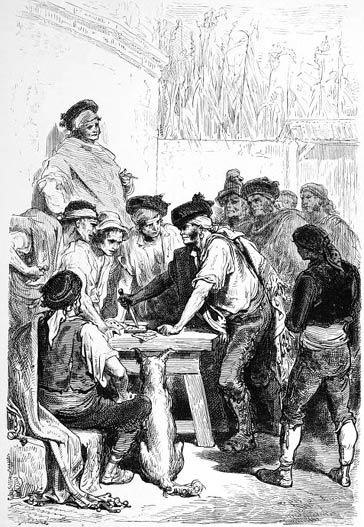
A CUT-PRICE SELLER DEMANDING A BARGAIN. L’Espagne, by Baron Charles d’Avillier. Illustration by Gustave Doré.
«I was at several tertulias or evening parties, which were agreeable enough. Cards and conversation formed the sources of amusement»
John Carr (Descriptive travels in the Southern and Eastern parts of Spain and the Balearic Isles, in the year 1809, 1811)
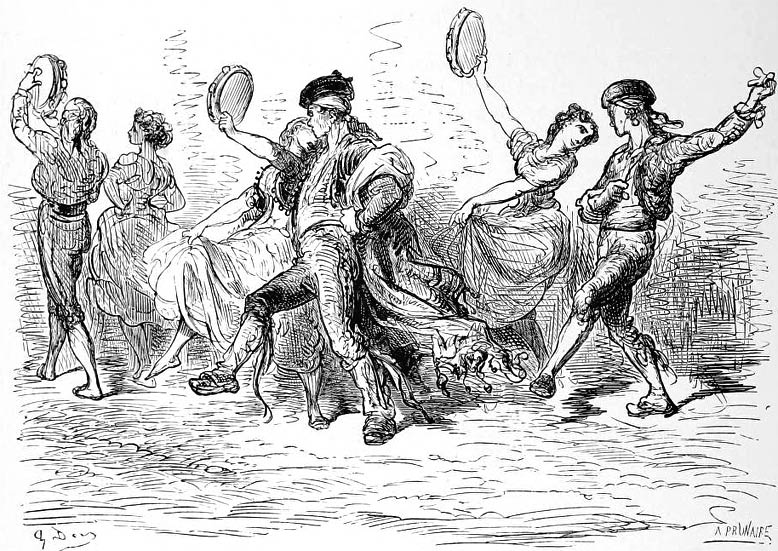
MAJOS AND MAJAS AT THE ROCÍO FAIR, NEAR SEVILLE. L’Espagne, by Baron Charles d’Avillier. Illustration by Gustave Doré.
Some attribute the lack of interest in reading to, among other things, the fact that the majority of bookstores are religious and only sell religious texts. In 1836, however, Alexander Mackenzie noticed that the number of readers and reading rooms had increased (171). Richard Ford provides lists of reading clubs and casinos. During the same period, Samuel Widdrington witnessed a growth in reading rooms in La Coruña: “There is an excellent and liberally managed club, principally supported by the merchants, with reading-rooms and other conveniences in a very good locality” (169).
Louisa Tenison also stated that Spain is not a country of readers. This is evidenced by the fact that there were very few bookshops and those that existed were not good. Neither did she see many books in the homes that she visited (Vol. II, 331). Matilda Betham-Edwards observed that there were no newspapers in Spain, or the few she saw only printed serial stories and did not contain any political news or any coverage of social debate (47).
Louisa Tenison remarked that there was little in the way of society balls in Seville (187). As opposed to the ballroom dancing and the high society events they were accustomed to, in Spain they witnessed dances in which every strata of society took part.
Many other travellers also remarked on this fact. Thomas Roscoe noted that the women danced minuets and mazurkas, more or less graciously, but were outstanding in dancing the bolero and fandangos (The tourist in Spain: Biscay and the Castiles, p. 238):
Like their passion for all festivals, solemn or simple, that of the Spaniards for the dance is carried to the highest degree of enthusiasm. Just as at their festas de toros, no sooner is the prelude to the evening’s joys struck up, than a murmur of delight runs through the rooms, the whole frame seems to vibrate, the eyes and face glow with delight; and I could not help repeating to my companion the remark of an English divine, that if any one were to come suddenly into a church or a court of justice playing the fandango or the bolero, priests, judges, lawyers, criminals, audience, one and all, grave or gay, young or old, would quit their functions, forget all distinctions, and all set themselves a dancing (The tourist in Spain: Biscay and the Castiles, p. 242).


