


Transport (4 of 4)
Kate Field was not the only author to experience the peculiarities of travelling in Spain. Marguerite Purvis records the fear she experienced when she heard gunshots during her train journey from Seville to Cordoba in 1870. Despite the commotion and the initial panic, the episode turned out to be nothing more than a bit of fun when a passenger decided to fire his gun at birds out of the window:
The railway officials were quickly on the alert, and, with reassuring words to the frightened passengers, hurried to the spot from whence the sound proceeded. One of these officials was a Frenchman, who quickly returned to inform us that it was only a Spaniard, in one of the first-class carriages, who had been firing his gun at small birds out of the window “pour se divertir!” (157).
Even more problematic than the deficient means of transport and often unfinished roads are the beggars and peddlers who constantly harass travellers, according to authors such as Julia Byrne. During her 1866 journey, the writer openly describes these two groups as a “plague,” and accuses the latter of causing the confusion and chaos typical of Spanish stations. Many travellers note the hustle and bustle of the stations, where loud voices advertising accommodation options and other services blend with the calls of tour guides desperately seeking customers. When Augustus Hare arrives in Valencia in 1873 he is greeted by a mob of characters loudly advertising the excellence of their hotels and others trying to get hold of their luggage at all costs (67).
«And now, in we get, terribly squeezed and crowded; but the diligence will grow —´twill stretch»
Emmeline Stuart Wortley (The sweet south, 1856)
These authors travelled by stagecoach, cramped in with too many passengers, as Emmeline Stuart Wortley humorously recounts in her journey from Malaga to Granada in 1856:
The mules seemed perfectly awake —that was a comfort (…) And now, in we get, terribly squeezed and crowded; but the diligence will grow —´twill stretch (…) Now, finding nobody, or hardly anyone, but ourselves, knew of this new diligence, I thought it was unnecessary to secure the whole of the inside places. Sad mistake! For it seemed pretty well known, and this freshly-introduced vehicle seemed to be built to carry just as many as chose to get into it —all Malaga (if all Malaga had a fancy to squeeze itself into it). Limitation of numbers seemed to be despised by those ardent speculators (156-158).
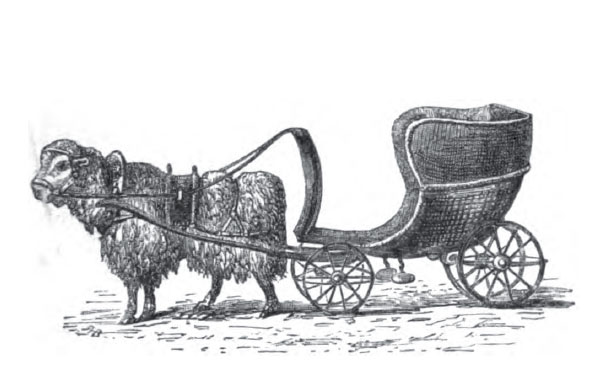
SHEEP-PULLED CARRIAGE FOR CHILDREN, MADRID. Cosas de España: illustrative of Spain and the Spaniards as they are, by Wm. Pitt Byrne (1866).
«One of the great annoyances of Spanish travelling is, that the only good and quick trains go at night; and it is the same with the diligences»
Mary Elizabeth Herbert (Impressions of Spain in 1866, 1867)
The variability of the timetables and the strange departure times of stagecoaches and trains often irritated travellers. Matilda Betham-Edwards narrates having to catch a train at five in the morning to go from Burgos to Leon (37). The longer journeys are often made during the night, a most inappropriate time if one considers that, as Susan Hale points out, Spanish trains do not have sleeper carriages (50). Ellen Hope-Edwardes also finds the timetables frustrating, complaining that she has to wake up at four o’clock in the morning to travel to Monserrat —a feat she wouldn’t have accomplished without the help of the night watchman. When she arrives at the station, there is nowhere to buy a coffee or take shelter from the cold, as the windows are wide open. The rugged landscape further complicates the journey to their destination (32). Mary Elizabeth Herbert describes a similar situation in her 1866 account:
One of the great annoyances of Spanish travelling is, that the only good and quick trains go at night; and it is the same with the diligences. In very hot weather it may be pleasant; but in winter and in rain it is a very wretched proceeding to spend half your night in an uncomfortable carriage, and the other half waiting, perhaps for hours, at some miserable wayside station (207).
There are also many exceptions to these critical views. In Thomas Roscoe’s 1838 account, the stagecoach, the preparations and the drivers are described as excellent:
We found our vehicle — a spacious and lumbering concern, sufficient to carry double our number, well provided with mules and postilions, all looking as sharp, and sleek, and eager for the road, as if there had been no such animal as a Christino or a Carlist in the world (The tourist in Spain and Morocco, 23).
Transport developed in leaps and bounds in the first half of the 20th century, according to C. L. Freeston. Modern cars, good roads and major rail routes coexist with oxen, mules and donkeys. Unlike in England, herds do not overrun the roads and farmers are friendly to drivers (46-47). Rose Macaulay praises the modernity of the country as early as 1949. She compares contemporary Marbella with the fishing village depicted by 19th century travellers (140). John Lomas also describes the excellent condition of the roads he travelled on during his trip from Zaragoza to Barcelona in the first decade of the 20th century (246).
Finally, as regards maritime transport, the accounts detail journeys in ships, sailing ships, steam boats or faluchos. In many cases, Spanish ships, especially those used for short voyages, are old-fashioned and poorly maintained. In 1833, Susan Hale compared this means of transport to a kind of Spanish Noah’s ark (198). The boat was often used as a means to avoid the bandits that travellers had been warned about, including John Carr. In addition, the author is surprised that fares can be negotiated with the carriers. Instead of the original sixty dollars, they ended up paying only eight (112).
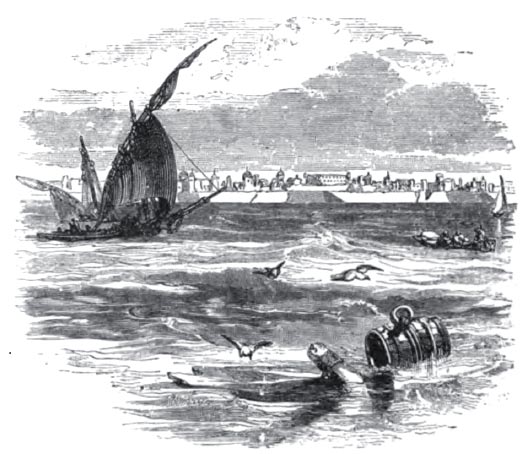
CADIZ FROM THE SEA. Spanish pictures drawn with pen and pencil, by Samuel Manning (1870). Illustration by Gustave Doré.


