


Transport (3 of 4)
In 1831, Alexander Mackenzie also describes travelling in crowded conditions. The author recounts that the passengers were crammed so tightly into the galera (covered wagon) from Madrid to Seville that it was impossible for them to move unless they all agreed to do so in unison (148).
Marguerite Purvis, who wrote under the pseudonym Mrs. William Augustus Tollemache, recounts in 1870 that in railway stations there is nothing to eat or drink, and no place to rest. The Spanish come prepared with baskets of provisions, but the English, who are accustomed to buying food and refreshments at the station itself, often have an unpleasant experience:
Railway arrangements in this country are very different to railway arrangements in France, where a “bouillon,” or “cafe au lait,” may be had at every station. In Spain, if you neglect the times appointed, you must fast for many hours, as nothing is to be had at the wretched little stations. Spaniards provide themselves with baskets of provisions; and English travellers would do well to take the hint. Dining at Toledo would have interfered with our sight-seeing: we therefore settled to go back as far as Aranjuez and dine there. This plan would secure us food and rest, neither of which could be had at Castillejo Junction (122).
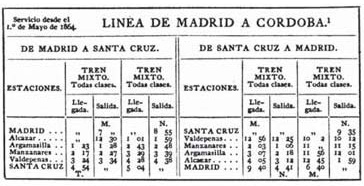
MADRID – CORDOBA LINE. Traveling in Spain in the present day, by Henry Blackburn (1866).
The number of passengers admitted by the Spanish coachmen and the poor travelling conditions are two frequent complaints. An aspect that is highlighted in this account by A. Andros, recounting his experience travelling by stagecoach from Bailen to Cordoba in 1860:
The solemn hour of midnight, when churchyards yawn, and tourists likewise, is tolling from a neighbouring clock when a rumbling is heard in the street and presently the huge diligence, looming in the distance rouses us from the lethargic state into which we have fallen and we sally forth for the booking office. “Well, Mr., have you any seats in the berlina? (the last word loudly and carefully pronounced.) “No, señor.” “Interior?” “Si, señor.” Now, I want a through ticket to Seville, so I exclaim with a mighty effort which nearly dislocates my jaw: “Interior dilignecia, primera classe, ferro carril.” “Si, señor.” “Recollect now, primera classe!” I am getting on famously with my Spanish this time. Paying 198 reales fare, I have my trunk and hat-box, or to speak more correctly, my maleta and sombrerera, conveyed to the dilly, and ensconce myself in the interior, on entering which I am nearly overpowered by the stifling heat; never have I felt anything like it before; not even in the pit of the Princess’s at a grand Shakspearian revival. There are three occupants besides myself, to wit, my blear-eyed friend, and a hideous man with his spouse, a coarse bloated female who expectorates freely out of the window the whole night. In this agreeable company I resign myself a martyr to the fearful aroma arising from exuding skins, a steaming compound of carbonic acid, and a strong suspicion of garlic (109-110).
Shortly afterwards, he continued his journey from Cordoba to Seville, but this time by train. His first-class carriage seemed positively luxurious compared to the diligence.
«Between travelling on a snail’s back and a Spanish railroad there is little choice»
Kate Field (Ten days in Spain, 1875)
The journey times described in the earliest texts are almost unimaginable today. For example, it took Louisa Tenison eighteen hours to travel from Malaga to Granada on horseback in 1853. According to Richard Ford, it takes forty hours in a slow stagecoach to get from Valencia to Tarragona. Julia Byrne makes a similar comment fifteen years later, in 1866. Another long journey involves travelling from Madrid to Toledo, which takes eight hours, according to Matilda Betham-Edwards in 1868. In 1870, Marguerite Purvis spent 22 hours travelling from Cordoba to Valencia. The roads were dreadful according to George Ticknor, who in 1876 claimed to have spent thirteen days travelling the 630 kilometres between Barcelona and Madrid.
The most varied forms of transport are present in these texts. The galera is a kind of covered wagon pulled by mules, described with great sarcasm by Tenison in his 1853 journey. The author fails to understand how this type of vehicle can travel on such roads (134). Similarly, V. S. Prichett was amazed to see a tram pulled by three mules in Badajoz (37). Other journeys involve animals such as horses, mules or, intriguingly, ponies. George Cayley travels by pony for part of his route from Ronda to Gibraltar, and ends up being kicked off and rolling down a hill:
We breakfasted, and departed by a road which seemed a combination of broken pig-troughs filled with melting snow. It soon narrowed to a path not above a foot wide, and my pony took the occasion to slip off backward, and roll with me, end over end, down a drop of about nine feet (it might just as easily have happened to be ninety). I was luckily no worse, and managed to scramble up to the road again at an easier place a little farther on. It is rather a happy accident, as it will probably make the Moor more cautious. He is very clumsy with his feet, and unused to mountain roads. The day before, when we were scrambling on the rocks, off the road which we had lost, both he and I fell head over heels into a small chasm, which luckily had bushes at the bottom (158).
The writers detail countless trials and tribulations from their journeys across Spain. Famous author Kate Field warns that trains do not announce the names of the stops, which can be misleading for travellers, herself included. On a trip to Biarritz, Field passed the town and failed to reach her destination. In the end, she was forced to make her way back by carriage. The return journey came with its own set of complications, due to the rain and the constant fear of bandit raids. In the end, the author manages to arrive safe and sound at her destination (16-17). All these inconveniences did not dissuade her from continuing her Spanish journey, and she decided to embark on a boat trip to Santander, which presented new difficulties: upon reaching the Cantabrian capital, the passengers were detained on board the ship due to an outbreak of cholera in the city (68). Finally, the passengers were allowed to leave the ship, but without their luggage, as they were declared quarantined. On her way back to Madrid, Field almost misses her train due to the tardiness of her staff. However, the author and her entourage arrive in time to board because the train was also late, like everything else in Spain (172).
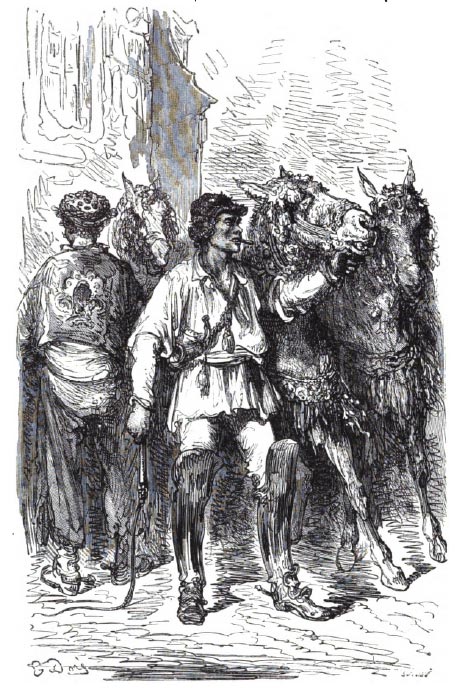
SPANISH POSTILLION. Spanish pictures drawn with pen and pencil, by Samuel Manning (1870). Illustration by Gustave Doré.


