


Transport (2 of 4)
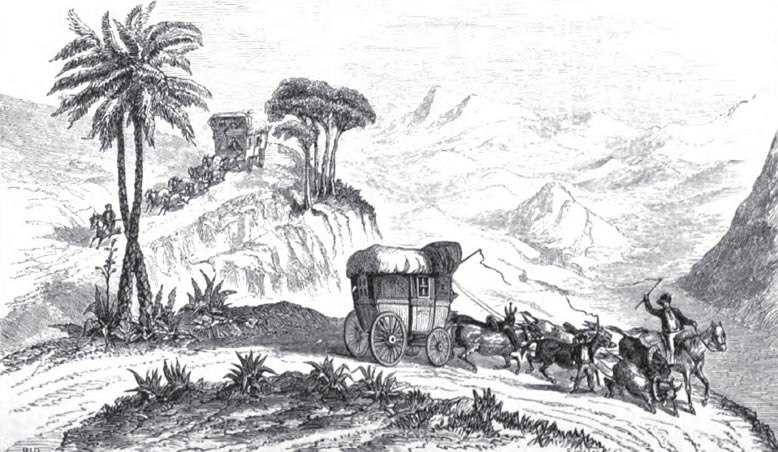
STAGECOACH. Cosas de España: illustrative of Spain and the Spaniards as they are, by Wm. Pitt Byrne (1866).
George Ticknor refers to the curious mode of transport that is the caballo de posta (post horse):
(…) the courier, with the mail, riding a few yards before him; both mounted on small horses, which were changed every hour, going steadily at an easy gallop. To secure some change of position, during a journey of many hours, the stirrups were made extremely short at starting, and gradually lengthened, as the day went on. Mr. Ticknor had his own saddle, of course, and carried, attached to it, a skin of wine, and a haversack with bread, and, occasionally, some other food (222).
Authors are also amused by how the pace and speed of the stagecoach is ensured, as described comically by George Dennis. The lead driver uses his voice, and when that is not enough, the younger driver throws stones at the mules while shouting their name:
The voice is the helm of the machine. An Englishman is at first as much amused at the continued exhortations of the mayoral to his mules as astonished at their obedience. Should one of them prove lazy or rebellious, by shouting its name in a loud angry tone, he immediately recalls it to a sense of duty. The zagal, too, plays his part. From time to time he alights, and filling his sash with pebbles, runs at the side of the vehicle, and screaming the name of each beast in succession, as “Capitana...a! Marques...a! Valerosa...a! Manchega...a!” discharges at the word a stone, with unerring aim, at the crupper of the animal. When he has thus worked the whole team into a gallop, with a loud “arre...e!” he springs into his seat (Vol. I, 266).
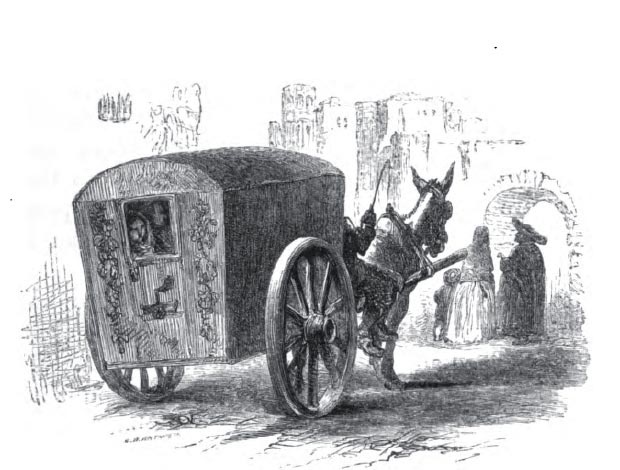
Thomas Roscoe describes travelling in a small carriage in Valencia as a rather unpleasant experience:
The driver sits on one side below you, and keeps incessantly talking to his horse, not in high German as the great Emperor Charles recommends, but in broken and saintly Spanish, mingled with apostrophes to his favourite patron, while he keeps saluting the animal upon the buttocks (The tourist in Spain and Morocco, 160).
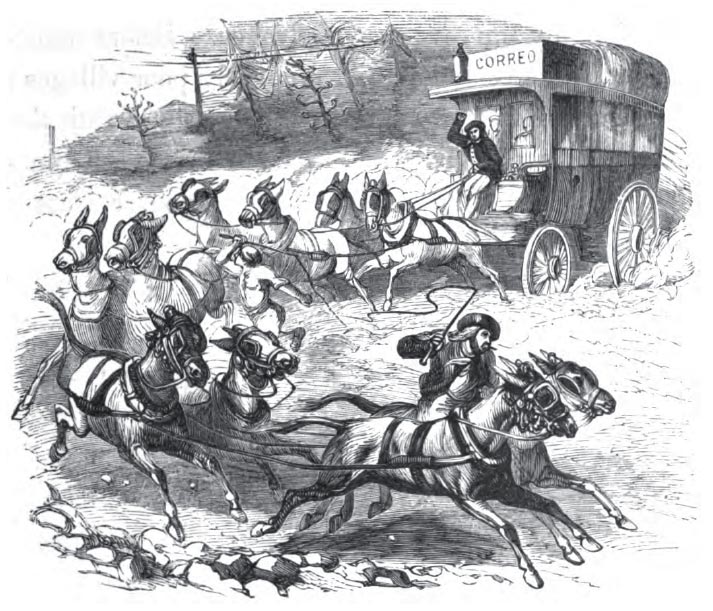
STAGECOACH. Pen and pencil sketches of a holiday scamper in Spain, by A. C. Andros (1860).
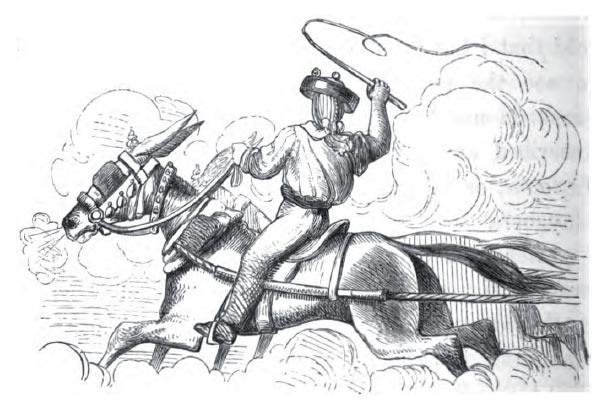
(1) THE POSTILLION. Pen and pencil sketches of a holiday scamper in Spain, by A. C. Andros (1860).
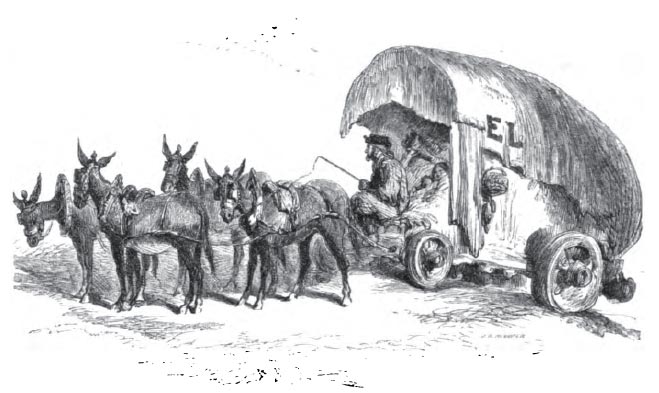
(2) GALERA; (3) TARTANA. Castile and Andalusia, by Lady Louisa Tenison (1853).
As for travel by train, railway stations in Spain are dreadful. Henry Blackburn comments on the appalling conditions: there are no benches in the waiting room, stations usually don’t open until the last minute, and there is no staff available to provide information. For many authors, the most frustrating aspect is that everyone smokes while keeping the windows shut tight. Blackburn complains that when travelling north, they were not informed of the need to change trains in Aranjuez: after a full night’s journey the group realised they were on the wrong train and about to arrive in Alicante. First they had to journey back, enduring a seven-hour wait followed by another 12 hours of travel. Adding to the situation, it rained incessantly. And to make matters worse, their luggage ended up in Cordoba. This is how Blackburn describes his ordeal in his 1866 text:
The arrangements of a Spanish railway station are peculiar, and thoroughly unlike anything else in the world. There is no newspaper or bookstall, no refreshment-room, and no one to give you any information. The waiting rooms are not opened until shortly before the starting of the train; there are no benches in the outer hall. (…) The solitary waiting-room was a most miserable hole, the door off its hinges, the range rusting in the fireplace, the garish French paper stripped from the walls, the windows looking on the platform all broken, the tiled floor half untiled and showing the bare earth. There was not a chair or a table, and the flaring gas-burner had neither chimney nor globe. That every one should be smoking, also, is a fact which constantly recorded can only prove wearisome. It is “un costumbre del pais” (117-118).
«When all other seats are taken, passengers are packed away on the roof»
Henry Blackburn (Traveling in Spain in the present day, 1866)
This author writes scathing reviews, which are very ironic and amusing to read from a 21st century perspective. Blackburn comments that after seeing the stagecoach, it was difficult to tell whether it was dirtier on the outside or the inside (125). He also explains that passengers pile into every possible place, some even travelling on the roof of the vehicle, surrounded by suitcases and various packages. When the coach is full, some passengers have to climb onto the top of the vehicle and battle with the suitcases and provisions, some of which are even alive, as Blackburn notes:
The roof is a sort of warehouse, where passengers’ luggage and merchandise are stowed away, including provisions of all kinds, both alive and dead. When all other seats are taken, passengers are packed away on the roof, and often have an exciting time of it in warding off the charges of portmanteaus and boxes as the diligence sways from side to side, and when it becomes dark, as may be imagined, the combat thickens (126).


