


Accommodation (4 of 4)
«A comfortable little old-fashioned inn, with a ‘patio’ full of orange-trees, leading to a public ‘sala,’ rather like a room at Damascus, with alcoves and fountains, gladdened the hearts of our wearied travellers»
Mary Elizabeth Herbert (Impressions of Spain in 1866, 1867)
Mary Elizabeth Herbert also describes the Venta de Cordoba as comfortable and clean in 1866. It has beautiful oriental style fountains and elegant alcoves:
A comfortable little old-fashioned inn, with a ‘patio’ full of orange-trees, leading to a public ‘sala,’ rather like a room at Damascus, with alcoves and fountains, gladdened the hearts of our wearied travellers. After a good night’s rest (and one advantage in Spain is, that except mosquitoes, your beds are generally free from other inhabitants), they started down the narrow, badly-paved streets to visit the cathedral (39).
Susan Hale visits in 1883 and fondly recalls spending extended periods of time on the rooftop of the Fonda de Europa in Seville. Hale praises the staff enthusiastically, engaging with them in amicable chats and exchanging impressions, feeling a genuine connection with the local people (158). A few decades later, in 1928, V. S. Prichett describes the posadas in Extremadura as humble, but clean and comfortable. Rose Macaulay, who praises the neatness of Malaga during her visit in 1949, is of the same opinion: the squalor described in 19th-century texts and the bandits have now disappeared (136).
Accommodations improved significantly throughout the 20th century, as noted by C. L. Freeston in 1936, who compares his lodging with those in other countries, providing detailed descriptions of the meals, prices and facilities (104). Ultimately, the author dispels the negative reputation of flea-infested hotels from the past (126). A. Andros also comments on prices, finding the lodgings quite cheap compared to the stagecoaches, which he considers relatively expensive (103).
Some of the visitors are very demanding and rigid in their unwillingness to adapt to the local customs and ways of life, particularly when they differ significantly from what they are used to in their home countries. The colonial gaze appears on numerous occasions. Julia Byrne, for example, treats all innkeepers with contempt, and is extremely surprised that, upon arriving at three o’clock in the morning, the owners of the inn do not get up to make dinner (294). Similarly, Matilda Betham-Edwards behaves arrogantly towards the Spaniards who help her on her travels. The writer complains that the bellboys take too long to move her twelve trunks and looks down on them for making her wait. She refuses to eat in the dining area of the fonda due to people smoking and insists that their food be served in their rooms when staying in a private house, shamelessly demanding favours from her hosts (83).
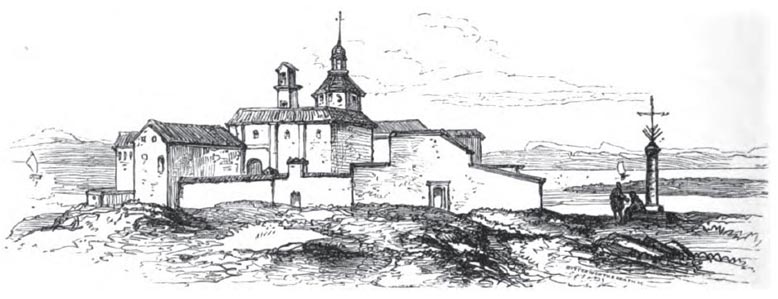
CONVENT OF SANTA MARÍA DE RÁBIDA. Spanish pictures drawn with pen and pencil, by Samuel Manning (1870).
The descriptions of accommodations provide valuable information on the transformation of Spain over the course of a century: the country went from having no major hotels or establishments of note at the end of the 19th century to becoming one of the world’s major tourist destinations in the 20th century, with a vast network of quality hotels. The changes are remarkable in this chronological journey. Although it sounds hard to believe today, in 1811 Palma de Mallorca was not a tourist hotspot, and consequently had very few places to stay, according to John Carr (333). The situation was similar in the Spanish capital. Henry Blackburn notes that a Grand Hotel in Madrid is like a drop of water in a desert (Artistic travel, p. 215). It is surprising to read that towns such as Marbella, Palma or Torremolinos had no hotel infrastructure at all at the beginning of the 19th century. In view of this lack, travellers sought all sorts of alternatives, such as staying with neighbours or asking the local parish priest to provide them with accommodation. Andrew Blayney describes the situation in 1814:
After passing through the romantic village of -Belameda, we arrived at Torre a Molinas, a small town with about fifteen hundred inhabitants. Here we put up at the house of a priest, in which we found every thing clean and comfortable, and the General’s staff and some other officers, in all thirty-six persons, sat down to an excellent breakfast of cold and hot meats, pies, etc (46).
On occasion, the absence of accommodation forced travellers to stay in convents, which at the time served as hostels for pilgrims and cheap lodgings for merchants. Philip Thicknesse describes his experience in 1789, when he stayed in several convents, including Santa Catalina and San Pedro in Barcelona. In 1811, British writer John Carr also solved the lack of accommodation by enjoying the great hospitality of the Benedictine monks in Montserrat (303).


