


Accommodation (3 of 4)
The poor quality of the accommodations is offset by the excellent service, friendliness and generosity of the hosts. In 1843, Samuel Widdrington described his stay in Oviedo:
We arrived in a place which had exactly the appearance of a stable yard or corral, the entrance being nearly inaccessible from the accumulated filth (…) I was addressed by a young girl in the plainest possible garb, but her answers to my questions and observations were made with so much grace, and in such a peculiar manner, that I began to think better of the quarters, and finally determined to remain (78).
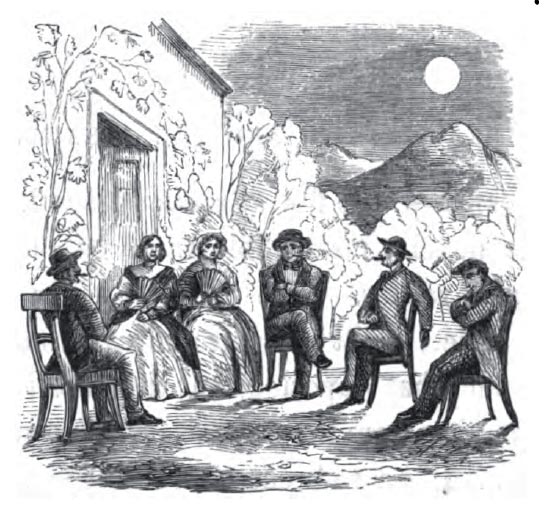
AT THE STONE CROSS. Pen and pencil sketches of a holiday scamper in Spain, by A.C. Andros (1860).
George Cayley comically recounts his bad experience at his accommodation in Cartagena, where fleas were eagerly awaiting him in bed:
We talked and laughed till our cigars were done; and as we were getting drowsy, and dropping off, Don Alonzo cried out lustily for a light, saying, “Los animalitos ya me pican muchisimo” (the little animals have begun to sting me exceedingly). I had nearly choked myself smoking under the bedclothes, by way of dissuading the little animals from approaching me; but my torments shortly began, as by little and little the love of blood overcame the dislike to tobacco in the minds of my bedstead population (56).
During his journey in 1839, George Dennis decides to sleep in a chair rather than risk sleeping on a mat on the floor and getting bitten by bedbugs. On the company of insects in posadas, Blayney humorously describes one of his experiences in 1814:
I retired immediately to bed, and rested well in spite of damp sheets and bugs: I had indeed of late been so much accustomed to companions of this description, that I should now have almost felt myself solitary without them (80).
«In addition to a numerous, body of bugs and fleas, a light band of musquitoes did me the honour to serenade me with their humming»
John Carr (Descriptive travels in the southern and eastern parts of Spain and the Balearic Isles, in the year 1809, 1811)
Dennis also points out that in Spanish posadas, travellers must abandon any expectation of privacy, as rooms are open to all the inmates of the house, who can enter without asking permission (Vol. II, 346). Besides dealing with bedbugs and fleas, John Carr recounts a curious episode of being attacked by mosquitoes at his accommodation in Cadiz in 1811:
In addition to a numerous, body of bugs and fleas, a light band of musquitoes did me the honour to serenade me with their humming during the greater part of the night, and left such tokens of their congratulations upon my arrival, behind them, that on getting up, but little refreshed by repose, and looking in a glass to shave, I could scarcely recognize my face (25).
Some authors describe both the positive and negative aspects of their lodgings with a great deal of humour. Such is the case of Nathaniel Wells in 1846:
It is a modern inn, and differs in some essential points from the ancient Spanish posada, —perfect specimens of which are met at Briviesca and Burgos. In these the vestibule is as the same time a cow-shed, sheepfold, stable, pigsty, —in fact, a spacious Noah’s Ark, in which are found specimens of all living animals, that is, of all sizes, down to the most minute; but for the purification of which it would be requisite that the entire flood should pass within, instead of on its outside. The original ark, moreover, possessed the advantage of windows, the absence of which causes no small embarrassment to those who have to thread so promiscuous a congregation, in order to reach the staircase; once at the summit of which, it must be allowed, one meets with cleanliness, and a certain degree of comfort (78-79).
CHAMBERMAID. Pen and pencil sketches of a holiday scamper in Spain, by A.C. Andros (1860).
The authors of the earlier accounts frequently note the curious Spanish custom of lodging all the tenants in the same room. The innkeepers claimed this made it easier to wake everyone up in the morning. The absence of windows is another common issue that Alexander Mackenzie refers to in 1831, explaining that widespread suspicion in Spain leads to properties with few windows and doors (63).
Many of these travellers stayed with local families, which gave them a firsthand experience of life in the country. In 1844, Samuel Widdrington lodged with a widow in Seville, immersing himself in the local customs and language: “Spanish style, where besides being very well attended, we had the advantage of hearing the Sevillian dialect spoken in its utmost purity” (240).
In contrast to previous descriptions, this second part of the section includes examples where authors praise their accommodations and meals. For example, Matilda Betham-Edwards, who arrived with low expectations based on the negative impressions she had read, finds these opinions to be wrong and exaggerated. She does not agree with previous travellers who claim that accommodation in Spain is shoddy. The author finds nothing to complain about in her many overnight stays. Moreover, Betham-Edwards and her entourage of female companions find everything easy enough. She stays at the same fonda in Toledo that other visitors had criticised and is delighted with the experience. Similarly, they find the warnings of an Englishman who advised against sleeping in Cordoba due to its supposedly awful accommodation to be completely unfounded. In fact, Matilda contradicts him by describing the wonderful place where she stayed, the marvellous Hotel Suisse (119-121).
Nathaniel Wells also praises the cleanliness of many pensions throughout in Spain, as opposed to what he had read in previous guidebooks (175-178). Furthermore, in 1843 Samuel Widdrington claims that the most notable aspect of an inn run by a rather colourful character is its neatness: “a regular robber, who had made so much money in his vocation, that according to common report, he had the whole of the authorities of Valladolid at command” (39). Francis Trench is also delighted with the fonda Isabel II in San Sebastián, describing it as excellent, spacious, very clean and with good stables (8-9). John Carr comments similarly on his visit to madame Bertram’s house in Cadiz, which he recommends to all travellers, as well as Doña Rosina’s in Algeciras, and the noble hotel where they lodge in Málaga. Moreover, accommodation in Spain offers an added value: widespread hospitality. In 1811, John Carr claims that if a traveller is unable to find a posada upon arrival, by presenting his passport to the mayor, the official will arrange accommodation, even if it means staying in a private house (163). Thomas Roscoe also describes an excellent Castilian posada in Arevalo, with very good services and facilities:
With reference to our neat, commodious little inn, one of the best conducted and cleanest in the province, this sentiment was peculiarly well timed; for without any thing of the elegancies or luxuries of polite life, it supplied us wherewithal to rest and go away content. The landlord, as if determined to excel all his contemporaries, and remove every ground for the charge of ill-manners brought against them in this district, was complaisant to a degree of obsequiousness and readily added to our stock of provisions (The tourist in Spain and Morocco, p. 66-67).


