


Accommodation (2 of 4)
«The travellers who flocked there, it seems, were not in the habit of requiring beds, for our hostess did not possess such luxuries»
Louisa Tenison (Castile and Andalucia, 1853)
Major differences can also be noted between how visitors and hosts evaluate the quality of the accommodation. While George Borrow comments in 1842 that his accommodation in Madrid is rather mediocre, the landlady considers her guesthouse to be fit for a king’s son:
It was rather a singular house in which I had taken up my abode. I occupied the front part of the first floor; my apartments consisted of an immense parlour, and a small chamber on one side in which I slept. The parlour, notwithstanding its size, contained very little furniture: a few chairs, a table, and a species of sofa, constituted the whole. It was very cold and airy, owing to the draughts which poured in from three large windows, and from sundry doors. The mistress of the house, attended by her two daughters, ushered me in. “Did you ever see a more magnificent apartment?” demanded the former; “ is it not fit for a king’s son? Last winter it was occupied by the great General Espartero” (162-163).
Similarly, in 1866, London-based author Julia Byrne complains that the stagecoach driver cheats them out of their fare and that they have to pay an extortionate price to stay at a filthy inn (254). For Byrne, like for so many other travellers of her time, anything that does not correspond with her worldview and her colonial vision is labelled as “uncivilised.” The guesthouses and inns she encounters in Spain are mostly run by honest proprietors. However, because they are nothing like English accommodations, she describes them as being far removed from civilised life (264). Many authors struggle to grasp the historical and social realities of the country, and they often cannot resist comparing the situation to their experiences at home.
In 1853, Louisa Tenison claims that Spanish hotels are scarce and not very good, and says that the city of Seville is ill-prepared to receive foreigners (Vol. I, 126). There are no houses to rent, likely due to the lack of tourists from abroad and because Spaniards do not travel (Vol. I, 219). In addition, there is a shortage of beds. When Tenison visits an Andalusian inn in 1850, she remarks: “The travellers who flocked there it seems, were not in the habit of requiring beds for our hostess did not possess such luxuries”(241). These shortcomings are offset by the widespread kindness found throughout the country. On one occasion, during her travels, the local mayor generously sends beds and mattresses after learning of the arrival of a group of foreigners.
George Cayley visited Spain that same year and was surprised to find that there were no forks or spoons in Spanish guesthouses:
(…) forks, and spoons, —things unknown to the hostels of Spain, where you have your plate and pipkin set before you, and pull your own navaja (clasp-knife) out of your sash to despatch the comestibles. Sometimes by earnest entreaty one may get a wooden spoon among a large party and with the wine-jug they never think of giving two persons more than a glass —but then, of course, the other may drink out of the jug (163).
Travellers share numerous anecdotes about the things that they encounter in their accommodations. Elizabeth Murray describes a breakfast spread that includes more than the habitual Spanish coffee. She describes a room cluttered with pots and strange items, portraying the whole establishment as very untidy, with a room full of bathing implements and a little girl running around naked with a fan in her hand imitating her mother (143).
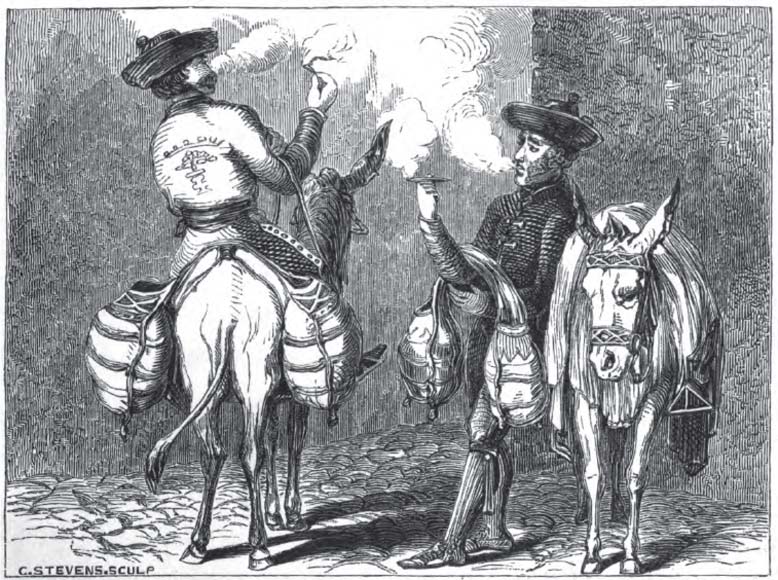
Las alforjas [or The bridle roads of Spain], by George John Cayley (1853).
Elizabeth Murray amusingly recounts trying to avoid cigar smoke and the garlicky smell of Spanish food while staying in a hotel in Seville. In her quest for fresh air and smoke-free dining, Murray asked the housekeeper if they could all dine in the courtyard. However, a sudden thunderstorm made all the guests rush into the house through the first door available, which happened to be the writer’s quarters. They ended up dining in her lodgings and smoking to their heart’s content. The poor traveller laments at the thought of the rarefied atmosphere that would remain in her room:
In the meantime, unpromising as the appearance of things was, and notwithstanding the damage the various articles of furniture in the patio had suffered, the guests were determined not to lose their dinner. The dinner table, accordingly, was removed from the open court to the first place of shelter that could be found within doors, and this, as ill luck would have it, happened to be my bedroom, which was entered immediately from the patio. Here the whole company, not very much to my satisfaction, made themselves quite at home; and with such articles as could be collected from the ruins of the feast, the dinner proceeded- None were in quite such exuberant spirits as they had been before this unhappy event, and as the servants, during the confusion, had found the wine agreeable to their own taste, and had indulged freely in it, there was no artificial stimulus to sharpen their wit and to add to their hilarity. I was thoroughly vexed at the turn things had taken. I thought of the odour of garlic with which the room, even the curtains of the bed, was sure to be thoroughly seasoned (155-156).
The authors describe all sorts of discomfort. Ellen Hope-Edwardes grumbles about the poor quality of the pillow in her room at a boarding house in Malaga, writing that it felt like a sack of potatoes had been stuffed into the pillowcase (137). V. S. Prichett also encounters a number of issues when searching for accommodation in La Mancha. After travelling several kilometres in search of La Venta de la Segura, feet throbbing, stomach rumbling and night closing in, the author finally arrives at the designated location. However, instead of an inn, he finds a blacksmith’s shop. The blacksmith offers to prepare some food, although he warns the author that they are poor and don’t have much to spare. They have no spare beds either (91-93). The traveller ends up sleeping on sacks of straw under the mules’ blankets, which have an unpleasant odour. The scene is quite comedic: he is surrounded by sheep, goats and a pack of dogs, with several mice scurrying over him to boot (94-98).
Bart Kennedy finds a posada in a small village in Guadalajara that is even worse. After an eighteen-kilometre trek on foot, the writer arrives in Torija. The innkeeper offers him a choice between sleeping on a bench by the fire or in a room, and the English writer opts for the room, considering it safer in case of danger. The owner leads him through labyrinthine corridors to a room in the cellar that resembles a dungeon more than a proper accommodation: it has no windows, the sheets are damp, and the door cannot be locked. The next day, he describes the posada as a neglected, dirty lair where the only thing not covered in dust is an image of the Virgin (198-204).


