


Flamenco (2 of 2)
Flamenco is occasionally compared to the dancing, singing and expressions of the Black population of the United States. Both traditions share a connection with musical expressions of the African continent, as Thomas Ewing Moore describes in detail in his 1927 account (149-150). V. Prichett writes about Spanish people singing and dancing to popular songs during his sea voyage in 1928. The author transcribes some of the lyrics from these songs, thus providing another interesting philological and anthropological testament:
As the hours passed by this man lay there breaking into sporadic song. Four men began to dance with a great deal of heel stamping and snapping of fingers. The Arab was in that stamping and that rhythm. It seemed to rise in a vibrant, almost visible wall about them, to rouse the senses by its thousand agitations, its checked, spiralling notes of passion, humour, and aged custom. The dust rose from the deck, there was a vapour of crackling feet; bodies, arms, and heads swaying and wagging loosely like marionettes on a string, till, as the effort became fiercer and more strained, the women got up and began beating their hands in time and shouting, “Anda! Anda! Anda!” (203).
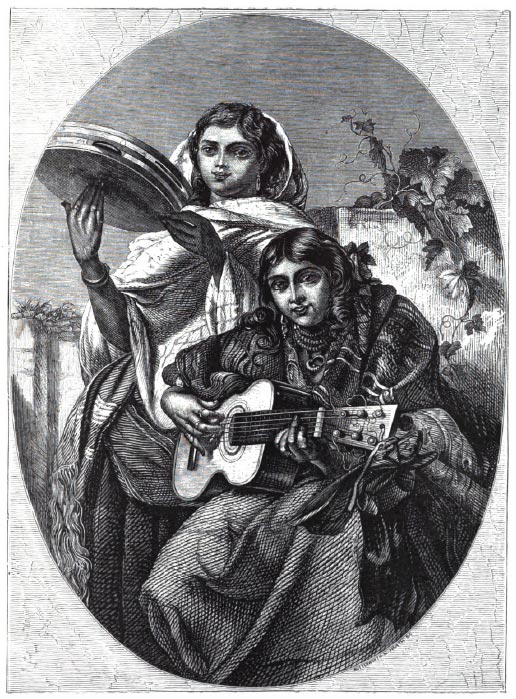
GYPSY MUSIC OF SPAIN. Spanish pictures drawn with pen and pencil, by Samuel Manning (1870).
«As the hours passed by this man lay there breaking into sporadic song. Four men began to dance with a great deal of heel stamping and snapping of fingers»
V. Prichett (Marching Spain, 1928)
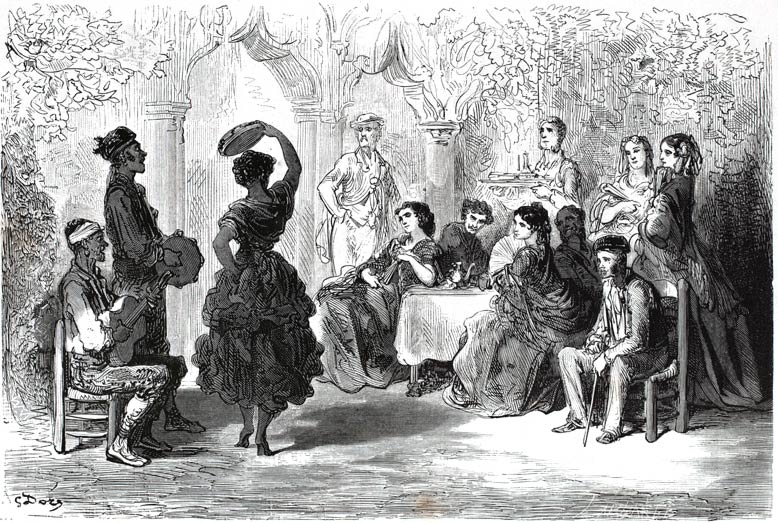
GYPSIES DANCING IN A SEVILLE COURTYARD. L’Espagne, by Baron Ch. d’Avillier. Illustration by Gustave Doré.
Some authors do not like the commercialisation of flamenco. Many Spaniards have the same sentiment, as reflected in Gertrude Bone’s 1938 account:
It is a matter of some irritation to the Spaniard that the ‘voluptuous dances of the gitanos have such a fascination for the foreign tourist’, and the commercialized and impudent aspect of the gipsy dances arranged for the sightseer might well disconcert die sensitive. But a blacksmith and a gipsy who danced a dance called the ‘dance of the light’ seemed other and irresistible! We would make an attempt to see him (37).
David Urquhart explains to his readers the reason why this art form is usually performed in private. His theory is quite an unusual one because he claims that these dances are not performed in public as the people “would go mad.”
I found that it was no public performance to which I was recommended or invited, but a representation, in private, of dancers who did not appear on the stage. My natural question was, “Are these dances indecent?” The reply was, “No.” “Why, then, are they not performed in public?” and the answer, “The people would go mad.” I was told that they might be seen but could not be described, and a dancing-master would get the dancers and invite some friends (395).


