


Religious festivities (2 of 2)
«The ladies were all in full dress with black “mantillas” covering their heads and hanging down low on each side»
Francis Trench (Diary of travels in France and Spain: chiefly in the year 1844, 1845)
During his journey around Galicia, Richard Ford notes that the pilgrimages and the customs that surround the Camino de Santiago were going out of fashion, even in Spain. Ford puts this down to the secularisation of society. Nevertheless, Ford says that to make the journey to Santiago along these ancient paths is worthwhile due to its scientific and cultural interest (A handbook for travellers in Spain, Vol. II, 601). The English traveller was already aware of the economic importance of this phenomenon at that time and of the marketing surrounding the pilgrimage. He states that in Santiago, like in all holy places, people have become accustomed to the aroma of spirituality and have moved on to focusing their efforts on other matters, such as profiting from seasonal tourism (Vol. II, 608).
Corpus Christi is another religious festivity that occupies considerable space in these pages. In 1844, Francis Trench arrived in San Sebastian, coinciding with an important date on the Catholic calendar. The writer describes the decorations in the city, the atmosphere and the how elegantly the people dressed for the occasion, especially the women. He states that they all wore mantilla shawls, but there wasn’t a hat to be seen.
The ladies were all in full dress with black “mantillas” covering their heads and hanging down low on each side. These were made either of rich lace, or silk, or merino, trimmed with velvet. Some wore a scarlet or crimson shawl (China crape I was told), over which the “mantilla” hung. Ther was something very peculiar, but at the same time very handsome in this combination of black and red. It was quite characteristic of the country in old times—gloom and magnificence combined. I did not see a single bonnet. The promenade was soon over, and all the windows were quickly occupied by spectators awaiting the grand religious procession (10).
In a different sphere, another custom that perplexed many travellers are the funerals and other events surrounding death. Spaniards’ particular relationship with death is an aspect mentioned by many authors. V. Prichett believed that Spaniards have a special predilection for a person’s final moment, stating that nobody loves death as much as the Spanish (24). An early text by John Armstrong from the mid-18th century refers to the particular burial customs in Spain, noting that the deceased person is buried in a priest’s habit (212)
To conclude this topic, Ellen Hope-Edwardes asserts in her account of 1883 that the poor do not use coffins for their burials and that the dead are sometimes carried in open coffins (228). A further aspect that surprises them is the custom of the use of niches, which David Urquhart refers to in his 1850 account:
The people of Cadiz neither put their bodies in graves nor their wines in cellars: the dead are built up in walls, resembling bins of a wine-cellar; their wines are deposited in structures like cathedral (131).
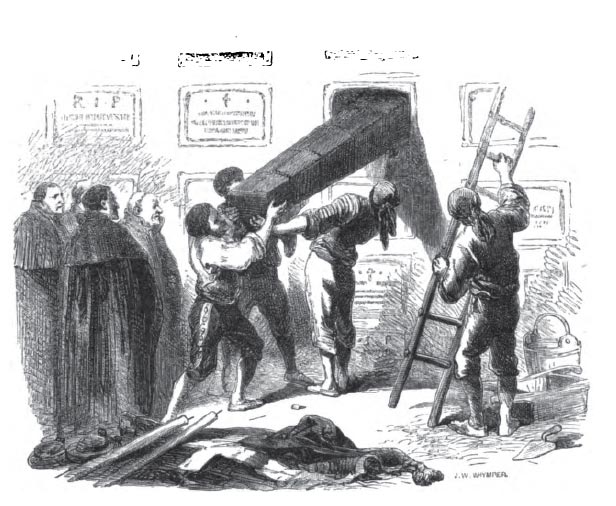
SPANISH FUNERAL. Castile and Andalucia, by Lady Louisa Tenison (1853).


