


Bandits (3 of 4)
George Dennis dedicates important portions of his work to depicting the famous Spanish bandits, largely relying on his imagination. During a walk in Cadiz, Dennis encounters a group of men with thick black hair, unbuttoned shirts, and red neckerchiefs. Stereotyping them as typical Spanish bandits, he is surprised to discover they are actually farm labourers who invite him to have a drink with them. On another occasion, his relentless pursuit of bandits plays a trick on him. On the journey from Jerez to Puerto de Santa Maria, the author encounters a couple of individuals whom he initially imagines to be bandits. He expresses his surprise, almost with a hint of satisfaction, believing his expectations had been fulfilled. However, they turned out to be two harmless, friendly peasants who greet them as they pass:
On our reaching a narrow and lonely part of Toad, two men, armed to the teeth, suddenly sprung upon the high bank before us. “Here,” thought I, “are the robbers at last!” (…) But my fears were groundless; for instead of presenting their muskets, they took off their hats as I passed, and saluted me with a civil, “Go with God, cavalier!” —the customary salutation exchanged by travellers (Vol. I, 137-138).
Ultimately, the author acknowledges that Andalusia’s reputation as a dangerous region is undeserved, and adds that the legend is driven by the Andalusians themselves. The author argues that the people in the south fail to grasp that some people, like foreign visitors, willingly expose themselves to certain risks just for the pleasure of travelling. The Andalusians themselves exaggerate these stories to dissuade these behaviours:
That the dangers of travelling are often greatly magnified by that spirit of exaggeration, in which all Spaniards, but especially Andaluces, delight to indulge there is little doubt. As Spanish robbers, nevertheless, are not all mere “men in buckram, ” a journey is looked upon by the peaceable citizens as an undertaking of great importance and peril, and as they cannot sympathize with foreigners who would expose themselves to hazard for the sake of pleasure alone, they naturally try to dissuade them from such enterprises, by representing the dangers of the road, rather as they are regarded by their own excited imaginations, than as they actually exist (391).
For Thomas Roscoe, the romanticised image of bandits adds a positive value by introducing an adventurous element to the journey. As he sets off on horseback towards Toledo, the author describes the scene:
(…) and there was not a bush on the road which did not conceal a formidable gang of banditti. One might, at first thought, imagine that relations of this kind are unpleasant preludes to a journey. But experience teaches us a totally different lesson. They are, in every way, exceedingly beneficial. If in reality there be robbers, the traveller is put on his guard, expects the rencontre, and is in some degree prepared for it: if there be not, an air of adventure and romance is cast over his movements, and he enjoys much of the excitement without the danger of falling among thieves (268).
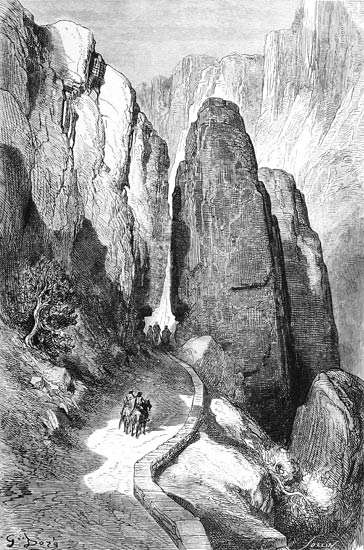
DESPEÑAPERROS GORGE, IN SIERRA MORENA. L’Espagne, by Baron Charles d’Avillier. Illustration by Gustave Doré.
«(…) we entered the defile of Despeñaperros, which, even in quiet times, has an evil name, on account of the robberies which are continually being perpetrated within its recesses, but at the period of which I am speaking, it was said to be swarming with banditti»
George Borrow (The Bible in Spain, 1843)
George Borrow’s tale of bandits is more myth than fact. As he passes through Despeñaperros, the famous bible seller warns of the dangers that lie in wait. In the end nothing happens, thanks to Divine Providence, he says:
Two leagues from this place we entered the defile of Despeñaperros, which, even in quiet times, has an evil name, on account of the robberies which are continually being perpetrated within its recesses, but at the period of which I am speaking, it was said to be swarming with banditti. We of course expected to be robbed, perhaps stripped and otherwise ill treated, but Providence here manifested itself. It appeared that the day before our arrival, the banditti of the pass had committed a dreadful robbery and murder, by which they gained forty thousand reals This booty probably contented them for a time: certain it is that we were not interrupted. We did not even see a single individual in the pass, though we occasionally heard whistles and loud cries We entered La Mancha, where I expected to fall into the hands of Palillos and Orejita. Providence again showed itself (254).
In Galicia, Borrow recounts an interesting run in with a thief, who is none other than his own guide. The author and his companion require the guide’s services to get from Ferrol to Ribeiro. The guide tries to steal part of the horse’s tack, but they catch him in the act and he leaves empty-handed. The frustrated thief walks away cursing them:
At last, a respectable looking man said to him, “Are you not ashamed to have attempted to rob two innocent strangers?” “Strangers” roared the fellow, who was by this time foaming with rage, “innocent strangers, carracho they know more of Spain and Galicia, too, than the whole of us. Oh, Denho, that servant is no man, but a wizard, a nuveiro. — Where is Perico?” (464).
Samuel Widdrington shares a curious anecdote about his fear of bandits. His distrust is not only of bandits, but also of mayors, who sometimes make the situation worse than the incident itself:
(…) we had letters to the several heads of provinces on all sides. I also requested that they would write to the alcaldes of the villages in the neighbourhood to request their assistance in case we should require it. One reason for this was that in my former travels I have known a robbery take place at the gates of a place, and when the parties went to the alcalde that he might take some steps to arrest its perpetrators, it was found he was at his siesta and must not be disturbed (83).


