


Bandits (2 of 4)
«Robbers are really remarkable in Spain, from their complete absence»
Emmeline Stuart Wortley (The sweet south, 1856)
Emmeline Stuart Wortley, who travelled during that same decade, claimed that bandits did not exist. The writer criticises what she describes as a story whose recipe always uses the same ingredients and questions the fact that there are so many robbers and bandits: “Robbers are really remarkable in Spain, from their complete absence” (106). Stuart Wortley suggests the truth probably lies somewhere in between. The English aristocrat comically advises travellers to leave their watches at home, as she does not understand what possible use they can be of to any visitor in that country (111). Finally, she adds that it is curious that robbers are the sole people who seem to care about time in Spain, even if it is to steal the devices used to measure it (112).
In 1809, John Carr claims that it is common to encounter robbers on the road to Cadiz, although they saw only the appearance of one, who however, proved to be a smuggler mounted on a fine Andalusian stallion. The author states that though pursuing an illicit profession, the Spanish smuggler is in general considered as a man of chivalrous notions of honour (78). Despite being recommended to travel with the muleteers who make the group journey from Malaga to Granada because of the route’s supposed insecurity, Carr decides to travel by horse-drawn carriage to Velez-Malaga, believing that there was more honesty and humanity in Spain than the natives seemed disposed to allot to it (147). Such is the English author’s confidence in the good faith of the Spaniards that he even dismisses the two guards he had hired to accompany him on the journey (193).
Arthur Brooke also comments on the guards, who he believes to be more dangerous than the bandits themselves. He represents them as follows in his text from 1831:
The appearance of the whole party was motley and grotesque; and our guards, who were as cut-throat a looking set of fellows as I ever cast eyes upon, were mounted, armed with guns (not one of which, in all probability, was loaded), and seemed much more intent on amusing themselves with their cigars, than interested in the safety of the travellers, who were scattered in all directions. The country had been much infested with robbers; and the worthies m whose care we were placed, according to the common Spanish system, were very probably part of the gang themselves who had nothing else to do (38).
On another of his journeys through Sierra Morena, Brooke describes the group escorting his stagecoach as a gang of ruffians. He explains how an agreement was reached with the robbers themselves, persuading them to change their profession and protect the travellers in exchange for a generous salary (271). The man who was now in charge of the guards had once been a famous and feared bandit (274).
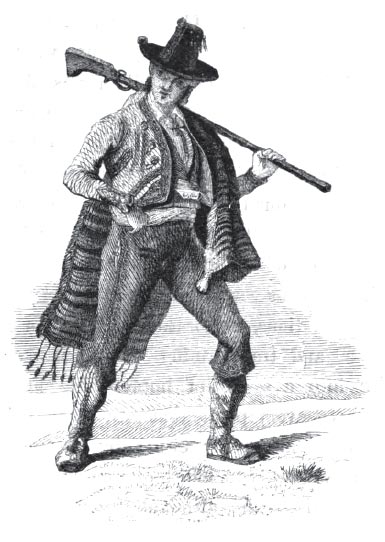
A SMUGGLER. The Rhone, the Darro and the Guadalquivir: a summer ramble in 1842, by Mrs. Romer (1843).
When travelling through the Serrania de Ronda, Brooke notices a lot of crosses along the way. Indulging in the wild stories of evil bandits, the author imagines these symbols as markers indicating places where people died at the hands of assailants. Brooke asserts that given the abundance of crosses, foreigners might mistake them for markers indicating distances along the road (176). Despite his fears of being assaulted, he arrives safe and sound in Ronda (180-182).
According to Andrew Blayney’s chronicle from 1814, the bandits inspired respect, even fear, in the French soldiers. His narration makes for a very interesting read. During the Napoleonic invasion, this British military man fought in Spain against the Gallic troops and was taken prisoner by the French army, who held him captive for four years. During one of his transfers as a prisoner, he comments:
(…) we quitted the village of Guadarama, to cross the mountains which separate the New and Old Castilles. Here, as usual, when we came to any difficult pass, nothing but brigands was in the mouths of the French officers, whose apprehensions were plainly visible in their looks and conversation (324).
In his two volumes, Alexander Mackenzie also frequently elaborates on the myth of the bandit anti-hero, despite admitting he lacks evidence of their existence. Perhaps unfamiliar with Spanish customs, Mackenzie describes how Spaniards effusively bid farewell to their relatives at train stations, purportedly for fear of them falling victims to bandits during their journey (10).
Furthermore, this type of story is fuelled by conversations between travellers who accidentally meet somewhere on the peninsula. While Mackenzie was waiting for the coach from Madrid, one of his companions fantasises about the reasons for the delay. The passenger speculates that it has probably been held up by robbers and murderers.
Mackenzie, who is particularly interested in this phenomenon, spends several pages compiling rural legends about robbers (276-279), including the well-known thirteen children of Ecija, who, according to him, have recently adopted very “civilised” ways and have stopped murdering their victims, claiming that they now share the booty with the mayor and the local monks (61). This American traveller also mentions the famous phrase your money or your life, “la bolsa o la vida” (49).


