


Tradition and modernity (3 of 3)
«Despotism, religious and political, has rendered Spain ignorant, superstitious, slothful, poor and impotent»
George Dennis (A Summer in Andalucia: two volumes in one, 1839)
In contrast to those authors who embrace traditional Spain, Dennis rejects a past that he believes led to the stagnation of the country: “Freedom in England has brought knowledge, enterprise, wealth, power in its train. Despotism, religious and political, has rendered Spain ignorant, superstitious, slothful, poor and impotent” (Vol. II, 361).
Some authors are content to admire and celebrate the immutable, proclaiming that this picturesque primitivism is precisely what they anticipated to find in the country. They prefer to contemplate ancestral Spain, which aligns with their expectations. Alexander Mackenzie is drawn to the immutability he observes during his two trips around the country. Nothing has changed between his first and second visits, particularly the type of characters he encounters on the street. Coming from New York, a city that is constantly changing, he finds the stagnation of Spanish life surprising. The tone of his analysis is positive, and, in a way, he seems to appreciate Spain’s lack of evolution, which allows him to indulge in the local picturesqueness that will surely captivate his readers (Vol. I, 167-168). The author criticises the French influence on certain cultural practices such as theatre and dance, the attire and even the typography used in printing presses (Vol. I, 179).
This duplicity of modernity and tradition is what Henry Carnarvon highlights when visiting Lucena: “To English eyes it was curious to behold a party dressed for an evening assembly, proceeding to a house a few hundred yards from the town with muskets in their hands. It was a strange mixture of modern civilisation with an almost feudal state of society” (285).
In his introduction to George Cayley’s work, Martin Hume notes that by the mid-19th century, Spain’s rustic charm was beginning to fade:
Gone now, or almost gone, are the quaint provincial costumes that made of Spanish travel a feast of colour and picturesqueness; gone, in the considerable towns at least, the haphazard accommodation for travellers, the overcrowded and verminous posadas, the unsophisticated service and the scanty fare. The frequent intercourse with strangers, too, has rubbed off some of the old-world bloom from the manners of the people (9).
The perception of the decline of national customs became more pronounced in the 20th century. In 1927, Thomas Ewing Moore lamented what Tenison and Ford had already pointed out: women were taking an interest in foreign fashions, and wearing hats instead of mantilla shawls. Hairstyles, tobacco, hats and other modern customs are gaining ground against the mantilla, although they are penetrating Spain more slowly than elsewhere (63-64).
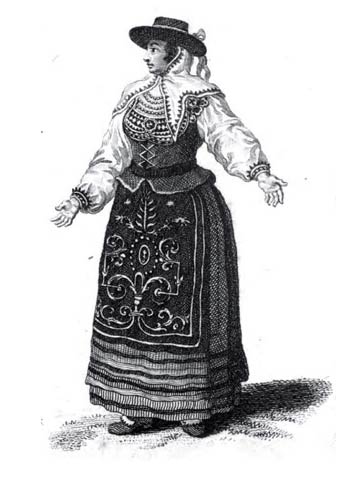
PEASANT GIRL DRESSED IN HER BEST CLOTHES. A second journey in Spain, in the spring of 1809, by Robert Semple (1809).


