


Tradition and modernity (2 of 3)
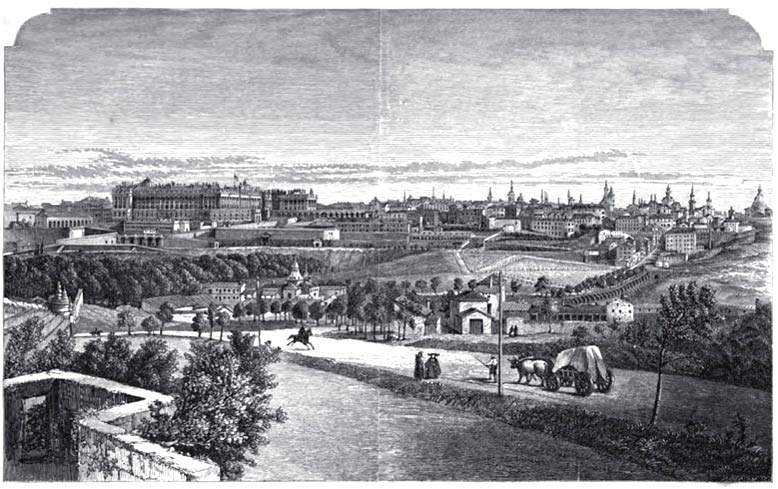
MADRID. Impressions of Spain in 1866, by Lady Herbert (1867).
«Spaniards seem to suffer in appearance more than any other European nation by adopting the modern costume»
Henry Blackburn (Artistic travel in Normandy, Brittany, the Pyrenees, Spain and Algeria, 1892)
Elizabeth Herbert actively shuns Madrid due to its modernity, quoting Prosper Merimée by asserting that the capital fails to evoke anything for her because it is too “civilised.” The churches in the city, many of which are of recent construction, illustrate this sentiment as they do not align with her image of Spain.
The contrast between contemporary fashion and traditional dress also sparks debates among some travellers. Louisa Tenison criticises the unfortunate choice of the sombrero over the mantilla shawl by some Spanish women. In men’s fashion, she also laments the trend where men have adopted foreign garments, such as gabanes (overcoats), instead of wearing the traditional cape:
(…) and if Spaniards could only be made to feel how unbecoming bonnets are to them, the rich masses of whose splendid hair prevent the bonnet being properly worn, they would cherish the mantilla as conferring on them a peculiar charm in which they are safe to fear no rivals (Vol. I, 65).
Similarly, Henry Blackburn also mourns the disappearance of native garments, beloved by travellers for their picturesqueness and colourful qualities:
Spaniards seem to suffer in appearance more than any other European nation by adopting the modern costume. A swarthy, stout Señor, in a scanty paletot, badly-made trousers, and “chimney-pot” hat, loses what he most prizes and depends upon, — his dignity of bearing; and there is no question that “las Senoras,” who look grand in their dark dresses and black lace mantillas (which are still de rigueur in the churches), do not appear to advantage in Parisian bonnets and bright colours (206-207).
For Tenison, the abandonment of customs and traditions by the upper classes, subsequently imitated by the lower classes, does not signify cultural and economic progress. Despite superficial indications such as a renewal of fashion trends, the writer argues that Spanish society is not advancing in important matters, only in superficial affairs. Ironically, Tenison frequently longs for the achievements, comforts and advances of her beloved native England.
The brasero (brazier) is another element that provokes the debate between modernity and tradition. Tenison embraces this device as one of her most remarkable discoveries during her visit to Spain, dedicating over five pages to it in her 1853 work. While finding it charming, the writer mocked this alternative to a proper fireplace and complained that the country was not prepared for cold weather. However, shortly thereafter, she laments that braziers are disappearing in favour of more “modern” forms of heating.
«(…) the courteous manners of the ancient Spaniards not having yet given place to the bluntness and coarseness which distinguish so large a proportion of the population of countries now rapidly progressing»
George Dennis (A Summer in Andalucia: two volumes in one, 1839)
Dennis also reveals his attachment to the traditional by citing the education and good manners of the Spanish working classes as an example. The author prefers a lack of development because progress tends to make societies more coarse and impolite:
Such politeness among the lowest classes would in England be deemed a proof of the march of intellect, but in Spain, it is rather an evidence of the stagnation of improvement; the courteous manners of the ancient Spaniards not having yet given place to the bluntness and coarseness which distinguish so large a proportion of the population of countries now rapidly progressing in commerce and the practical sciences (Vol. I, 346).
Moreover, according to Dennis, modernity implies the pollution of cities, the clamour of factories, and the proliferation of modern communications, as he writes in his 1839 work.
Arriving in Malaga by boat, he describes the scene and the differences with an English port. In Spain everything is quieter and less developed, something that seems quite innocent to an Englishman:
How different this scene from an English seaport! Not a wreath of smoke rises from the multitude of houses; even the foundry is at rest; no rumbling of carts and carriages reaches the ear; no hum of busy thousands tells that the human world has risen from its slumbers, and is rejoicing in the new day. The church bell calling to early mass; the hammering ft-om a boat on the beach, re-echoing from the rocks at my feet; the “arre!” of a muleteer from the road below, are the only sounds that from time to time break the deep silence, or rather the sweet, gentle murmur of the summer sea — the musical breathings of its slumber (Vol. II, 261).


