


Underdevelopment (3 of 3)
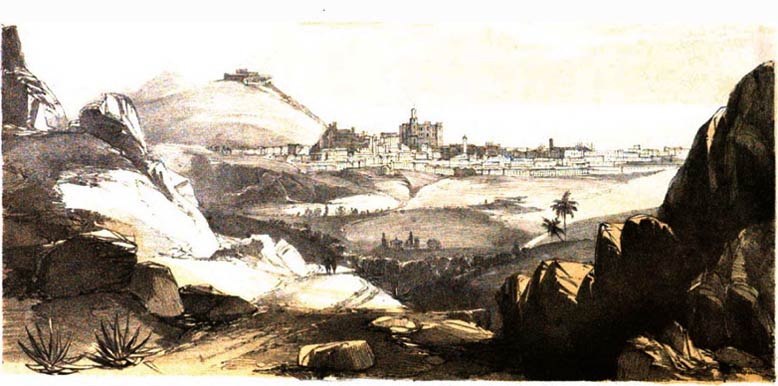
MALAGA FROM THE HERMITAGE. Castile and Andalucia, by Louisa Tenison (1853).
In some of these narratives, readers will detect a contradiction between praise for Spain as an idyllic land, as a gift bestowed by nature to its people, and criticism of the moral corruption of its inhabitants. Despite being blessed with a benign environment, Spaniards are scrutinised for perceived laziness and their failure to fully utilise the country’s natural wealth. The land is presented as a locus amoenus, an unspoilt haven or Paradise, an ideal location of fertility and well-being, a cliché often found in travel literature influenced by the imperial discourse. The perceived unproductiveness of the people in contrast with the fertility of nature stems from the arrogant attitude of colonial subjects, who consider themselves superior to the cultures they visit.
On leaving Valladolid, Thomas Roscoe describes this pastoral paradise where the fortunate Spaniards live, which has failed to meet his expectations: “It is almost as flat as the Milanese, and would remind the traveller of that rich rice and pasture land, but for the laziness and ignorance of the inhabitants, which effectually prevent all comparison” (The tourist in Spain: Biscay, 98).
Similarly, during her visit to Alhaurin in Malaga, Louisa Tenison describes some people happily enjoying the favourable climate and the fertile land. The author wonders how such a beneficial environment could produce impoverished inhabitants: if the land is rich, why are its people poor? Tenison contends that the absence of leaders to advocate for the development of communications and improvements to schools plays a significant role in underdevelopment (Vol. II, 360).
Elizabeth Murray gives an analogous account when she describes the beggars of the Canary Islands on her 1859 voyage. The British writer expresses her disdain for the young beggars and laments the contrast between the beauty of the landscape and the human misery:
It is the misfortune of this country, however, that so much tat is grand, beautiful, magnificent in nature, is associated with all that is mean, contemptible, and repulsive in man. What a saddening and humiliating spectacle it is to behold the abject and crouching misery of human beings side by side with, or in the midst of, a scene where nature has raised her most glorious altar to elevate the soul to him who is her author and maker. What language can I use in which to describe the unutterably low, degraded, humbled condition in which I found so many individuals of what I must now consider a generally abject race. The number of beggars is very great in comparison with that of the whole population of the islands; and in what other part of the world can such abject, whining, miserable suppliants be found? (283-284).
Furthermore, Thomas Roscoe describes the Basque landscape by speaking of the beauty of the banks of the Bidasoa river with its green fields, the ruins of the Fuenterrabia promontory and the Jasquevel mountain ranges. In contrast, he is highly critical of local characters:
Never did farce or comedy bring together a more complete set of uncouth originals. To begin with the top of the list, there was an old actor and manager, named Petto, who amused himself (…) was Señor Torino, with a wife, nephew, and two children, the worst in manners I ever in my whole travels encountered (The tourist in Spain: Biscay, p. 20).
«It is the misfortune of this country, however, that so much tat is grand, beautiful, magnificent in nature, is associated with all that is mean, contemptible, and repulsive in man»
Elizabeth Murray (Sixteen years of an artist’s life in Morocco, Spain, and the Canary Islands, 1859)


