


Underdevelopment (2 of 3)
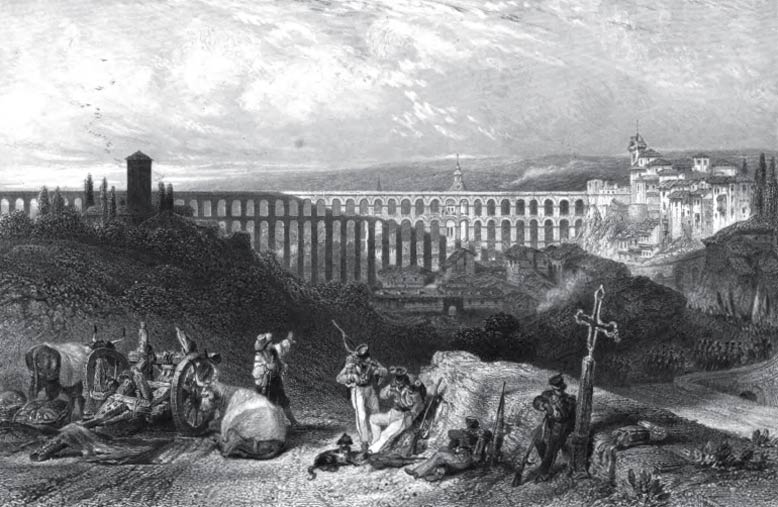
CITY OF SEGOVIA. The tourist in Spain: Biscay and the Castiles, by Thomas Roscoe (1837).
«(…) the public works are either on a scale of magnificence far surpassing those of other countries, or are so mean and poor, as scarcely to be said to have an existence»
George Dennis (A Summer in Andalucia, 1839)
The underdevelopment of contemporary Spain becomes apparent when compared to its heroic and glorious past. For example, during her trip in 1853, Louisa Tenison notes a significant decline in the economy, heritage, and even intellect, compared to what she had previously encountered. At times, she finds the country to be lifeless, almost like a desert, contrasting sharply with its historical greatness (Vol. I, 176-179). A similar sentiment is echoed by George Dennis in 1839, who criticises the infrastructure through a dual lens, contrasting a praiseworthy past and a miserable present. The author also critiques the disparity between the grand achievements of past centuries and the poor and insufficient contemporary infrastructure, which is evidence of the mismanagement of present leaders:
It is one of those anomalies which often astonish the traveller in Spain, where the public works are either on a scale of magnificence far surpassing those of other countries, or are so mean and poor, as scarcely to be said to have an existence. In the one case we see an emblem of the former power and wealth of Spain; in the other, of her present impoverished condition (Vol. II, 314-315).
Arthur Brooke also comments on the contemporary sorry state of Spain’s former glories. On his journey through La Mancha, the author admires the quality of the road which, according to him, is on a par with any other European road, before adding that it was not really built by Spaniards, but by foreigners during the reign of Charles III (281). Thomas Roscoe shares this opinion, claiming that Spaniards tend to take refuge in the brilliance of bygone centuries:
(…) the propensity of Spaniards to take refuge in the past (…) spontaneously forces itself upon their notice. Their patriotism flows in the same current at Toledo. If you inquire concerning the population of the place, the question is almost construed into an insult. Where is the necessity of demanding what is now? Ask what it was formerly, when two hundred thousand individuals thronged its streets (The tourist in Spain: Biscay and the Castiles, p. 278).
Roscoe also links the lack of progress directly to the adherence to some old customs and traditions:
The same stupidity which causes them to rejoice in the continuance of absurd customs, leads to the neglect of all improvement in agriculture, in manufactures, in the most necessary arts of life, and converts their villages and dwellings into nests of filth, where pride and vermin swarm together (The tourist in Spain: Biscay and the Castiles, p. 55).
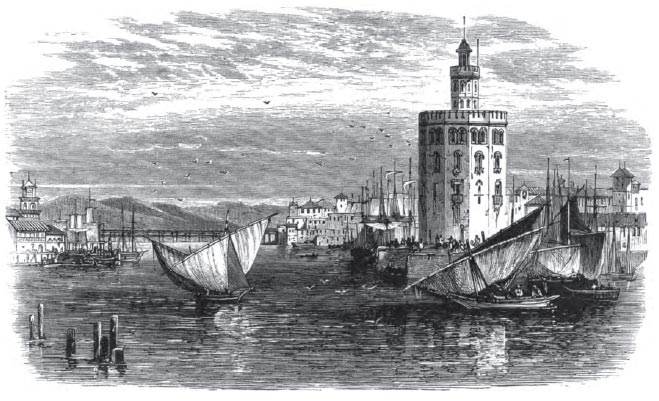
TORRE DEL ORO, SEVILLE. Spanish pictures drawn with pen and pencil, by Samuel Manning (1870).


