


Castile and León (3 of 3)
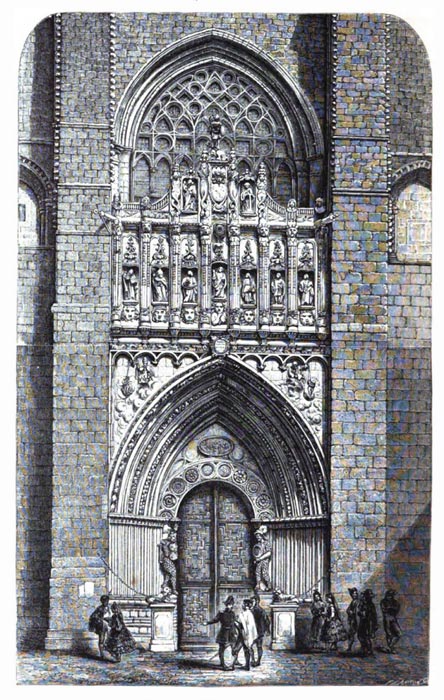
WEST DOOR OF THE CATHEDRAL OF AVILA. Impressions of Spain in 1866, by Lady Herbert (1867).
Lomas travels from Burgos to Ávila, where he feels like he has been transported back in time, with its beautiful cathedral, its churches of San Salvador and San Vicente, and the house of Santa Teresa. The writer states that he does not find the traditional costumes picturesque, as other travellers do, but he does note that inhabitants dress elegantly. During his tour of the Ávila market, he is delighted by the lively spirit of the vendors, the variety of vegetables and the striking attire of the locals (53-54). He likes the fact that in Ávila, as in other Castilian towns, people do not speak with a strong accent, as it allows for easier conversations with the locals, even though they speak extremely fast. Given the difficulties he experienced during his travels, as well as the poor transport connections, he makes the following ironic remark regarding the distance separating him from Madrid; he claimed that there are twenty leagues between them, three hours in time, and in a lifetime, a century (60).
«(…) one of the most perfect relics of mediaeval architecture in the world»
Samuel Manning (Spanish pictures drawn with pen and pencil, 1870)
Samuel Manning is overwhelmed by the charm of Ávila, which he describes as one of the most perfect relics of medieval architecture in the world (67). For her part, Elizabeth Herbert looks back on her experience in Avila as the only city in Spain where she saw women wearing traditional costumes:
This is almost the only place our travellers had yet seen in Spain where the women wore the old national costume. In Granada, Cordova, and Seville, the men retain their picturesque dresses; but their wives rarely do so. Here the women are all dressed in bright yellow canary-coloured stuff petticoats, with red cloth ‘appliquéed’ in patterns, on the skirt, green or red bodices, strings of pearls, and hair in circular rolls on the side of the head, with pins across each (229).
The writer Marguerite Purvis notices the politeness and formality of the people of Ávila. During her visit, she notes that everyone must uncover their heads inside churches, including the old and the bald, even if they feel the cold:
(…) there must be at all times the sacrifice of an uncovered head. No skull-cap, handkerchief, or covering is tolerated. Bald-headed or aged must uncover their heads or go back. Sacrifice, not mercy, is the rule, and if any shrink from encountering this shock to the system, mental or physical, let them abstain from ecclesiastical researches in this country (16).
In Valladolid, Alexander Mackenzie was delighted with the quality of the wines, especially considering their price: a bottle for a penny in 1836. He also finds it interesting that Castilian women drive carts. Upon seeing various instances of female drivers, he questions the supposedly weak nature of women, something which the science of his time was trying to prove, according to the author (Vol. II, 184). A year later, Thomas Roscoe discusses the accommodation and food in the city:
the Parador de las Diligencias, where we anticipated becoming acquainted with Valladolidian cookery. — Appetite, whetted by abstinence and fatigue, is generally a lenient judge; else I would say something in praise of our dinner, including the wine, which sparkled and seemed most excellent. (…) In other respects our hostelry was less to our liking. All the women of the establishment appeared to possess patent tongues, warranted never to wear out; and with these, put in motion by stentorian lungs, they maintained a clamour so incessant, that no ears, save those of a Spaniard, could long endure it (The tourist in Spain: Biscay and Castiles, p. 93).
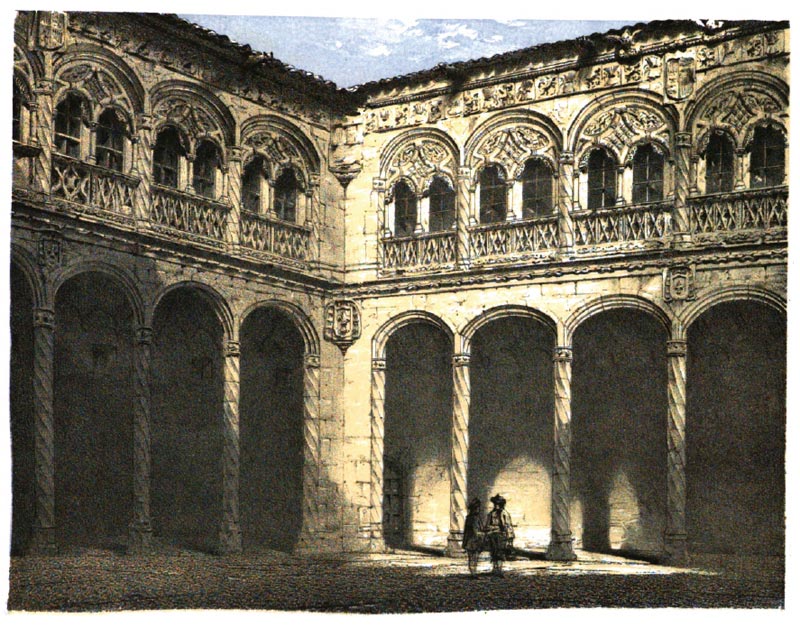
CLOISTER OF SAN GREGORIO, VALLADOLID. Castile and Andalucia, by Louisa Tenison (1853).
What Elizabeth Herbert appreciated most about her stay in the town of Medina del Campo (Valladolid) in 1866 was the manner of the social relations between lords and servants. During her travels through the country, she observed that in many cases domestic staff were treated almost like relatives: servants fulfil orders because they feel part of the family, not because they fear their master (251). Nathaniel West tells an amusing anecdote about his stay in Valladolid. West requested to see the church of San Pablo and was mistaken for a Frenchman because he spoke in French. Thereafter, every obstacle was put in his way to prevent him from entering the church until the employee on duty discovered that he was English. His attitude then changed completely: he allowed West to enter and accommodated all his requests (243-247).
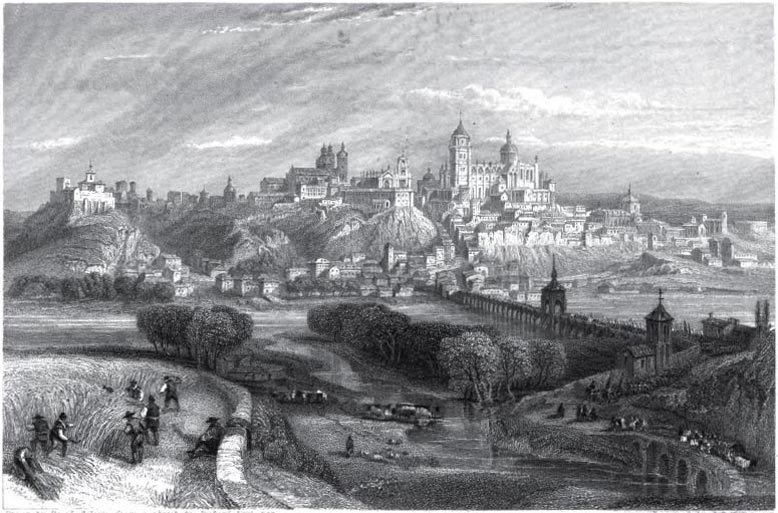
SALAMANCA. The tourist in Spain and Morocco, by Thomas Roscoe (1838). Illustrations by David Roberts.
On his arrival in Salamanca, Mackenzie is drawn to the atmosphere on the banks of river Tormes. He depicts picturesque scenes of singing washerwomen and other beautiful young women dressed in the typical Charro style of the region. He is also delighted by the Castilian food and believes that Burgos produces the best products in Spain: the sheep’s cheese is decidedly exceptional (Vol. II, 267-268). Thomas Roscoe was also fascinated by Salamanca during his travels in 1838. He is particularly pleased that he was able to get to know the daily life of the students at the university and learn what the people were really like. Roscoe also comments, albeit in the background, on what most travellers depict: the treasures of the university, the famous ex-communication bull against book thieves and the traditional dull lectures that left the desks deserted (The tourist in Spain and Morocco, p. 81). He is also fascinated by the bustle of the Plaza Mayor and recounts how it is also used as a bull ring. On these occasions, the Salmantinos who live in the square are expected to give up their balconies to the authorities:
The shops in them, of every kind, were brilliantly set out. It was holy festival; the watermen were hastening with their jars to the fountain, and the passing muleteers, — for one of the roads intersects this vast and noble square, (…) If an individual refuse to give up his balcony, it is either taken possession of by the alcalde, or it is forcibly blocked up (The tourist in Spain and Morocco, p. 78-79).
George Borrow is also delighted with this Castilian city, although he found its present state melancholy, owing to the decline in the number of students at its famous university:
Yet, with all its melancholy, what an interesting, nay, what a magnificent place is Salamanca! How glorious are its churches, how stupendous are its deserted convents, and with what sublime but sullen grandeur do its huge and crumbling walls, which crown the precipitous bank of the Tormes, look down upon the lovely river and its venerable bridge! (275)
For V. Prichett, Salamanca was once one of the great university cities of the world, and is now a place oppressed by theologians, which stands like an ornate Don Quixote in the desert (179). Prichett’s next stop is Zamora, a city where religion plays a significant role in its inhabitants’ lives and where processions bear witness to the penchant among Spaniards for blood and suffering, as can be seen in the bullfights and the brotherhoods (195).
The city of Palencia and its surrounding villages also feature in these writings, and George Borrow praises their unassuming hospitality. The inhabitants are humble but very helpful, and offer the basic things, which the traveller remembers:
Tired at last with rambling, we repaired to a coffee-house, where they regaled me with chocolate and sweetmeats. Such was their hospitality; and of hospitality of this simple and agreeable kind there is much in Spain (314).


