


Castile and León (2 of 3)
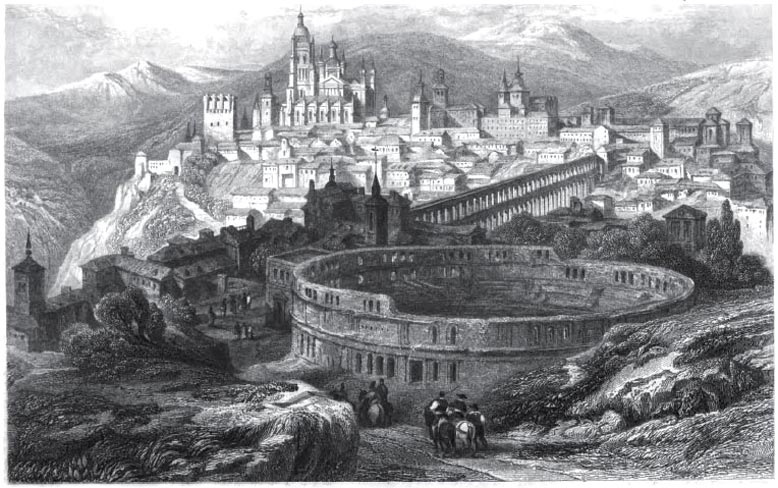
VIEW OF SEGOVIA. The tourist in Spain: Biscay and the Castiles, by Thomas Roscoe (1837). Illustrations by David Roberts.
After visiting León, John Lomas states that he finds San Isidoro more interesting as a building than the cathedral and regrets the poor state of the medieval noblemen’s houses. He is struck by the characteristic costumes worn on festive days when the charros take to the streets. The writer highlights the beauty of a few of the villages of León, such as San Miguel de la Escalada, and highly recommends a visit to the town (272).
In the province of León, Borrow is full of praise for the bucolic and picturesque landscape of El Bierzo. The English adventurer finds the lifestyle here so appealing that he imagines himself content as a shepherd, embracing the simplicity of life in these areas of Bembibre:
Perhaps the whole world might be searched in vain for a spot whose natural charms could rival those of this plain or valley of Bembibre, as it is called, with its wall of mighty mountains, its spreading chestnut trees, and its groves of oaks and willows, which clothe the banks of its stream, a tributary to the Minho. True it is, that when I passed through it, the candle of heaven was blazing in full splendour, and every thing lighted by its rays looked gay, glad, and blessed (…) At the time I would have desired no better fate than that of a shepherd on the prairies or a hunter on the hills of Bembibre (333-336).
Segovia and the aqueduct fascinate Louisa Tenison, who stops to draw the landmark that she finds impressive for its structure and its history. She describes the astonished gaze of the Segovians who ask her why she is so busy painting those “old stones” (Vol. II, 441). Others speculated that Tenison was sent to copy this ancient structure to later recreate it in her country. The truth is the author and her husband, Edward King Tenison, displayed a special interest in portraying places, people and landscapes that satisfied their taste for the picturesque. To this end, the couple travelled around Spain in 1850, she, bringing with her books and nibs and he, carrying around his complicated Talbotype camera. On the pictorial potential of the city of Segovia, the English writer comments that Segovia provides ample ground for the pencil (Vol. II, 444).
After visiting the impressive Alcazar, American author Alexander Mackenzie met many Castilians, whom he describes later in his book as people of honest conduct and admirable character (Vol. II, 387). During a trip made in 1936, C. Freeston writes that even if Spain did not have marvellous landscapes or good roads, the journey would be worthwhile just to see Toledo, Ávila and Segovia. Of the latter, he recommends the portentous Alcazar and the majestic cathedral (111-112). For John Lomas, the palace of La Granja has a special charm that makes it unique in this impressive region of Castile (83). He highlights the gardens and the fabulous use of water as a decorative motif.
Nathaniels Wells tells interesting anecdotes during his travels through Castile. On his way from Segovia to Madrid, he stops at the famous Venta de Juanilla in Somosierra, which he describes as a Noah’s ark full of animals of varied species. The author sarcastically states that the place would have to be flooded to make it clean. However, despite the rural setting and the rough company around him, to his surprise, he was served French champagne at the inn (78-80).
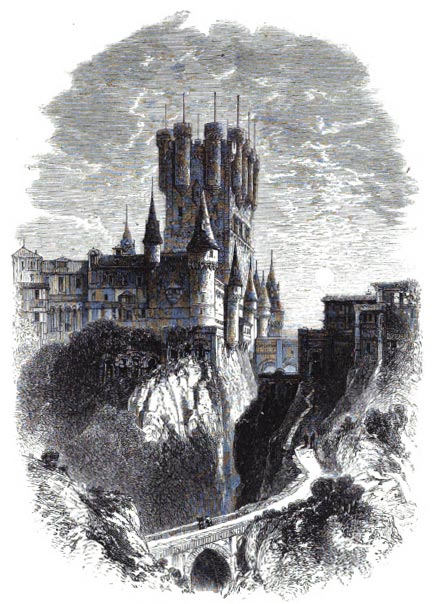
ALCÁZAR DE SEGOVIA. Spanish pictures drawn with pen and pencil, by Samuel Manning (1870).
«I have scarcely ever seen fairer complexions, or a greater prevalence of beauty, than among the country-people of Burgos»
Alexander Mackenzie (Spain revisited, 1836)
Matilda Betham-Edwards explains that the Castilian inns are the best in the country. In Burgos she is delighted with the how hospitable the maids are and the cleanliness of the guesthouse. In addition, one of the maids teaches her Spanish and they end up becoming good friends. This is how the description of her arrival at the inn in Burgos begins:
“Dos cuartos,” we said; “Si, si,” they replied, and on they went, climbing stair after stair, till at last we caught hold of their sleeves in breathless expostulation; and they consented to descend. Finally we were consigned to rooms on the third floor, so spotlessly, ideally clean, that a sanitary inspector could have found nothing to suggest. The rooms had whitewashed walls, iron bedsteads that might have come out of Heal’s warehouse, deliciously cool floors of brick-red tiles, wool-mattrasses, sweet-smelling home-spun sheets, and pillows bordered with the lace of La Mancha (30).
According to Andrew Blayney, Burgos is a very hospitable place, as well as one of the best-built Spanish cities he has ever seen (369). The British soldier travelled through Spain from 1810 to 1814, and during his visit to the Castilian city he stayed in the house of a priest, who received him with great kindness. Alexander Mackenzie describes the impressive cathedral and his visit to the tomb of El Cid. He also remarks on how pure-bred the local inhabitants are:
The people of this neighbourhood pride themselves on the purity of their Cantabrian descent, uncontaminated by Moorish blood, and, indeed, I have scarcely ever seen fairer complexions, or a greater prevalence of beauty, than among the country-people of Burgos (241).
Louisa Tenison writes in 1853 that in the Atapuerca area of Burgos province, nothing is prepared for the visitor. Keys are needed to access everywhere or, if the door is unlocked, a guide must be sought for them. (Vol. II, 374). On the other hand, other places in the province of Burgos, such as the Carthusian monastery of Miraflores and the monastery of Las Huelgas, are among the few “picturesque” sites in the region, according to Nathaniel West: even if it had nothing else to offer, Burgos would be worth visiting merely to contemplate the tomb made by Gil de Siloé (73).
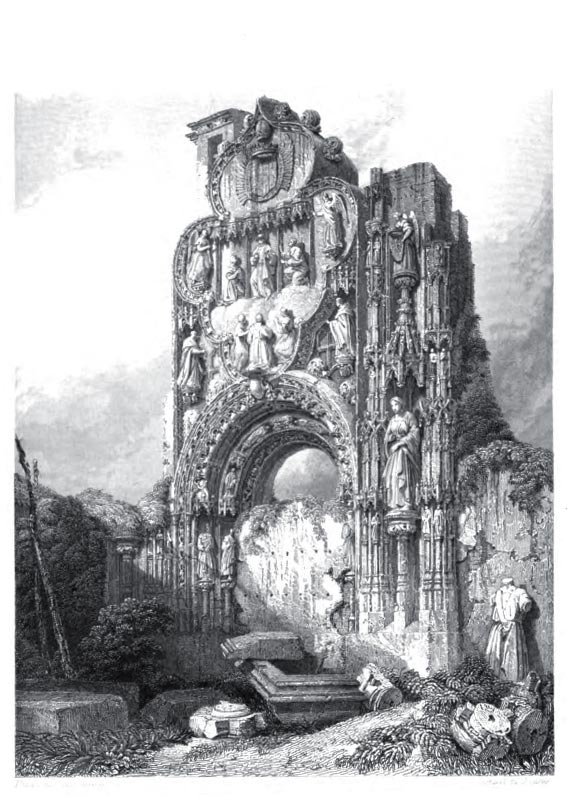
RUINS OF THE CONVENT OF THE CARMELITES, BURGOS. The tourist in Spain: Biscay and the Castiles, by Thomas Roscoe (1837). Illustrations by David Roberts.
Decades later, John Lomas refutes the idea of Burgos being a dreary and unwelcoming city with nothing but the cathedral to see before continuing with one’s journey. The author disagrees strongly with this assertion. During his stay in 1908, he states that it is one of the places in Spain that has developed most services for tourists and that, even if it did not have a cathedral, it would be worth the visit (15). Lomas suggests several walking routes, one through the city and another to the Carthusian monastery of Miraflores and San Pedro de Cardeña.
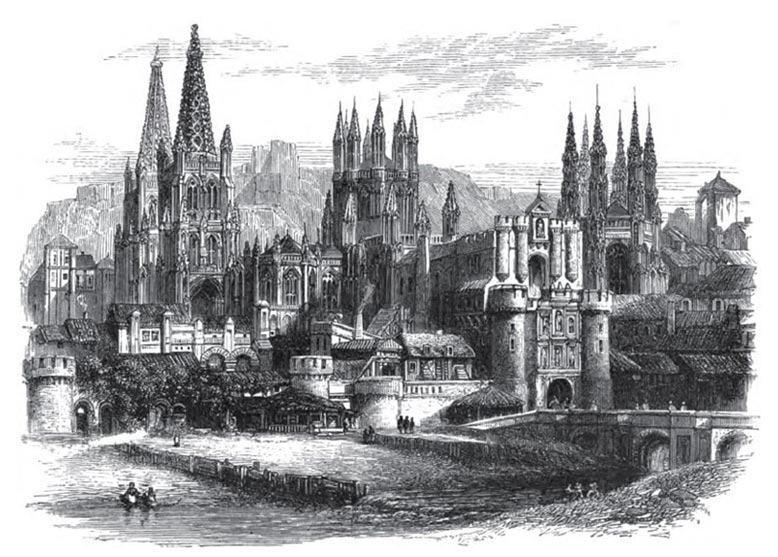
BRIDGE, GATE AND CATHEDRAL OF BURGOS. Spanish pictures drawn with pen and pencil, by Samuel Manning, (1870).


