Andalusia (3 oj 3)
When visiting Malaga, travellers highlight picturesque mountain villages, such as Ronda, and quiet coastal towns. For example, Andrew Blayney arrived at a small coastal village in 1814, which he refers to as “Torre a Molinas.” From a contemporary perspective, it is difficult to understand that he could find no place to stay there. The author, and the group of French soldiers who were holding him captive, finally find lodgings at the home of a priest (46). Andrew Blayney is captivated by Ronda’s landscape, with its impressive cliffs and beautiful alameda. Blayney also praises the people of Ronda for their joviality and courage, and for being different from those of the plain and the valley. Their sincerity and independent spirit make them unique (Vol. II, 187-188). Finally, John Carr believes that the Malagueña epitomises beauty in Andalusia, about whom he provides a detailed description of her red lips, captivating gaze, slender figure, dainty feet and a remarkable carefree demeanour (141).
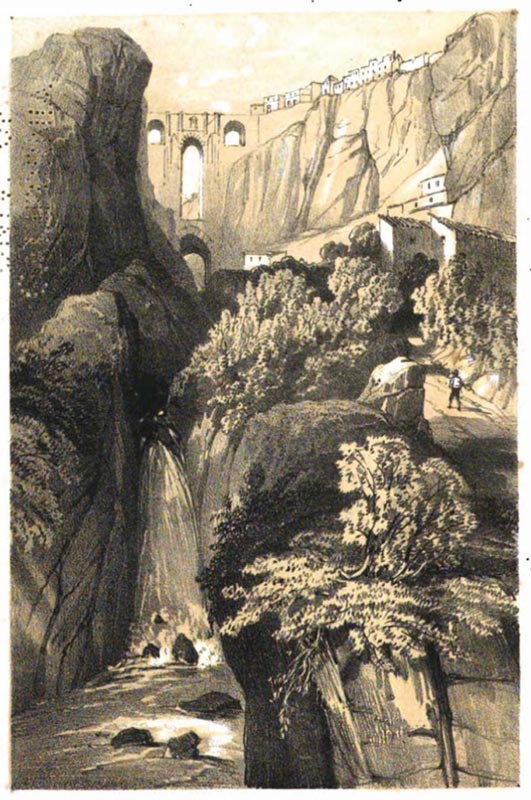
RONDA. Summer in Andalucia: two volumes in one, by George Dennis (1839).
«(…) Seville is verily a wonder. The Cathedral alone would justify this boast»
George Dennis (A summer in Andalucia, 1839)
Seville is a crossroads for travellers disembarking at Cadiz and heading for Madrid, as well as an unmissable stop on the itinerary of writers in search of the bygone Spain descended from the times of al-Andalus. John Carr was enthusiastic about Seville’s gastronomy and the hospitality of its people. In his 1811 text, he recounts his journey from Seville to Cadiz, stopping at a charming spot and taking advantage of the opportunity to savour some food: an excellent soup of bread, tomato and olive oil. In the afternoon, the travellers go for a walk where they chance upon one of the most beautiful images imaginable: an impressive farmhouse, which Carr describes in detail as if it were a cornucopia of fruit reflecting the fertility of the land. The idea of Andalusia as an idyllic garden, with friendly peasants, completes the scene (102-104). According to George Dennis, Seville is a city that deserves to be visited at least once in a lifetime:
"Vedi Napoli e poi mori!" — See Naples and then die!" exclaim the Neapolitans. The same fond admiration of their city has suggested the above extravagant couplet to the Sevillanos. Nevertheless, who that has seen the Cathedral, the Alcazar, the remains of Roman and Arabian architecture, and the venerable, picturesque city itself, can deny that Seville is verily a wonder? The Cathedral alone would justify this boast (Vol. I, 153).
Henry Blackburn’s account of Seville dates from 1866. One of the city’s most notable features is the host of particularly Spanish characters, such as the water carriers and the girls in mantilla shawls. The artistic sensibility of Seville is also featured in his account:
If in Madrid politics are uppermost in men’s minds — if in Cadiz or Barcelona commerce is of the most importance — in Seville they should give place to poetry, music, and the “belles lettres.” Seville is not itself without “life” — life in music, in dance, in song — animation everywhere.
Passing down almost any street in Seville, the senses are gratified with the most delightful perfumes issuing from the inner patios, and with sounds of music and dancing (Artistic travel in Normandy, Brittany, the Pyrenees, Spain and Algeria, p. 245).
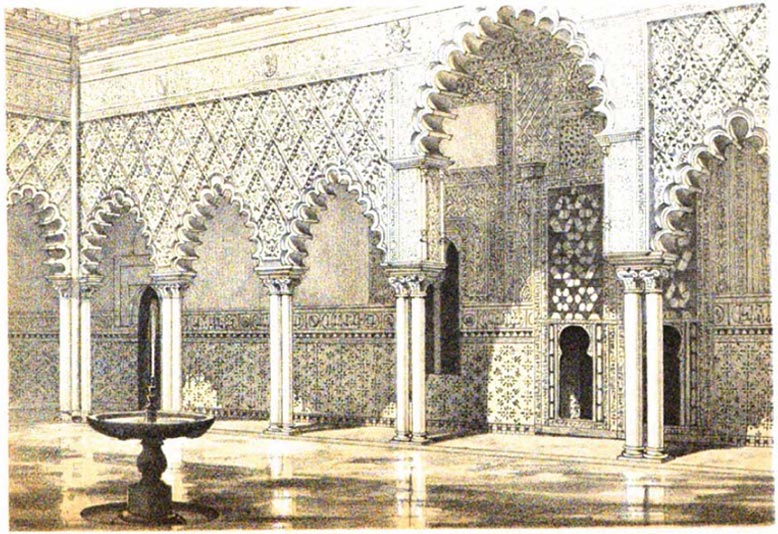
SEVILLE’S ALCAZAR. THE MAIN COURTYARD. An autumn tour in Spain in the year 1859, by Rev. Richard Roberts (1860).
Another city widely reported on is Cordoba. In the words of John Lomas, this city is the queen of Andalusia where every day one meets the politest smile and the most authentic beauty (127). For George Dennis, Cordoba is a thoroughly Spanish city, albeit neglected. Even so, it is essential to visit it because it has preserved the distinguishing aspects of Spanishness in the face of imported fashions from other countries:
Cordoba is genuinely Spanish; notwithstanding its daily communication by diligence with both Cadiz and Madrid, where foreign fashions have sway, it preserves its purity unsullied. That monstrous usurper of taste, the French bonnet, does not show itself within Cordoba, and the mantilla reigns without a rival. The men, too, are all in the majo costume (Vol. I, 299).
Few 18th and 19th century travellers included cities such as Huelva, Almería or Jaén in their itinerary, although they did so more frequently in the 20th century. In his account of Jaén, Bart Kennedy highlights the great activity and movement he witnessed during his visit in 1912, more so than in other similar cities. It reminds him of an English city, yet also bears resemblance to a smaller version of Seville in his eyes. At the hotel, he is offered a good dinner, and he describes an amusing episode typical of the problems of not speaking the language, which he remedies by putting into practice the lessons he has learned about good manners in Spain: flattery. He is ultimately charmed by the city and delighted with his hosts at the hotel, who almost waive his payment, impressed by his exquisite manners (149-150).
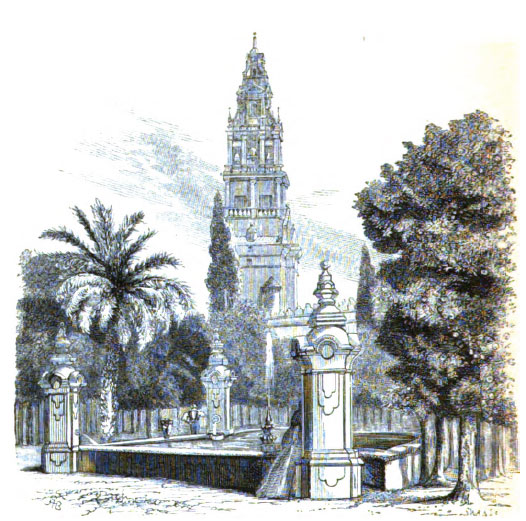
THE MOSQUE FROM THE COURTYARD OF THE ORANGE TREES. Cosas de España: illustrative of Spain and the Spaniards as they are, by Mrs. Wm. Pitt Byrne [=Julia Clara Pitt Byrne] (1866).