


Government (3 of 3)
«It is melancholy to see such elements of national dignity and national prosperity, as exist in the noble attributes of the Spanish character, and the no less generous nature of her soil, entirely nullified by the disastrous and enduring effects of an unsettled Government»
Julia Byrne (Cosas de España: illustrative of Spain and the Spaniards as they are, 1866)
Byrne laments that all the elements of national dignity and prosperity, both the noble attributes of the Spanish character and the generous nature of the land, are totally nullified by the disastrous effects of an unstable government. During her visit in the 1860s, the author observes a constant turnover of ministers, which she views as detrimental to government efficiency
The continual changes of ministry must be most prejudicial to its character as well as its efficiency, but time alone can show whether the apprehensions which naturally suggest themselves will be realized. The state of the Court —that “Corte” which regards itself as the “Corte” par excellence— can scarcely continue without producing visible and disastrous results, and there is little reason to hope for any amelioration. It is melancholy to see such elements of national dignity and national prosperity, as exist in the noble attributes of the Spanish character, and the no less generous nature of her soil, entirely nullified by the disastrous and enduring effects of an unsettled Government (49).
Byrne also directs her criticism towards another official institution, the postal system. When attempting to make shipments to their home countries, several authors encounter this national institution, which is an example of poor organisation and underperformance. According to the author, Correos and organisation are not two words that go together (69).
After his trip in 1876, Geoge Ticknor wrote this scathing criticism of the governors and the corruption rampant in the Spanish upper class, perfectly encapsulating his views:
Yet, with all these gross and portentous defects, —without a police and with an Inquisition, without an administration of justice and with legalized, systematic corruption in all its branches,— the Spanish government (if it deserve the name) still seems to fulfil the great object a government should always propose to itself; for a more quiet, orderly people, a people more obedient and loyal, I have not seen in Europe. The reason is that this corruption is still mainly in the higher classes, and in the agents of the government (194).
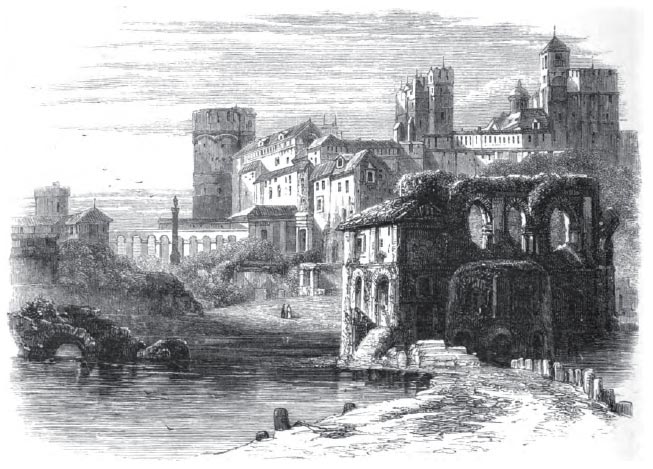
INQUISITION PRISON, CORDOBA. Spanish pictures drawn with pen and pencil, by Samuel Manning (1870).
David Urquhart is one of the few authors to express a positive opinion on the government. Albeit symbolically, the writer argues that in Spain the term político is still synonymous with educated, using the pairing of the terms politics and polite in the original English:
They have dignity, which we take for pride, and none of our so-called ease, which to them is vulgarity. Therefore did they beat France when all Europe was at her feet, and therefore will Spain live on when we shall have passed away — unless, indeed, we live long enough to teach them our civility.
Chateaubriand in 1805 anticipated the events of 1808. He said: “Spain, separated from other nations, presents yet to history an original character: the stagnation of manners may yet save her; and when the people of Europe are exhausted by corruption, she alone may re-appear with splendour on the scene of the world, because the foundation of manners is still undisturbed” (177).


