


Government (2 of 3)
«If the various dealers with whom you are brought into contact will do all they can to cheat you to any amount (…) they are only imitating, on a smaller scale, the conduct of those official authorities whom they are expected to reverence and honour»
Elizabeth Murray (Sixteen years of an artist’s life in Morocco, Spain, and the Canary Islands, 1859)
Louisa Tenison comments that the government is solely focused on enriching itself at the expense of the public coffers, as criticised by the author who portrays those in charge of public administration as overly accommodating and ambitious (107). According to the English writer, rather than protecting the population, the government acts against their interests (Vol. I, 296). Her text elaborates on the abuses and plundering by this class in the mid-19th century, expressing astonishment that those who condemn these irregularities admit they would engage in similar actions to enrich themselves if they held government positions (Vol. I, 301).
Emmeline Stuart Wortley strongly discredits the Spanish governments and administration during her 1856 trip. Apart from specific examples of corruption and ineptitude, the low esteem in which she holds the authorities is also evident when she mentions that they use works of art and antique tapestries as “carpets and rags” (14). She describes the country as a backward place, the “China of Europe,” and ends by blaming the government’s blunders on geographical determinism (130-137). The author introduces all of this in an epigraph entitled “Savagery and civilisation,” which echoes the prejudiced rhetoric typical of the 19th century.
In 1856, Stuart Wortley fiercely criticises the despotic nature of the government and criticises oppressive administrators for various reasons, including corruption, abuse, neglect, and malfeasance (313). The author argues that such issues pervade all levels and departments of government, using terms like “incompetency, vacillation, treachery and dishonesty” to describe those in power (314). He laments the near-impossibility of navigating procedures in Spain and notes that rules are frequently approved one day only to be changed the next without justification or prior notice (314). The author observes a culture of improvisation, poor administration, and inadequate management, which understandably fuels public discontent with their leaders (315). Importantly, despite these criticisms, the author highlights that the populace is characterised by their “noble” qualities (328).
According to Elizabeth Murray, the government’s corruption and deceit set a detrimental example that leads people to mimic such behaviour, almost justifying crimes. The London writer attributes the trickery of Spaniards to the negative influence of the government and state administrations, who teach through their own contrary actions:
We can scarcely feel surprised that so wretched a system is productive of the most unhappy results on the character of the people. If they are tricky, grasping, and rapacious, who can blame them, when the government, which should protect and cherish them, so unmercifully robs them of their little acquisitions. If the various dealers with whom you are brought into contact will do all they can to cheat you to any amount, of a large sum if they can, of a small if nothing more is in their power, they are only imitating, on a smaller scale, the conduct of those official authorities whom they are expected to reverence and honour (291).
In 1866, Julia Byrne criticises the complete absence of planning and the frequent policy changes that hinder people from being productive or establishing businesses that could improve local standards:
It is impossible not to blame the Government for this lamentable state of things; the constant changes which take place in its deliberations must necessarily discourage any attempt at steady enterprise, while its policy seems to be rather to keep the people amused than employed; to flatter the national weakness for winning money by luck, rather than earning it by industry; while the example of the higher classes sets before them the disastrous error of despising domestic order, cleanliness, and comfort, and aiming at external glitter and ephemeral luxury (8).
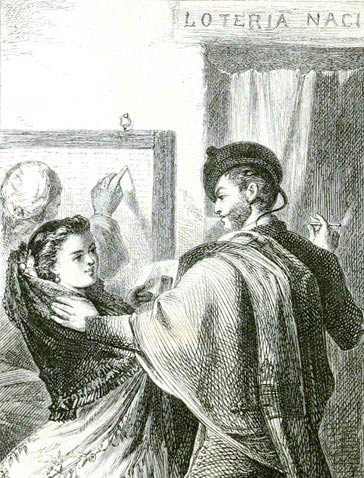
NATIONAL LOTTERY. Traveling in Spain in the present day, by Henry Blackburn (1866). Illustration by John Phillip.
«(…) while its policy seems to be rather to keep the people amused than employed; to flatter the national weakness for winning money by luck, rather than earning it by industry»
Julia Byrne (Cosas de España : illustrative of Spain and the Spaniards as they are, 1866)


