


Economy (3 of 3)
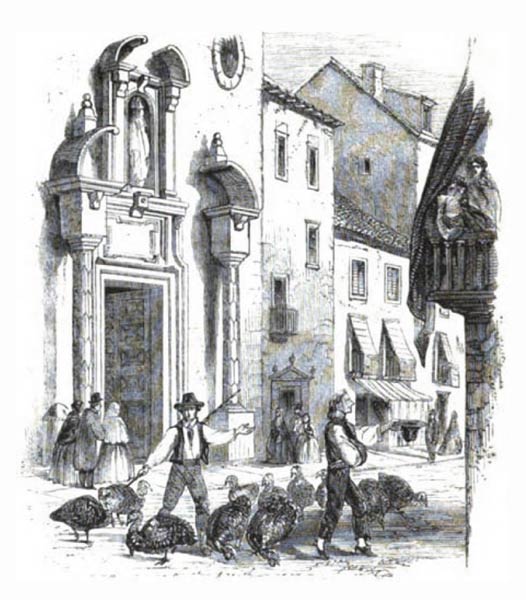
STREET VENDORS SELLING TURKEYS, MADRID. Cosas de España: illustrative of Spain and the Spaniards as they are, by Mrs. Wm. Pitt Byrne (1866).
Although authors do perceive a change in the Spanish economy over time, the country is still lagging behind the rest of Europe in terms of industrial activity and modernisation, according to many texts. In 1927, Thomas Moore notes that he rarely sees automobiles in some Spanish towns, a stark contrast to the norm in any medium-sized city in his country of origin (305).
As the texts progress into the 20th century, authors underline the presence of tourists and the significant economic activity they generate: new accommodation, shops and souvenirs, transport lines and a wide array of options listed by authors such as C. Freeston. In 1936, Freeston comments that the Patronato Nacional de Turismo (National Tourist Board) has succeeded in enhancing the experience for travellers and encourages this institution to continue its commendable efforts, such as signposting roads and generally aiding orientation in a country poised for a tourist boom (92). Freeston’s book gradually reads more like a guide than an adventure novel, and even includes a list of information offices as an appendix.
Some expressions of culture, including flamenco, started to be commercialised in the first decades of the 20th century, as Gertrude Bone wrote in her 1938 work:
It is a matter of some irritation to the Spaniard that the ‘voluptuous dances of the gitanos have such a fascination for the foreign tourist’, and the commercialized and impudent aspect of the gipsy dances arranged for the sightseer might well disconcert die sensitive. But a blacksmith and a gipsy who danced a dance called the ‘dance of the light’ seemed other and irresistible! We would make an attempt to see him (37).
Apart from incidental mentions, travellers observe that Spaniards are less focused on pursuing profitable commercial endeavours than they are on cultivating social relationships. This is evident in several instances where travellers are not charged for services or products and are treated as guests simply because they are foreigners. Spaniards prioritise leaving a positive impression on visitors over making financial gains. For instance, Rose Macaulay’s car broke down and had to be taken to a garage in Granada for several hours in 1949. However, the mechanics decided not to charge her for their services, aiming to offset the negative experience of the accident with positive memories of the city.
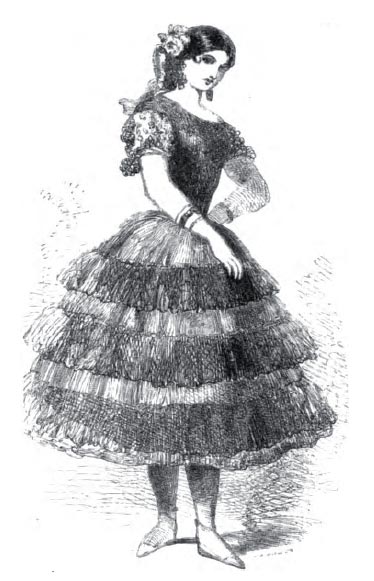
THE BOWLING ALLEY. Castile and Andalucia, by Lady Louisa Tenison (1853).


