


Economy (2 of 3)
«It was soon explained to me that smugglers cannot be seized at sea within a league of Gibraltar; and that, as the little boat had entered the British waters, further pursuit on the part of the guardacosta’s cutter would have been dangerous»
George Dennis (A summer in Andalucia, 1839)
Authors also frequently comment on contraband and the effects of smuggling on the economy. Some writers describe it as a typically Spanish practice, although others claim that it is most abundant in Gibraltar. On the boat trip from the British colony to the city of Cadiz, George Dennis witnesses coastguards chasing smugglers. According to this text from 1839, the maritime disputes between the British and Spanish favour the smugglers, who take refuge in British waters to avoid arrest:
By the aid of sweeps and sails we crept along beneath the Rock, passing the town, batteries, and Alameda in succession, and when off’ the little village of Rosia, our attention was attracted by two black spots on the bright surface of the Bay at some distance to the west. These we soon discovered to be a small smuggling-boat pm-sued by one from the Spanish guardacosta off Algeciras. 1 here was just fight enough for us to discern that the chase contained but two men, while in her pursuer there were six. This gave the latter great advantage; the little smuggler nevertheless boldly held her way across the Bay, as fast as her pair of oars could urge her towards the town of Gibraltar. We watched them as they skimmed the blushing waters, not without an anxious concern in the fate of the little chase, which seemed resolved to die game. The revenue-boat was gaining on her rapidly, —every stroke lessened the intervening distance, and I fully expected to see her fall a prey to her pursuer, more especially when she all at once seemed to relax in speed, as though well nigh exhausted. Great was my astonishment when the other boat, now not fifty yards astern, instead of pushing forward to seize her, suddenly stopped short and put about. It was soon explained to me that smugglers cannot be seized at sea within a league of Gibraltar; and that, as the little boat had entered the British waters, further pursuit on the part of the guardacosta’s cutter would have been dangerous (Vol. II, 374-375).
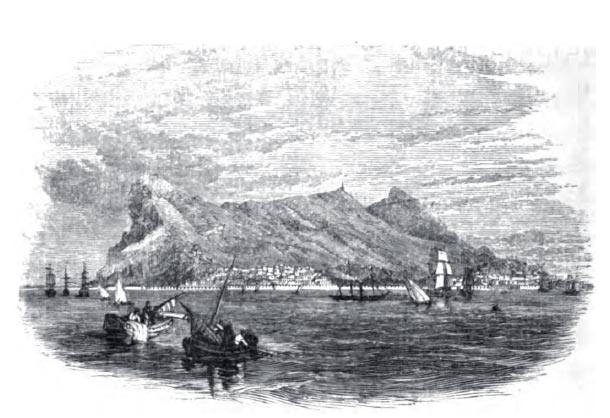
GIBRALTAR. Pen and pencil sketches of a holiday scamper in Spain, by A.C. Andros (1860).
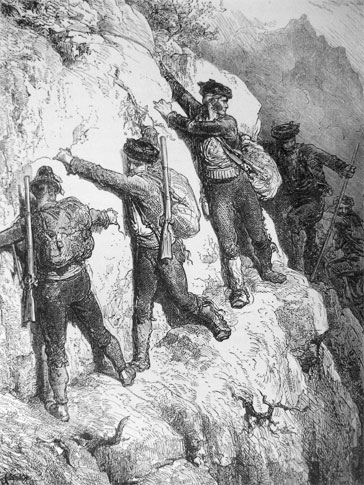
SMUGGLERS. L’Espagne, by Baron Charles d’Avillier. Illustration by Gustave Doré.
«Barcelona has remained true to her traditions. She is still, as of old, a city of merchant princes, a hive of industry, at once the Liverpool and Manchester of Spain»
Albert Calvert (Catalonia and the Balearic Isles: an historical and descriptive account, 1910)
Authors also dedicate a substantial part of their texts to mining, which they study given its economic importance and impact on countries like England and the United States. Interestingly, some of these accounts were written by authors who visited Spain to research potential mining resources in certain regions, envisioning future exploitation by British or American companies. Richard Ford analyses Spain’s economic history in relation to mining and concludes that there is a natural tendency towards a mismanagement of natural resources. He notes two significant facts: resources are usually exploited by foreign management and Spain is sometimes forced to resort to foreign supplies for provisions.
The Carthaginian labourers in these districts were then, as now, very poor; the one was dug up by a sweat of blood, and modern Spaniards have always neglected the surer source of wealth, agriculture, which lies on the surface of their fertile soil; they have, like Orientals, loved to gamble; buoyed on by their imaginations, and readily believing what they eagerly desired, they have sighed for sudden acquisition of riches, for some brilliant treasure accident, and have thus lost for solid substance in the attempt to catch at a glittering shadow (Manual para viajeros en España. Vol. I, 341).
Despite its slow pace, industrialisation began to emerge around the mid-19th century, according to Richard Ford. Factory buildings started to appear in places like Alcoy, which was rare for inland Spain, as noted by the English author. While there are workers in some towns, their hardship was evident (357). The emergence of modernity, factories, the manufacturing economy and industrialisation became increasingly visible at the dawn of the 20th century. For many writers, Catalonia was the most modern and industrial area of the country. English mining engineer, Albert Calvert, highlights the industrious nature of Barcelona in comparison with the cities of Castile:
Barcelona has remained true to her traditions. She is still, as of old, a city of merchant princes, a hive of industry, at once the Liverpool and Manchester of Spain. To those who visit the capital of Catalonia after an acquaintance only with the moribund cities of Old Castile, this vision of España Moderna comes as a shock and a revelation. The first impression is not pleasing. You approach the city through a vast wilderness of suburbs, teeming with life, and breathing apparently through grimy factory chimneys. We realise that we have returned to the civilised twentieth century. But the brighter side of modernity is soon revealed. In its heart Barcelona is clean, bright, and spacious. The boulevards are unequalled in Europe—except perhaps by Budapest—and the street prospects are worthy of Washington (8).


