


Tourism (2 of 2)
Many authors lament that very little is designed with visitors or tourists in mind, including the placement of artworks in churches, the inconsistent opening hours of attractions, and the inadequate attention to their needs. For example, Susan Hale commented in 1883 that when visiting the churches of Granada, the paintings were hung so high that no one could appreciate their beauty (262). Other authors are also astonished by the absence of street names in certain cities, which significantly complicates navigation and finding major attractions, especially for foreign visitors unfamiliar with the local language and unaccustomed to seeking directions.
The promotion of tourism and the interest in publicising the country’s heritage and customs is already featured in some of these books from the early 19th century. In 1883, Ellen Hope-Edwardes mentions a pamphlet for a flamenco show. This was one of the earliest mentions of flamenco being presented as a tourist attraction, promoting it as an authentic Spanish experience not to be missed by any visitor to the country. The author also observes various commercial elements. During her visit to the Alhambra in 1882, she remarks on the presence of flower sellers, gypsies offering palm readings and to tell her fortune, and performers dancing and singing.
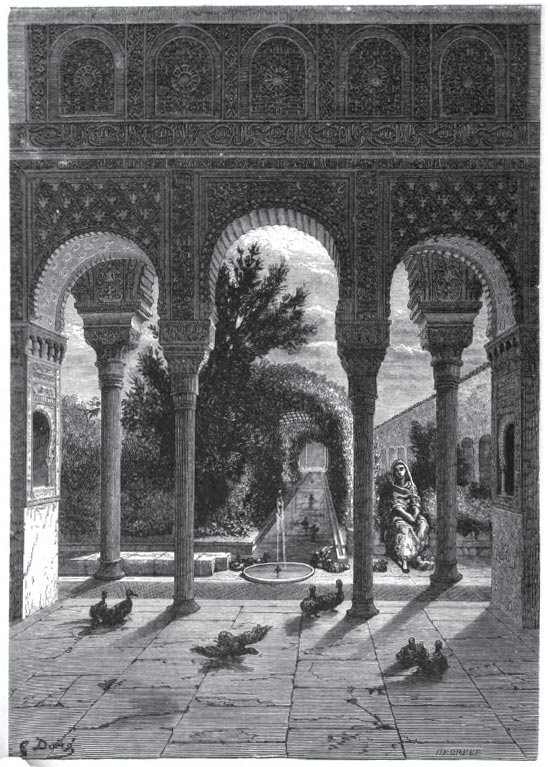
THE GENERALIFE. Spanish pictures drawn with pen and pencil, by Samuel Manning (1870). Illustration by Gustave Doré.
«Spain is probably the only European country which has not been overrun by tourists»
Marguerite Purvis, bajo el pseudónimo de Mrs. William Augustus Tollemache (Spanish towns and Spanish pictures, 1870)
The potential for tourism in Spain is appreciated by many English-speaking travellers who had a keen commercial eye. In 1844, Richard Ford comments in his handbook that Malaga is an interesting destination for travellers: there are English-speaking businesses, delicious local wines, and soap and textile factories (Vol. I, 283-287). Samuel Manning remarks in his 1870 work that whereas thirty years earlier Ford had complained that Spain attracted hardly any tourists, over time the Spanish themselves began to lament the influx of English and Americans who visited their country annually. The number of hotels had increased, transportation had become more frequent, and travel guides on Spain were already bestsellers by then. (12).
The lack of commercial vision and awareness of the importance of tourism and its specific needs is also criticised by Alexander Mackenzie. On arriving in Pamplona, he describes José Botero’s famous inn. The author mentions the simplicity and cleanliness of the establishment, noting that pretentiousness and grandiloquence are still unfamiliar concepts in Spain. However, the writer criticizes the lack of business acumen of the inn owner for not displaying a sign indicating the presence of an inn in the building, a common practice among many other innkeepers (63-64).
Another text published that same year praises precisely this absence of mass tourism and commercial structures in Spain. According to Marguerite Purvis, Spain is the only country that has not yet been overrun by tourists. For this reason, the magnificent Prado Museum is little known and visiting it is an almost individual treat:
Spain is probably the only European country which has not been overrun by tourists. Whilst the Galleries of Italy, Germany, and perhaps even of St. Petersburg, are familiar to English travellers, the Royal Museum at Madrid, which contains one of the finest collections of Pictures in the world, is comparatively unknown (33).


