


Infrastructure (2 of 2)
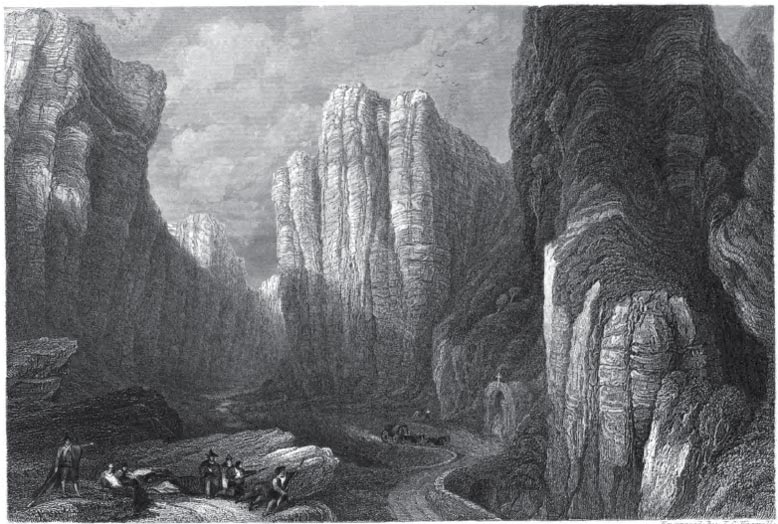
PANCORBO MOUNTAIN PASS. The tourist in Spain: Biscay and the Castiles, by Thomas Roscoe (1837). Illustration by David Roberts.
«(…) the road being too bad in places to admit of more than a foot’s pace. Sometimes we had to get out whilst our drivers repaired it with stones from the wayside»
Marguerite Purvis, bajo el pseudónimo de Mrs. William Augustus Tollemache (Spanish towns and Spanish pictures, 1870)
Contrary to the negative opinions mentioned above, in 1843 Samuel Widdrington praises the well-constructed roads, noting the excellent design and durability (35). John Carr shares this view, stating that the roads in Menorca are fairly decent, although not plentiful in number. Mules and donkeys are used for transport, and travel is very pleasant and comfortable, despite there only being five carriages and two carts on the whole island (371-372).
As he travels along the mountainous roads of the peninsula, Andrew Blayney recounts encountering some of the most intricate bends in Europe, as well as the worst road surfaces. He describes his itinerary as he departs from the town of Fuengirola, in Malaga:
Quitting Fiangerolla we passed through a very mountainous country, and by a rugged pathway, not deserving the name of road, and which skirting the sea, I had still the mortification of contemplating our shipping cruising in the offing, and observed that they had been joined by the Circe frigate. The manner in which the French conveyed their artillery through this mountainous track is worthy of notice (45).
The roads are so riddled with potholes that wheels break and stagecoaches and omnibuses often suffer breakdowns. Consequently, in 1870, it takes Marguerite Purvis five hours to get from Granada to Bobadilla. Their mule-drawn omnibus could not travel any faster due to the poor conditions of the roads. The pace was no faster than if they were walking:
We found we had two drivers. “Why was this?” “One drives, the other walks,” replied our Spanish servant. “ Walks,” we exclaimed, “if walking be the pace, how is it possible we can reach Granada to-night?” He now revealed to us that to catch the train from Loja was impossible, the road being too bad in places to admit of more than a foot’s pace, but that we should reach Loja at seven o’clock. (…) The road was, indeed, rough and bad beyond description. Sometimes we had to get out whilst our drivers repaired it with stones from the wayside, and then our running coachman led the mules across the ugly bit whilst we looked on at a distance, and wondered that any springs could withstand such jolts, any mules keep their footing (161-162).
Before long, one of the wheels breaks, forcing the travellers to disembark from the carriage and proceed on foot. One of the coachmen stays behind to repair the wheel and catches up with them later:
There was a stop. “What had happened?” The other driver was down, —the wheel was coming off, and Loja was two hours’ drive from this point! We had nothing for it but to get out. “ In half an-hour the wheel would be repaired, and if we walked on the carriage would soon overtake us.” Carriage and luggage were abandoned, and we started. (…)
The grateful sound of wheels now broke on the ear. It was the omnibus, which overtook us as we were descending the hill to the town (162-163).
Other urban infrastructures like lighting and sewage systems are also criticised by some travellers. In their journeys through less-explored regions of Spain, travellers describe cities lacking adequate lighting, making it challenging to feel safe or even walk around at night. Andrew Blayney is surprised to find that in Jaen, neighbours are obliged to place candles on their window sills at night by municipal order. He explains the experience in his text from 1814:
«I observed that the inhabitants were obliged by order to keep a candle burning in every window throughout the night, by which the streets are lighted in a cheap and easy manner» (151)
Andrew Blayney (Narrative of a forced journey through Spain and France, as a prisioner of war, in the years 1810 to 1814, 1814)
The 20th century ushered in significant developments in the construction, layout and maintenance of roads and pathways. For example, in 1930 Thomas Moore commented that Andalusian roads were good. Workers are often seen repairing the roads, even more so than in some parts of England (232-233). By 1936, the situation was much improved. C. L. Freeston stresses that the majority of the roads are of high quality, noting major recent improvements compared to accounts from earlier travellers. In his opinion, the roads are wide and allow for high speeds, and are unmatched by others in Europe (101).
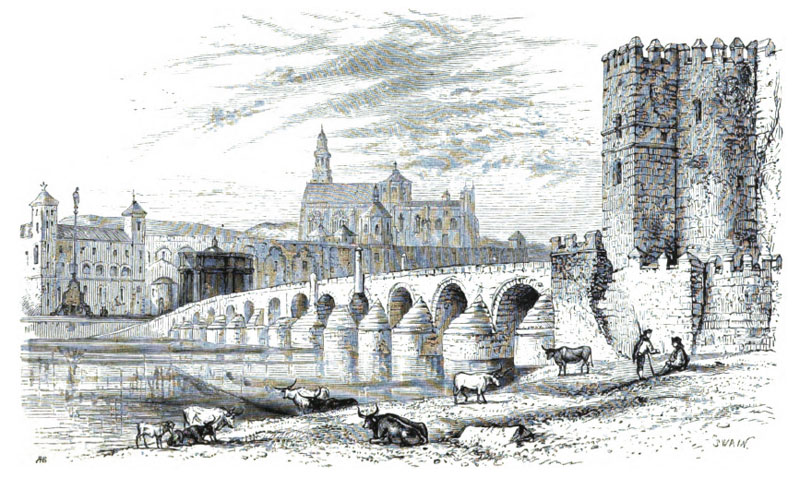
CORDOBA. Cosas de España: illustrative of Spain and the Spaniards as they are, by Wm. Pitt Byrne (1866).


