


4. Travel
Preliminary (2 of 2)
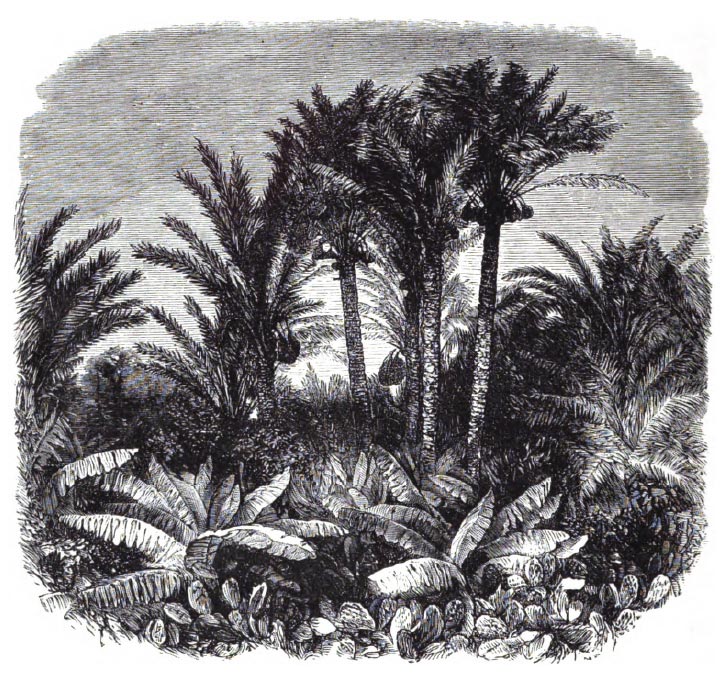
PALM TREES IN LA ALAMEDA, CORDOBA. Spanish pictures drawn with pen and pencil, by Samuel Manning (1870).
These accounts are as astonishing to us today as Spain was to travellers back then. Things that we now consider commonplace caused great amazement to these authors in past decades. For example, in 1850, a pilgrim or a date palm were everyday elements in Spain, but were considered extraordinarily exotic by a Canadian like George Clark:
This day, the 24th of July, 1849, will be memorable to me, as the date of my first seeing a pilgrim and a palm tree in their natural state (108).
The descriptions of luggage and travel arrangements provide insight into how things have changed. For instance, Matilda Betham-Edwards recommends travelling with a lot of luggage and dressed luxuriously to stand out and receive special attention and treatment: “Surely in no country but patient Spain would two ladies have been allowed to fill the first-class compartment of a railway carriage in the way we did” (27). This tireless British author travels with more than ten trunks and, in fact, recommends travelling with a total of three boxes of books, three bundles of rugs, a case with sketching materials, sketching blocks of various sizes, bags of needles and threads, opera glasses and spectacles, a tea pot, a water bottle and a gas cooker, cushions, slippers, several jars of dried fruit and sundries without number (27).
Before their departure, adventurers prepare for their journey by reading accounts written by authors who had travelled to the country previously and by consulting guidebooks that had just been published by others. Many of them quote each other or attribute certain information or comments to other authors. For example, Richard Ford’s handbook is cited repeatedly. In addition to using printed manuals to find their way around, travellers also depended on tourist guides, a practice that was initially uncommon, but became widespread in the 19th century and eventually became commonplace in the 20th century. The guides receive both extensive criticism and praise, which is why they deserve a section in this chapter. Matilda Betham-Edwards, for example, is satisfied with her guide in Toledo, but most are criticised for their confusing and unhelpful explanations.
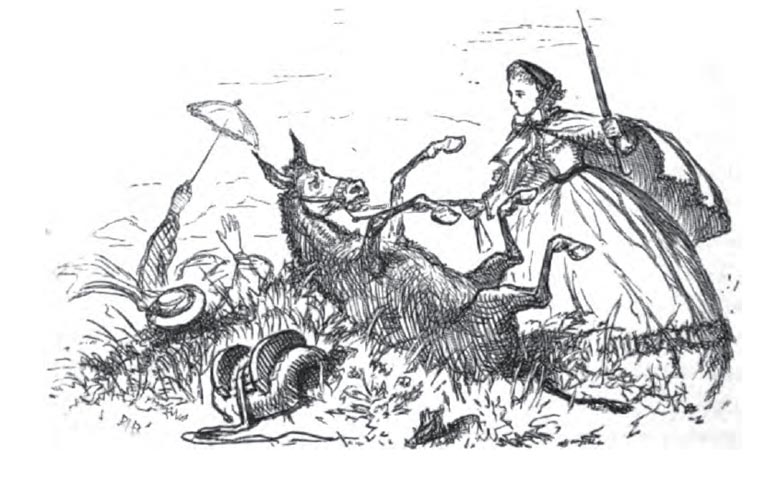
RESTLESS DONKEY. Cosas de España: illustrative of Spain and the Spaniards as they are, by Wm. Pitt Byrne (1866).
Many of the texts strongly recommend exploring off the beaten path. John Lomas recounts visiting villages in Asturias, Galicia and Castile and Leon during the first decade of the 20th century, where he encounters landscapes that rival the beauty of Switzerland. Albert Calvert shares the same opinion about a remote and rarely visited village in Catalonia, Gerona, which he describes as a place of profound, undiscovered beauty, far from mass tourism (23). Calvert enjoys visiting places that remain almost untouched thanks to their isolated location. In 1919, Calvert stated that the Balearic Islands receive very little tourism, and that given the minimal influence of foreign visitors, the islands are not at risk of losing their unique, local identity. A notion that contrasts sharply with the current reality of these islands. In 1927, Thomas Moore encourages visitors to venture into the more unknown parts of Andalusia, recommending small inland villages such as Osuna and Estepa or Sierra de Aracena, and to escape the tourist-filled cities of Granada, Seville and Cordoba. The author enjoys the mountain villages of Huelva and Riotinto, and ironically remarks that the only traffic consists of donkeys, albeit only during rush hour. He finally encounters cars in Jerez de la Frontera, which he describes as uncommon for these parts, and claims their presence is only due to the festivities in honour of Virgen del Carmen.
Already in the 19th century, foreigners noticed the excess of government regulations, the need for various permits and licences, and a bureaucracy that further deteriorated the poor services available to travellers. As Thomas Roscoe recounts about his trip in 1838:
One need hardly be surprised that, with municipal regulations resembling these, the inns of Spain, like its trade and commerce, should ” fall into the sear and yellow leaf;“ and though not quite so bad at the present period, both the traveller and the merchant may well sigh for the times gone by, or for the promised regeneration that is to come (The tourist in Spain and Morocco, 69).
In addition to administrative difficulties, some travellers report unfavourable treatment by locals simply because they are foreigners. Many feel they are cheated when shopping and believe they are sometimes overcharged. In 1883, Ellen Hope-Edwardes recounts she was forced to haggle over every transaction, and felt tricked because she was not accompanied by a local (75).


