


Trade (2 of 2)
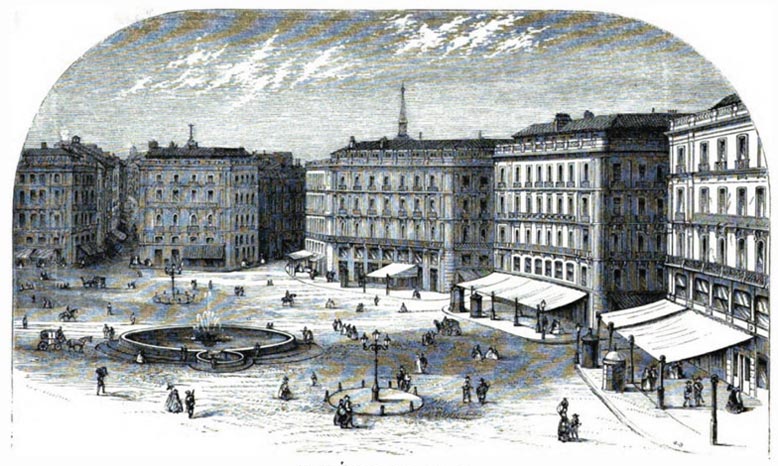
PUERTA DEL SOL, MADRID. Cosas de España: illustrative of Spain and the Spaniards as they are, by Wm. Pitt Byrne (1866).
«In spite of the old saying, “Aquel pierde venta Que no tiene que venda —He loses his inn Who sells nothing within,” it is rarely that a store of provisions is kept in a Spanish venta»
George Dennis (A summer in Andalucia, 1839)
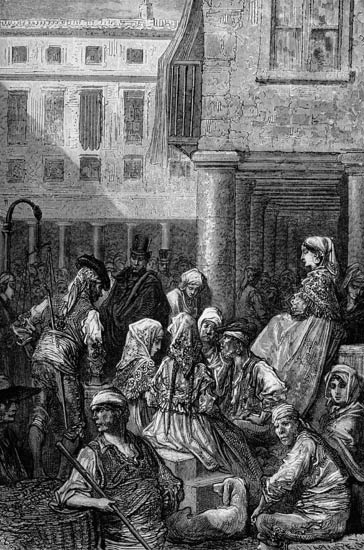
MARKET IN VITORIA. L’Espagne, by Baron Charles d’Avillier. Illustration by Gustave Doré.
Another curious observation is that in some restaurants, patrons are required to bring their own provisions for their food to be prepared. George Cayley uses this very modern concept of “bring your own food” as early as 1853, noting that he trudged to the marketplace and bought a pound of sardines for dinner, which he then helped to cook. (214). The same idea is repeated in another text, stating that a man brought a donkey whose broad saddle-bags were crammed with lettuces, and after buying three or four for un cuarto each (three cuartos equals about a penny), gave them to one of the daughters of the house for salad (249).
According to George Dennis in 1839, it is not uncommon to find that there is no food in a venta or posada, which the Englishman finds surprising:
In spite of the old saying, “Aquel pierde venta Que no tiene que venda —He loses his inn Who sells nothing within,” it is rarely that a store of provisions is kept in a Spanish venta; even in the posadas of small towns, as in this case, “no hay —there is none”, is a frequent reply to all enquiries for food. This appears strange enough to an Englishman, who expects at an inn to have his every want supplied (Vol. I, 340).
Finally, it is worth including Terence Hughes’ description of the typical Spanish venta and the colourful crowds that congregate there. This interesting portrayal was written in first part of the 19th century:
The interior of the road-side venta is thus a rapidly changing and always picturesque spectacle. The Muleteros, with their hybrid convoy of mules, donkeys, and small mountain horses, heavily laden and creeping at a snail’s pace, the labrador and farm-servant going to and from market, with their leathern leggings open at the sides to let in the air, and display the calves (…) the contrabandists always travelling in numerous convoy upon mules of choice excellence, possessing qualities for which their masters would not exchange them against the choicest Andalucian barb, — the masters themselves, daring and roystering fellows, wearing the round or peaked velvet hat, which is so admirably becoming to the Spanish face, and which, like the mantillas of the women, constitutes so truly a national costume (40-41).


