


Time (2 of 2)
«(…) is the land of to-morrow and holds the gospel of never mind!»
Charles Luffmann (Quiet days in Spain, 1910)
According to Kate Field, Spaniards’ favourite word is “mañana” (tomorrow) (97). For Charles Luffmann, Spain is the country of “mañana” (tomorrow) and “no importa” (don’t worry). Realising that Spain never hurries, Luffmann decides to adapt to this pace:
I have always known and loved, even where I could not approve, Spain; perhaps she appeals because she is the land of to-morrow and holds the gospel of never mind! So long in chains, I was almost tempted to hurry; but Spain forbids haste; nothing shows more folly or vulgarity than striving to get ahead; so catching the pulse of the country I moved to its time and tune (3).
Not all authors are critical of this behaviour; in fact, some commend this approach to time. For example, Emmeline Stuart-Wortley points out that it is difficult to find anyone in Spain who respects punctuality (113). When travelling from Cadiz to Seville, the leisurely pace of the people carrying their luggage nearly causes them to miss the boat. The author reflects on the usage of time and its usefulness by comparing Spain and England, pairing issues such as leisure/business and happiness/productivity. Stuart-Wortley concludes that although England is a modern, fast-paced and industrialised nation, ultimately, the tranquillity and balance of life in Spain favours its population, who live happier lives. With this in mind, the author interprets unpunctuality as something positive, considering the pre-modern state to be preferable to the dehumanised situation brought about by industrialisation in her country, Great Britain.
It is perhaps this British traveller who best grasps how Spaniards understand time, and compares their approach to the British interpretation. In the book she published in 1856 she admits, like most authors, that respect for time and punctuality are not the country’s greatest virtues. However, the author wonders whether her idea of “using time” is actually better than the Spanish value of “enjoying time.” In other words, in a thoughtful reflection, she juxtaposes the modern concept of time management in her country, which prioritises productivity, utilitarianism and haste, with the emphasis that Spaniards place on enjoyment and happiness:
Pause a little before you think of advising a Spaniard not to lose his time; he has never found it yet, and, moreover, believes it to be the old Scythe-bearer’s business to find him, and to take him by the forelock – if he can. However ´tis certainly anything but an Eternity of a perpetual now, – ´tis rather one of everlasting To-morrows, that postpone their coming for ever and aye; in fact, to all eternity. Perhaps, after all, in some respects, the worthy Dons are right! Are we much happier with our endless, anxious punctuality and fuss? Punctuality is the soul of business; but is this same business so very much the soul of happiness as we all seem to think? – (the idea of Business having a soul at all!) Is it not a little true that joy is man’s wealth, and care his poverty? Yes, is not the first his best of all wealth, if the last is not his worst of all poverty? “Procrastination” is said to be “the thief of time”, but, according to apparent Spanish interpretation, who steals it, “steals trash” (Vol. II, 113).
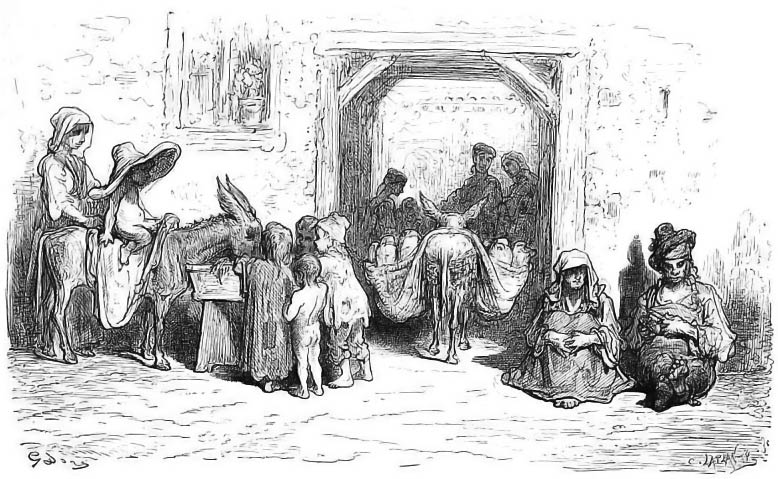
SKETCH IN VALDEPEÑAS. L’Espagne, by Baron Charles d’Avillier. Illustration by Gustave Doré.
«Rico, tell the driver whatever means as fast as possible; if (…) there is any word in Spanish that means, the reverse of slow»
Susan Hale (A Family Flight Through Spain, 1883)
Similarly Matilda Betham-Edwards also states that Spaniards are typically slow, and foreigners must simply put up with it (122). According to Ellen Hope-Edwardes, Spaniards are very fond of using the expression “more or less,” especially when referring to transport (108). She specifically refers to her trip from Alicante to Malaga, noting that nobody is certain about the departure time of the boat, only that it will be in the afternoon, spanning a seven-hour window. Susan Hale also makes an analogous observation about the trains. In Spain, haste does not exist —a cultural trait inherited from their Moorish ancestors:
Repose and procrastination pervade the system. Perhaps the officials inherit from Moorish ancestors the Mohammedan belief in “Kismet,” for it is by Faith and Fate that trains reach their destination, rather than by rule and time-table. They start sometime, and they arrive somewhere, and that is pretty much all that can be asserted of their punctuality (20).
Hale includes another example, adding a touch of humour: “‘Jump in, Tommy!,” cried his father. “Rico, tell the driver whatever means as fast as possible, if,” he added in a lower tone, “there is any word in Spanish that means the revers of slow.” (292). Thomas Roscoe has a comparable experience with a stagecoach driver who takes him to Vitoria:
As our muleteer partook largely of his countrymen’s disregard of time, it was always practicable particularly when there were any wine or brandy shops on the way, to outwalk his beasts, and loiter at our ease wherever there happened to turn up any thing to invite examination (The tourist in Spain: Biscay, p. 45).


