


The picturesque (2 of 2)
Poverty is one of the aspects of everyday life that foreigners often associate with a certain idea of the picturesque. During his visit to Granada, Augustus Hare walks through the Sacromonte neighbourhood, which he describes as a very poor area, but one that he finds intriguing precisely for that reason. According to the artist, the neighbourhood contains all the forms and colours of picturesque poverty (145). Nathaniel Wells shares the same opinion by stating that “mendicity is one of the curiosities, and not the least picturesque, of this antique country” (371). According to Wells, there should be a Mendicity Society for its preservation since no one can resist “the graceful appeal of a well-trained proficient” (371).
George Dennis expresses a similar sentiment about the Albaicin neighbourhood, inhabited mostly by the working class. According to Dennis, this area is one of the biggest highlights of the city of Granada, and he fervently recommends it to travellers. The author not only overlooks its partial abandonment, but he considers it as its greatest attraction:
Very few gens comme il faut reside within the precincts of the Albaycin; it is inhabited almost wholly by the lower classes, but it is this which gives it a peculiar character; and the traveller in Spain, who is seeking the strongest traces of Moorish blood and manners, should by no means neglect to visit the Albaycin. The dark, steep and tortuous alleys —the mounds of ruins on every hand— the dilapidated state of the buildings still standing —the fact of the hill being undermined with subterranean passages— the numerous legendary traditions connected with the place—all impart a more mysterious interest to the Albaycin, than belongs to any other part of the city of Granada (Vol. II, 109).
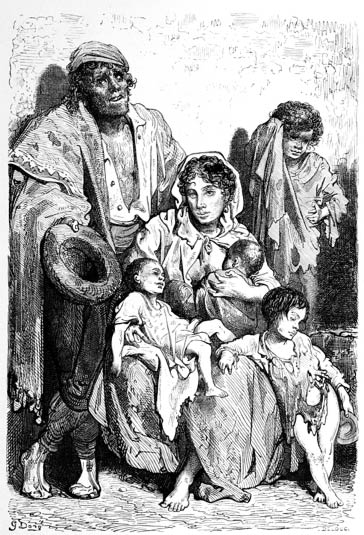
FAMILY OF BEGGARS. L’Espagne, by Baron Charles d’Avillier. Illustration by Gustave Doré.
«Each scene at the doors of the encircling towers, which are mostly let out to poor families, is a study. What combinations of colour! what picturesqueness in the natural grouping of the figures»
Augustus Hare (Wanderings in Spain, 1873)
For many travellers, the lack of resources has the potential to create exotic and distinct scenes, and is not viewed as a problem. In fact, there appears to be a perceived relationship between material scarcity and artistic richness, where the increase of one often leads to a decrease in the other. On passing through Ronda, for example, Richard Ford states that in this area there is more sustenance for the artist’s or painter’s eye than for his body. Due to the lack of good fondas for a meal, travellers must make do with feeding the spirit on the beautiful scenery, and enduring hunger until they reach Malaga (A handbook for travellers in Spain. Vol. I, 266).
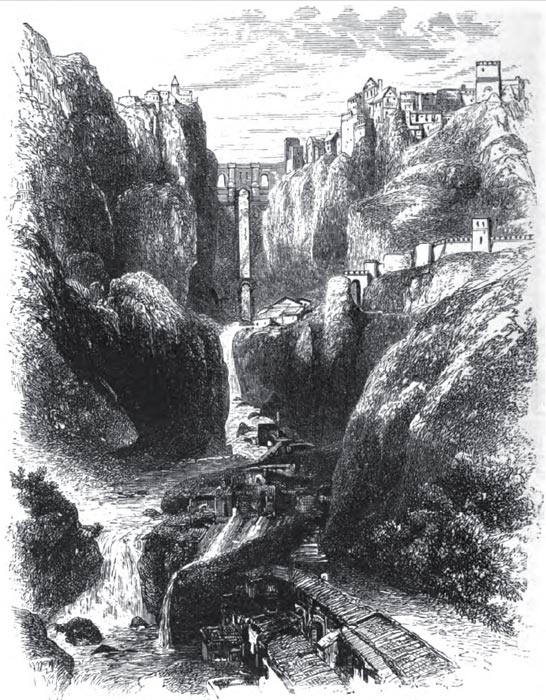
RONDA. Spanish pictures drawn with pen and pencil, by Samuel Manning (1870).
However, the modernisation of traditions, customs, hygiene and welfare is often seen as a threat to the preservation of the primitive character that these authors seek. Ford claims that the renovation of a square in Granada, now transformed into a market, has made the place less interesting because the picturesque element has been sacrificed in favour of civilisation (A handbook for travellers in Spain. Vol. I, 317). Susan Hale must have shared his opinion when she said that Spanish trains are too modern to be picturesque (270).
This intrusion of contemporary elements into the contemplation of the portrayed object, which taints its supposed originality and primitive purity, which could be likened to a form of “anti-painting” is documented in several writings as one of the most significant disappointments encountered by these authors. For Richard Ford, the smoke from the boats and the filth of the Guadalquivir, caused by the traffic, make the river as un-picturesque as the Thames (A handbook for travellers in Spain. Vol. I, 154-155).
In this context, it is interesting to note Richard Ford’s insight into the relationship between modernity and tradition, particularly in terms of how this has been interpreted by the scholars of the time. Ford criticises their mistaken application of the notion of progress to customs, equating them with backwardness. This approach, which the English author calls “picturesque barbarism,” involves the demonisation of traditions that are identified with primitiveness and their dismissal as impediments to achieving a desired level of cultural development:
Costume naturally exists where there is so little communication with European civilization. These dresses, worn only on holidays, last long, and would last longer did they not smack of “picturesque barbarism” in the eyes of the Español illustrado; his wish is to efface these nationalities with cheap cotton and commonplace calico. Meantime notice the Maragatos (Vol. II, 506).


