Orientalism (2 of 2)
Some writers, including Henry Blackburn, are so obsessed with Spain living up to their “Oriental” expectations that they even applied these adjectives to cities such as León and Valladolid. When describing Gibraltar, David Urquhart writes: “I cannot speak of this place in any sense as English. I must recollect only and describe it as Moorish” (39). David Trench also latches on to the oriental aspect of Spain and, on entering the country through the northern border in 1845, states that Pamplona —or “Pampeluna,” as he calls it— evokes the exoticism and poetry of the cities of the Orient. In fact, he calls the bell towers “minarets,” despite him never having seen a Muslim city except in photos:
Happily Pampeluna was in view, making its appearance from a considerable distance, and encouraging us onwards by its noble and peculiar aspect. Its bold position, as it rises from a treeless plain—the long lines and extent of its walls, in view, completely without decoration—its unvaried colour of a dark brown, resembling the hue of burnt clay, the minarets of its churches, and one or two lofty thin towers, rising above the town; these and other peculiarities, which I cannot more fully describe, strongly reminded me of Eastern cities, so far as I know them by views, and gave to Pampeluna a grand and poetical character, which I shall not easily forget (36-37).
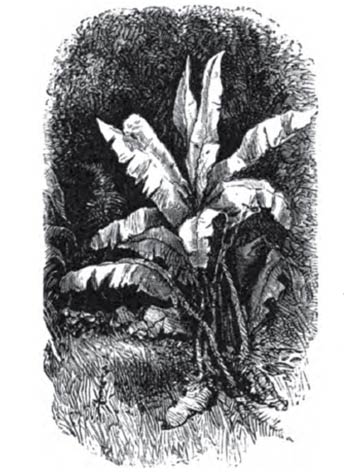
Spanish pictures drawn with pen and pencil, by Samuel Manning (1870).
«In southern Spain, the noble and striking palm tree at once arrests your eye, and all, above and around you, has an Oriental aspect (…)»
Terence Hughes (Revelations of Spain in 1845, 1845)
Terence Hughes, on the other hand, uses biblical or Koranic imagery to describe Andalusian exoticism, establishing, what is for him, a logical link between southern Spain and the ancient Middle East. By exalting the light, vegetation and traditions, Andalusia is depicted as a land distant in both time and space:
In southern Spain, the noble and striking palm tree at once arrests your eye, and all, above and around you, has an Oriental aspect — the blue and burning sky, the parched and sandy soil, the general desert air, the strange and magnificent growths, from the tufted aloe and cactus to the slender and ragged boughs of the blossomed pomegranate: all is of the East. You, northern man! are transported in spirit to the cradle of the world. Before your eyes, wherever you turn, are “ the ox and the ass,” * c the vine and the fig-tree" of the Bible. You realize in all its parts the picture of the Koran: “Palm-trees with heavily laden branches, vineyards, olive-grounds, and gardens with pomegranates and fruits of every kind” (Vol. II, 173).
Elizabeth Herbert also conjures up the notion of the ancient region of Palestine upon contemplating River Tagus as it passes through Toledo. The image of the river, the bridge and the waterwheel give the scene an oriental aspect more reminiscent of Syria than of Europe:
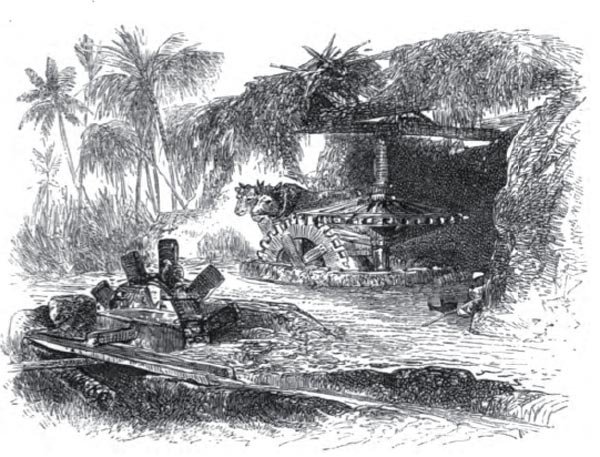
The Tagus here rushes down a rapid with a fine fall, looking like a salmon-leap, where there ought to be first-rate pools and beautiful fishing; and then flows swiftly and silently along through a grand gorge of rocks to the left. By the riverside was the Turkish water-wheel, or ‘sakeel,’ worked by mules. The whole thing was thoroughly Eastern; and the red, barren, arid look of the rocks and of the whole surrounding country reminded one more of Syria than of anything European (200).
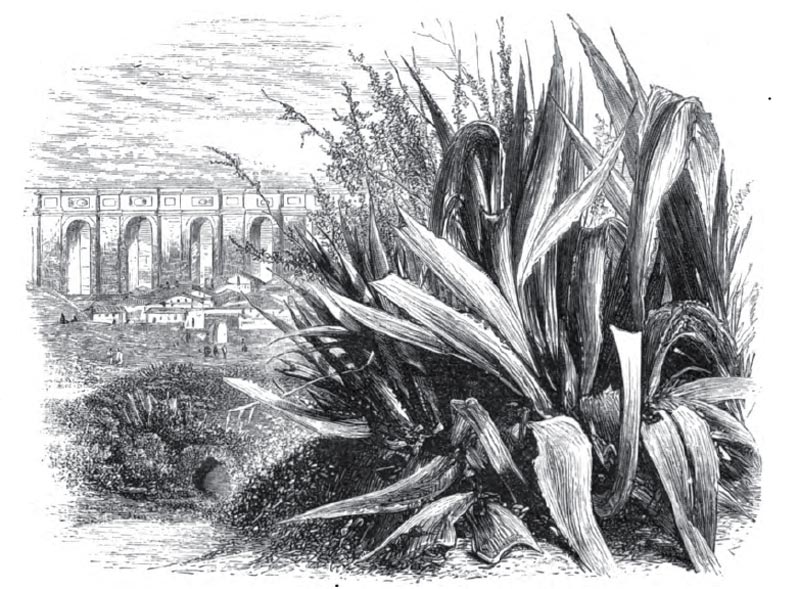
AQUEDUCT NEAR SEVILLE. Spanish pictures drawn with pen and pencil, by Samuel Manning (1870).
ARAB WATERWHEEL. Spanish pictures drawn with pen and pencil, by Samuel Manning (1870).