


Fiesta/siesta (2 of 2)
«I have known a robbery take place at the gates of a place, and when the parties went to the alcalde that he might take some steps to arrest its perpetrators, it was found he was at his siesta and must not be disturbed»
Samuel Widdrington (Spain and the Spaniards in 1843, 1844)
The word “siesta” also appears on countless occasions in Spanish, as it is interpreted as a purely local custom that has no correlation in other cultures. The siesta is often seen as a natural result of the laziness that many authors believe characterise Spain’s economic, commercial and social life. Samuel Widdrington tells an anecdote about a mayor and the siesta, illustrating how napping takes prevalence over work, even when fundamental issues such as justice are at stake: “I have known a robbery take place at the gates of a place, and when the parties went to the alcalde that he might take some steps to arrest its perpetrators, it was found he was at his siesta and must not be disturbed” (Vol. I, 83).
Thomas Roscoe drily refers to the revolutionary period when Spain faced the French during the Napoleonic invasion, and no one could take a siesta because of the situation:
“Wars and rumours of wars,” enough to startle this once quiet seat of ecclesiastic power and splendour from out its propriety, kept all ranks, — lay and cleric, national guard and garrison, governor and governed, wide awake; which is saying a good deal for their sense of honour, caution, or whatever we may please to call it, during the summer fervours of a Peninsular sun (The tourist in Spain and Morocco, p. 2).
This tradition is so relevant that the portrait of the country would be incomplete without it, as stated by L. Higgin:
The description of peasant life in Madrid would be incomplete if we left unmentioned the daily siesta in the sun of the Gallegos and lower-class working-men. On the benches in the Prado, on the pavement, in the full blaze of the sun, these men will stretch themselves and sleep for an hour or two after their midday meal. I have seen the Gallego porters make themselves a hammock with the rope they always carry with them—mozos de cuerda they are called—literally slinging themselves to the reja or iron bars of the window of some private house, and sleep soundly in a position that would surely kill any other human being (87-88).
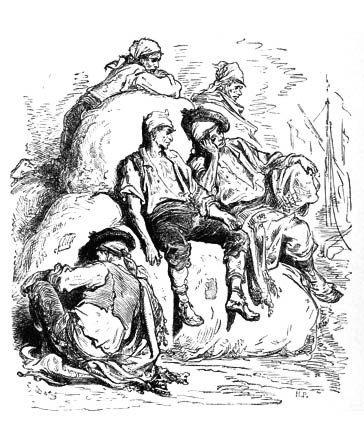
TRADERS IN ALICANTE. L’Espagne, by Baron Charles d’Avillier. Illustration by Gustave Doré.
«The clamour is continuous and incessant —except during the hours of siesta when all Spain is fast asleep»
Samuel Manning (Spanish pictures drawn with pen and pencil, 1870)
Samuel Manning is also surprised by the sudden silence that reigns in the streets of Madrid after lunch: “The clamour is continuous and incessant—except during the hours of siesta, when all of Spain is fast asleep” (77).
Authors including George Dennis appreciate this tradition, arguing that it is essential during the scorching summer months. During his journey in 1839, this author notes that in Spain, everything comes to a halt and the streets empty in the afternoons when the heat is most intense. Shops close, and workers find a shady spot to nap, seeking respite from the oppressive temperatures. He regards the siesta as a necessity, unlike other travellers from the north who consider the practice as a sign of apathy and laziness:
This is not a fair ground for the charge of laziness, so often urged against the natives of the south of Europe, for the heat at this hour will induce drowsiness even in the active and stirring Englishman, especially when not inured to the relaxing climate (Vol. I, 218).
Whether they are fond of siestas or not, many travellers admit to indulging in one at some point, especially on hot days following the exhaustion of long journeys and sightseeing. For instance, after an improvised picnic, American author Edward Penfield succumbs to the temptation of a siesta in the countryside with his companions. They take a nap under a leafy tree along the road, lying on blankets on the grass and enjoying by the sweet mountain breeze (19).


