


7. Clichés
Preliminary (2 of 2)
Sometimes, it is necessary to fabricate these stereotypes and present them to travellers, especially in modern times when readers almost expect to find certain images and clichés. Edward Penfield travelled to Spain in 1911 and complained about not encountering the typical scenes that he associated with Romantic Spain. He was disappointed with the atmosphere in the taverns, as he had expected to see bullfighters, guitars and women dancing flamenco. Offended by these clichés and romanticised expectations, the innkeeper promises to deliver an authentic sarao and has his sons put on the show the American wants to see:
(…) but when I expressed my disappointment over the unromantic appearance of the wineshops, where I had expected to find the brave toreador strumming a guitar in unison with a fair senorita’s lithe motions, my host, placing his finger beside his nose and drawing down the inner corner of his eye, promised to arrange an entertainment at the wine-shop of the village that night that would, he was sure, restore my old ideals. His sons played the mandolin, and evidently belonged to a musical club, for four other young men came with their mandolins and sat around the great circular table in the wine-shop. In their flat-brimmed sombreros, hair banged and brushed forward over their ears, in imitation of the bullfighters, sun-browned faces, short, black velvet coats and red sashes tightly binding their narrow hips, they made a picture, and played their weird, wild music, touched with pathos, well into the night (30-33).
«(…) I expressed my disappointment over the unromantic appearance of the wineshops, where I had expected to find the brave toreador strumming a guitar in unison with a fair senorita’s lithe motions»
Edward Penfield (Spanish sketches, 1911)
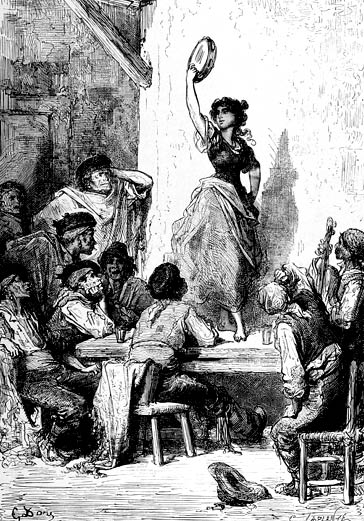
GYPSY DANCING THE VITO SEVILLANO. L’Espagne, by Baron Ch. d’Avillier. Illustration by Gustave Doré.
«I had presupposed a people proud, intolerant, bigoted, indolent, shiftless, lawless»
John Campion (On foot in Spain : a walk from the Bay of Biscay to the Mediterranean, 1879)
Other travellers come with preconceived ideas that are quickly disproved when they arrive in Spain, such as clichés about the local character, false stories of bandits, and exaggerated stories about the supposed cruelty of the Black Legend. These misconceptions range from simple expectations about the wardrobe and customs of the Spaniards to often offensive generalisations about the population. American author Edward Penfield comments that whilst visiting in 1910, he attended a popular wedding and admits to getting carried away by his imagination. He says that the guests were not wearing the beautiful attire he had imagined, although their dresses had been meticulously repaired (23). John Campion also confesses that his visit has challenged all his preconceptions:
Nor has my trip been altogether devoid of instruction. It has dissipated many erroneous, previously-conceived opinions, informed me of many an unsuspected fact. 1 had considered Spain to be a worked-out country: the undeveloped wealth of her natural resources is great beyond all calculation. I had presupposed a people proud, intolerant, bigoted, indolent, shiftless, lawless. 1 have found an upper class courteous and considerate to their equals, kind and familiar to their inferiors, fairly liberal and enlightened in opinion, and very wide awake to the faults and shortcomings of their country; a peasantry full of se1f-respect, of many independence, honest, hard-working, frugal, law abiding, sober (381-382).
Edward Hutton, however, informs his readers that he travels light and has no room to pack his prejudices about Spain (4). Nonetheless, before his arrival, he had already written: “I know nothing of Spain, nothing of the Spaniards. I am come to see this race which has suffered so much from treason, from corruption, from poverty, and the evil chance of war” (3-4). In other words, he knows nothing about Spain, but he is well aware of existing bias.
Some authors arrive with many prejudices, fabricating radical differences between Spain and their home countries, perhaps believing that their readers would enjoy reading about exotic places rather than observing the aspects they have in common. Undoubtedly, reader expectations, or what authors think their readers expect, play a significant role in this. In this respect, Philip Thicknesse comments in a late 18th-century work:
The road is not less romantic on the Spanish, than on the French side of the Pyrenees; but the face of the country is more beautiful, and the face of all things, animate and inanimate, are quite different; indeed, one would be apt to think, that instead of having passed a few high hills, we had been transported over a large ocean; the hogs, for instance, which are all white on the French side, are all black on this, as well as the men and women (143).
In his attempt to attribute a unique character to millions of individuals, Thicknesse also resorts to other national stereotypes. He calls Spaniards a hybrid race, a blend of the civilisations that have settled in the Iberian Peninsula. In short, he describes the Spanish character as combining the superstition of the Jews, the melancholy of the Arabs, the arrogance of the Goths and the desire for freedom of ancestral Spaniards (225).
The authors frequently refer to these clichés ironically. In his work Gazpacho, written in 1850, George Clark comments on the temperatures in Spain and other platitudes. After informing his friends that he was travelling to the Iberian peninsula, Clark writes the following: “’Going to Spain?,” said one. ‘You’ll be roasted alive!’ ‘By the Inquisition?’ ‘No! By the sun!’” (1). Merrydelle Hoyt also perpetuates the cliché of the scorching southern heat during her stay in Seville, suggesting exaggeratedly that summers are so hot in that city that if you open your mouth, it feels like your tongue would burn (84).
«Their superstition from the jews; melancholy from the Moors; pride from the Goths; and from the original Spaniards, a desire and thirst after thirst of all earthly blessings—liberty»
Philip Thicknesse (A year’s journey through France and part of Spain, 1798)


