


Anti-clichés (2 of 2)
«The Spanish working man is really a most sober, hard-working being, not much given to dancing, and not at all to drinking»
L. Higgin (Spanish life in town and country, 1902)
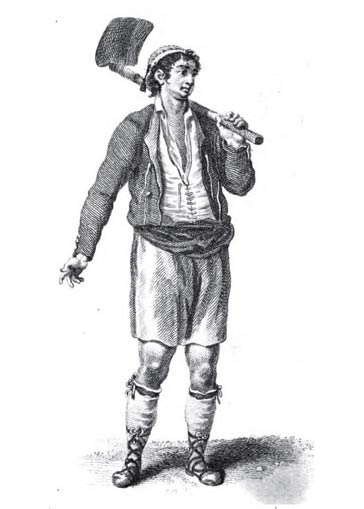
A PEASANT FROM ARAGON. A second journey in Spain, in the spring of 1809, by Robert Semple (1809).
Another widespread cliché about Spaniards is their lazy nature and predisposition to procrastination. However, many authors are keen to refute it after visiting the country themselves. L. Higgin stresses that Spanish people are hard-working, hard-working and reserved, which breaks with classic clichés common in other texts: “The Spanish working man is really a most sober, hard-working being, not much given to dancing and not at all to drinking. They are exceptionally clever and sharp, and learn any new trade with great facility” (261).
Years earlier, Arthur Brooke had already mentioned the hardworking nature of Spanish countrymen. The traveller depicted scenes of farmers perched on mountain slopes in southern Spain, defying gravity, a scene that denoted more activity and perseverance than he could have imagined in a Spaniard (Vol. II, 173). Fifty years later, Ellen Hope-Edwardes challenges the same cliché by arguing that Spaniards in general, and Malagueños in particular, certainly appreciate their free time, but they work hard from very early in the morning (146).
Similarly, George Dennis counters this stereotype, claiming that Andalusians work tirelessly. This fact is evident during any walk through the countryside, where one can witness the strength and excellent physique of the agricultural workers:
In person the Andaluz is seldom above the middle height, sometimes stout, though rather with muscle than with fat, but more generally light, spare, and astonishingly active and hardy. (…) So is it with the Andaluz. No labour seems capable of fatiguing him. He will work the livelong day exposed to the scorching summer sun; he will run for hours without resting; or, like his own mules, he will march all day without repose, and with the most scanty refreshment. His form is in general beautifully turned; his complexion is swarthy, less so, however, than that of the Portuguese; his eye large, dark, and full of fire; his countenance always expressive, and often handsome (Vol. II, 398).
«It is not saying much for Sevillian beauty, that I looked in vain amongst this vast number for one that was beautiful, pretty, or even interesting in appearance. I never beheld such an assemblage of uglinesses»
George Dennis (A Summer in Andalucia, 1839 (Vol. I, p. 206)
Another cliché that had been widespread since the 18th century was the poor state of posadas (inns) and hotels in Spain. Matilda Betham-Edwards disagrees, saying that she and her companion found nothing to complain about. Despite being women travelling alone, they found everything very comfortable. Before their visit, another English traveller had warned them, exclaiming, “I warn you not to attempt to stay one night in Córdoba; I forbid you to attempt it. It’s awful! It’s disgusting! It’s impossible!” (16). However, the writer enjoys a wonderful stay at the Hotel Suisse and reminds readers that it takes patience and good manners to be provided with everything one needs (110-113).
Thomas Ewing Moore explains that public infrastructures are not as neglected as other authors point out. The roads, in fact, are mostly good. Moreover, roadworks are regularly underway, even more so than in some parts of England (233). C. Freeston also debunks preconceived ideas about Spain, stating that it is no longer a country of beggars and flea-ridden inns (126). Several authors challenge the myth of the pretty cigarreras of Seville, suggesting that instead of embodying the idealised vision of beauty celebrated in famous operas, the women are far less appealing and attractive:
The most extraordinary sight in the Fabrica, is a room, or rather four connected rooms, about an immense square court, where three thousand women and girls are daily employed in twisting cigars. It is not saying much for Sevillian beauty, that I looked in vain amongst this vast number for one that was beautiful, pretty, or even interesting in appearance. I never beheld such an assemblage of uglinesses. As Juanico well expressed it, “Venus passed by their doors at the time of their birth, and would not even glance within.” The young female superintendant was the only exception — the only one who did not disgrace the city of “Donna Julia” (George Dennis. A Summer in Andalucia, Vol. I, p. 206).
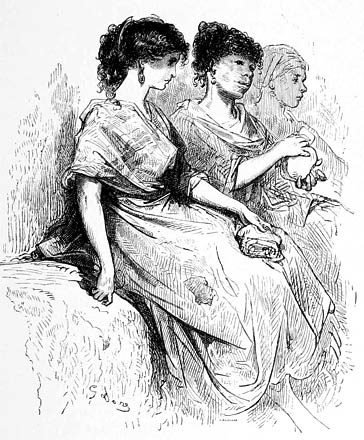
CIGARRERAS FROM THE TOBACCO FACTORY IN SEVILLE. L’Espagne, by Baron Charles d’Avillier. Illustration by Gustave Doré.


