


Valencia (2 of 2)
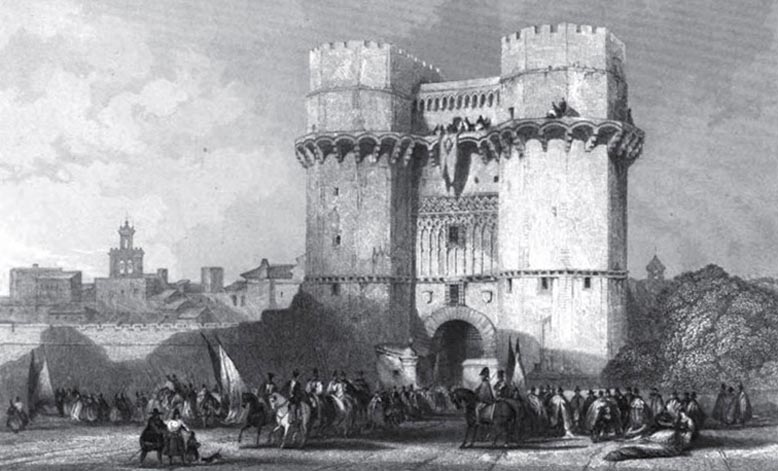
PUERTA DE SERRANOS, VALENCIA. The tourist in Spain and Morocco, by Thomas Roscoe (1838). Illustrations by David Roberts.
«The Valencians are great drivers of mules and horses, and many migrate to Madrid, where the men are excellent Caleseros, and the women attractive venders of delicious orgeat and iced drinks»
Richard Ford (Manual para viajeros en España, 1845)
Richard Ford comments that the Valencians are superstitious, and that the men are good drivers, and the women are great ice-cream makers. The Valencians may lack wealth in some respects, but they abound in everything the English lack, such as wine, melons and guitars:
In darker shades of character the Valencians resemble both their Celtiberian and Carthaginian ancestors; they are perfidious, vindictive, sullen, and mistrustful, fickle, and treacherous. Theirs is a sort of tigre singe character, of cruelty allied with frivolity ; so blithe, so smooth, so gay, yet empty of all good : nor can their pleasantry be trusted, for, like the Devil’s good humour, it depends on their being pleased ; at the least rub, they pass like the laughing hyena, into a snarl and bite: nowhere is assassination more common; they smile, and murder while they smile. (…) The Valencians are great drivers of mules and horses, and many migrate to Madrid, where the men are excellent Caleseros, and the women attractive venders of delicious orgeat and iced drinks. Like the Andalucians, although wanting in essentials and necessaries, they are rich in what in England are luxuries and the superfluous; they may not, like people who live in our Fore streets, have carpets, votes, trial by jury, beef, beer, breeches, ‘Punch’ and the ‘ Examiner,’ but they have wine, grapes, and melons, ices, songs, dances, and the guitar, love fans and melodrames in churches gratis; and they are happy: but life in Saturn or Jupiter is probably not more different than in Exeter and Valencia (Manual para viajeros en España. Vol. I, 363-364).
The Valencian character is often described negatively, perhaps as a result of a long English tradition that links the Spanish Levante region with the worst of the human race. This is the case in the first great Elizabethan tragedy, which takes place in Alicante: The Spanish tragedy, by Thomas Kyd.
Ford presents the tartana, a traditional mode of transport in Valencia that is similar to a covered cart and reminiscent of eastern vehicles. Ford laments the fact that the tartana is losing ground to other foreign vehicles imported from England and France. Marguerite Purvis, an English lady who travelled around the country in 1869, fuelled by her passion for painting, also spoke of this type of transport. The Valencian vehicle reminds her of a gondola on wheels:
Valencia is rich in what is sadly lacking elsewhere in Spain. Carriages are to be found in plenty, and such carriages as we believe Valencia alone can boast. They are springless, round- roofed, omnibusses, having two wheels, holding four persons, and drawn by one horse at a foot’s pace, the driver sitting on a low, cushioned step in front. These carriages are called “Tartanas,” and though at another pace they would probably be unbearably rough, they are easy and comfortable, and it is a great relief on a hot day to recline in one of these Valencian carriages (190).
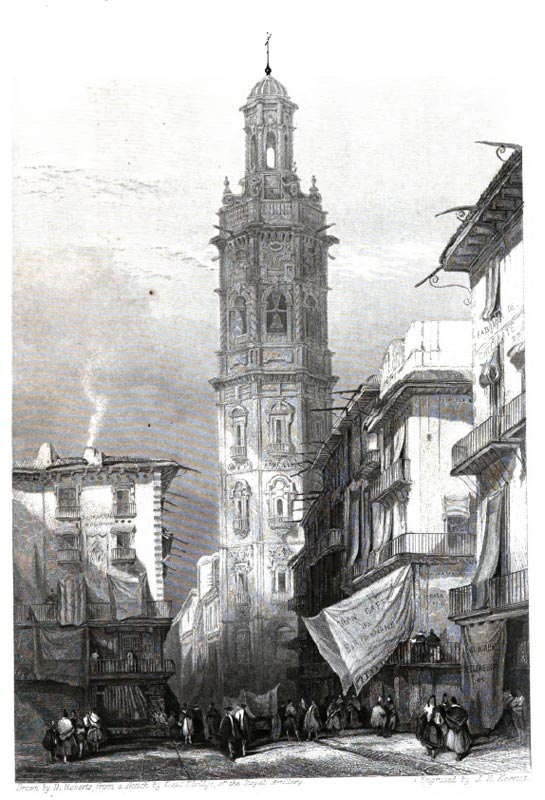
TOWER OF SANTA CATALINA, VALENCIA. The Tourist in Spain and Morocco, by Thomas Roscoe (1838).
Picturesque and magical are the adjectives used by A. Andros to describe Valencia. He passionately recounts a visit to the local market, narrating the most exciting hustle and bustle, with a square crowded with people, stalls, shops and piles of huge melons (41). He visits the “splendid” alameda, where the city’s inhabitants spend the cool evening hours in uncomfortable tartanas. He describes the stifling heat and says that the streets are deserted in the middle of the day as everyone is napping. On the way to the hotel, he meets a group of cripples, an experience that leaves him “paralysed,” and which he describes in detail as if they were otherworldly beings. He also finds it improper for the ladies of the area to go out in the streets at night. He ends his visit with a journey to Grao in an English carriage, which, according to the author, provided a more comfortable experience than the tartana. There he gazes in fascination at the crème de la crème of Valencian society.
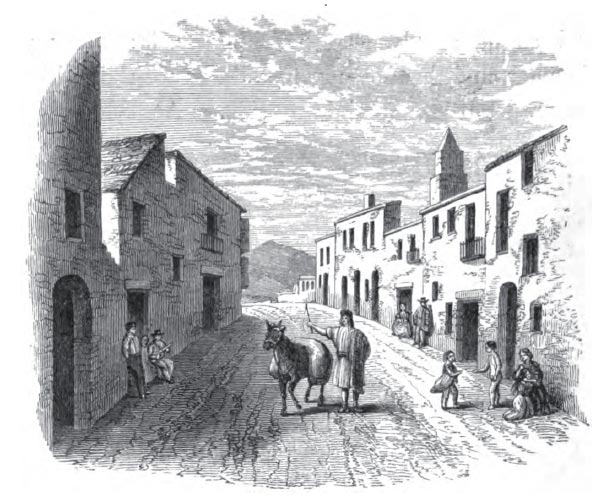
STREET IN MURVIEDRO. Pen and pencil sketches of a holiday scamper in Spain, by A. C. Andros (1860).
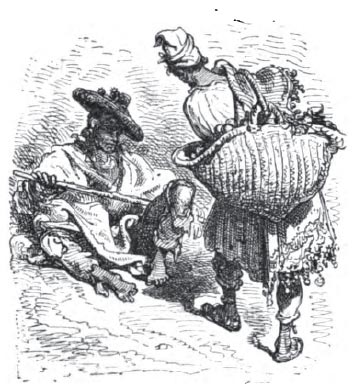
WORKERS IN VALENCIA. Spanish pictures drawn with pen and pencil, by Samuel Manning (1870).
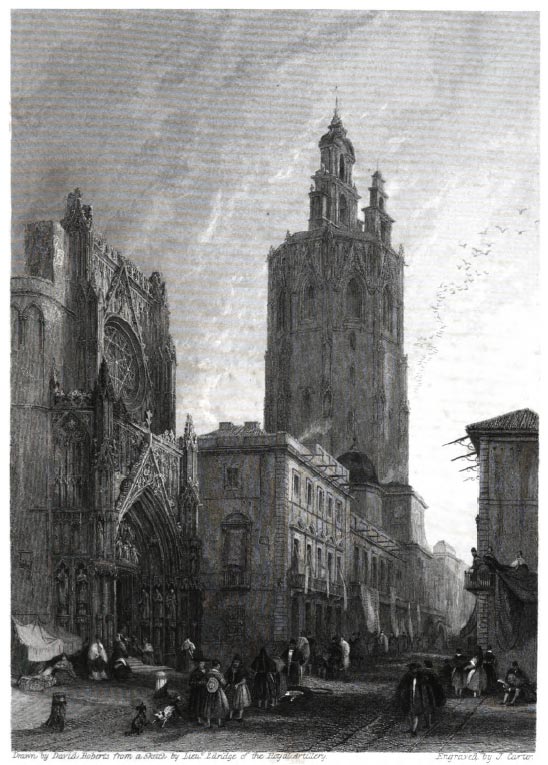
SQUARE-CATHEDRAL, VALENCIA. The tourist in Spain and Morocco, by Thomas Roscoe (1838).
Augustus Hare visits Sagunto and is delighted to find himself surrounded by locals who inquire about his paintings and eagerly ask him questions about England, demonstrating their keen interest and curiosity. He is pleased to hear that they are immensely proud of their town, which they compare to Rome. Moreover, they say that their parish is on a par with the Vatican and that if the Pope had to leave Rome, Sagunto would be the place he would choose (74). After passing through Xátiva, he heads for Alicante, where he discovers a particularly good hotel, the Bossio, which he thinks is one of the best in Spain. Alicante strikes him as a city with a touch of the Orient (67). From there he goes to Elche and rides for the first time in a Spanish stagecoach, finding that the discomfort is greatly exaggerated and noting certain advantages over the railway. In Elche, he was amazed to see how the workers climbed up the trunks of the palm trees to pick the dates. According to this traveller, this is an honest and trustworthy town since everybody takes the dates and then leaves the payment for them (79).


