


Basque Country (2 of 2)
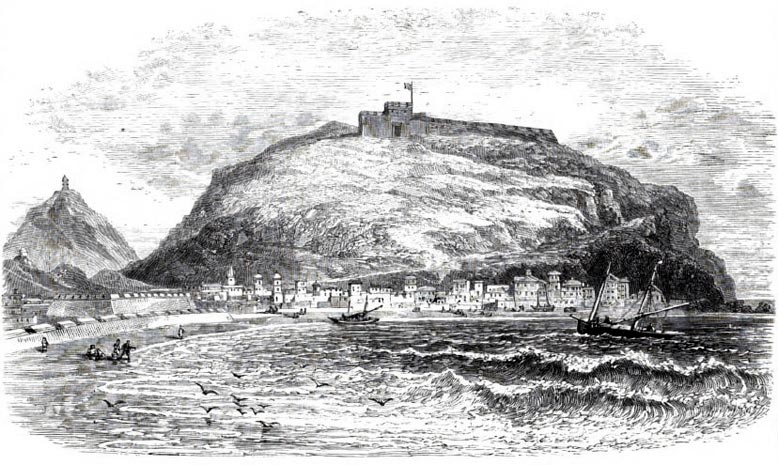
SAN SEBASTIÁN. Spanish pictures drawn with pen and pencil, by Samuel Manning (1870).
Samuel Widdrington travels through Guipúzcoa and Álava on his journey in 1844. He describes the arduous work of the peasants in the fields using a ploughing system they made themselves with a pitchfork. He also mentions that Basque women engage in manual work and that, despite this, everyone maintains a jovial disposition. Despite the loss of human life during the Carlist wars, the area is still well populated. He adds that the appearance of the houses, the people and their manners deteriorate considerably as one moves away from the coast and towards poorer areas with harsher climates and geography (Vol. I, 7).
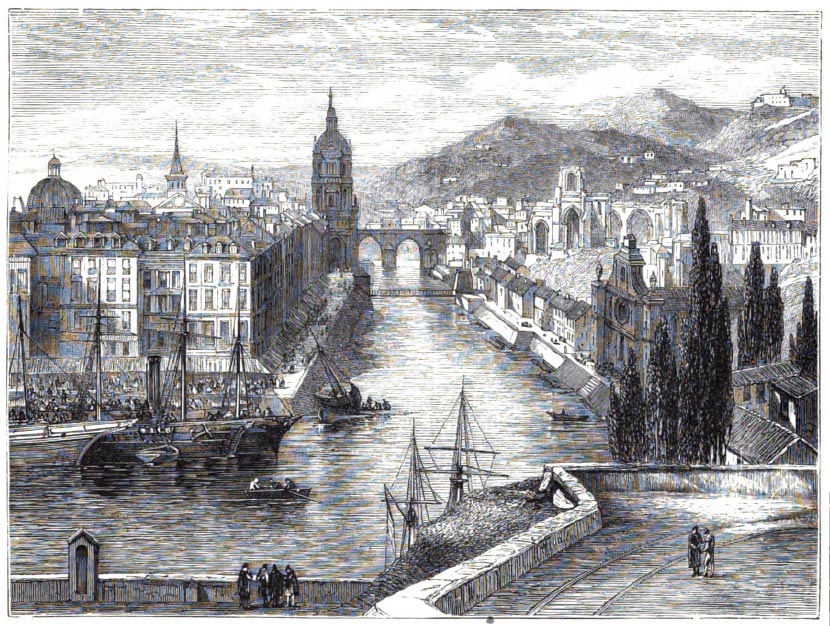
John Lomas focuses on the city of Bilbao. He describes it in detail and praises the beauty of its narrow streets and its orderly urban planning. Progress is readily apparent in its thriving shipbuilding industry:
(…) has a wonderfully English look about it. It is just sufficiently wooded, and dotted here and there with white villages, comfortable-looking country houses, and picturesque old churches (259).
BILBAO. Spanish pictures drawn with pen and pencil, by Samuel Manning (1870).
«San Sebastian is something more than a convenient resting-place, or preparation for the lower platform of life one must face in Spain. With its well-built streets, its shady Alameda and Avenida, and the really beautiful Plaza de Guipuzcoa»
John Lomas (Spain, 1925)
Lomas explains to the reader that it is a pity to pass quickly by train along the coast between Bilbao and Oviedo as the railway does not really allow one to enjoy the scenery. He declares that the old stagecoach routes, despite their discomforts, made it easier to take in the beauty of this area. He recommends travelling by car to stop at will and visit every location:
San Sebastian is something more than a convenient resting-place, or preparation for the lower platform of life one must face in Spain. With its well-built streets, its shady Alameda and Avenida, and the really beautiful Plaza de Guipuzcoa, where the birds still sing among the tamarisks, and the geranium and heliotrope are blooming into November; with its quaint bit of old town, and its bright double beach, upon which roll in unbroken line the magnificent billows of the Atlantic — billows indeed, carrying themselves majestically to the moment when they curl over to their death — the grumpiest of travellers must acknowledge that" it is a place to be desired (1-2).
David Trench also enjoyed his stay in the province of Guipúzcoa and the local cuisine. During his journey in 1845, he is delighted with the typical hearty breakfast of the area, which fuels him for the whole morning: a good piece of bread, hot chocolate and a glass of water with a large lump of sugar in it:
The objects of interest near Azpatia are situated in opposite directions, one at about three miles, the other at about one mile distant. Having partaken of the early refreshment common in Spain-bread, and a small cup of chocolate, with cold water in which a large piece of frosted sugar is melted, we set out for the baths (18).
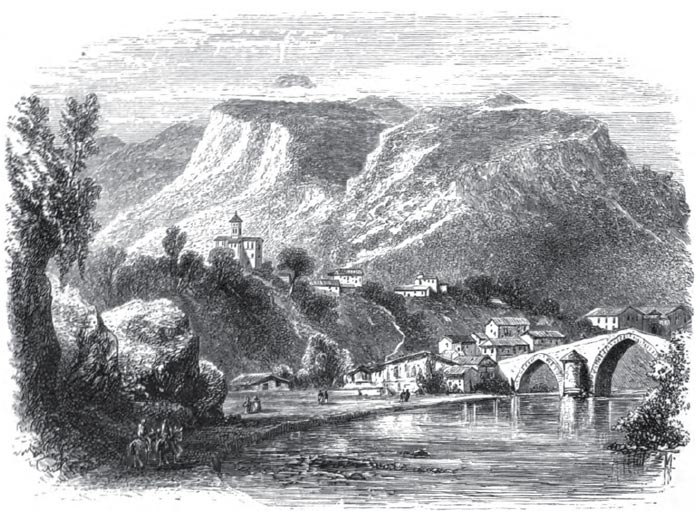
VILLABONA, NEAR SAN SEBASTIÁN. Spanish pictures drawn with pen and pencil, by Samuel Manning (1870).


