


Madrid (2 of 2)
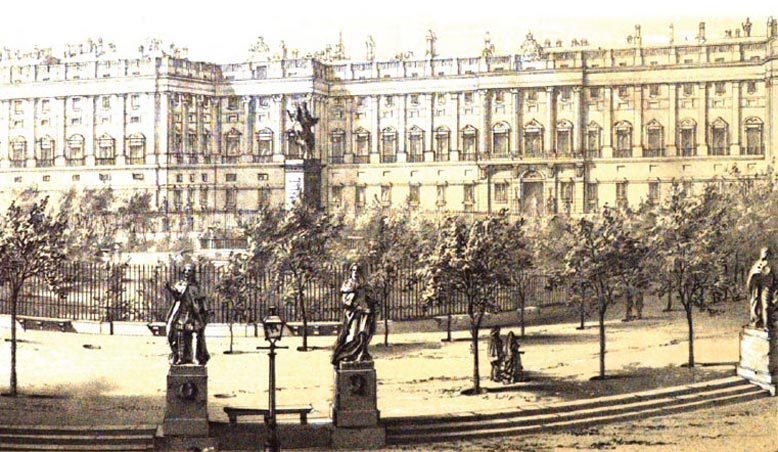
ROYAL PALACE. Castile and Andalucia, by Lady Louisa Tenison (1853).
In Thomas Rocoe’s opinion, the best landscape in Spain is the scenery surrounding El Escorial. In one chapter he describes everything about the view: the gardens, buildings, library, works of art and the charm of the landscape. Among all the wonders Spain has to offer, the scenery surrounding El Escorial, contemplated in the soft light just before twilight, is perhaps the most genuinely poetic and most likely to leave a lasting impression (The tourist in Spain: Biscay and the Castiles, p. 148). However, authors such as John Lomas comment that El Escorial disappoints nine out of ten travellers because they expect something from it that it is not: a place important for its history (87).
One aspect that the traveller Thomas Roscoe highlights is the beauty of the Madrilenian women and the distinguished balls that were held in the capital. During his stay in 1837, the author manages to connect well with the society of the time because he was a professional translator and had the ability to communicate in Spanish:
The colonel introduced his American guest to several officers of the guard, sauntering with the belles of Madrid, richly arrayed in their last court colours, their mantillas, basquiñas, and airy fans, most gracefully tutored to play their part, and bright satin sandals fitted close to the small foot, sparkling as they passed; their gay plumes and ribands, with that graceful waving motion, giving an indescribable air of enchantment to the whole person, and lighting up with fresh attraction the brilliant saloon. No more perfect studio for the painter of manners (…) (The tourist in Spain: Biscay and the Castiles, p. 208).
Finally, amidst numerous anecdotes, one stands out from the early 20th century involving Bart Kennedy during his visit to the market in Plaza de la Cebada in 1912. With great humour, he describes how vendors attempted to sell him vegetables in a manner that nearly buried him under an avalanche of produce:
The women were nearly all selling vegetables. As worked myself along vegetables were thrust at me from all quarters and points. I seemed to live in the middle of an avalanche of tomatoes and turnips and carrots and onions and potatoes and strings of garlic, and other vegetables that I had never seen before. Every woman wanted to sell me a handful or a basketful at once. (…) I was surrounded by the vegetables and by these cries as I wedged my forlorn and helpless way through the Calle de la Ruda, but at last I was through (162-163).
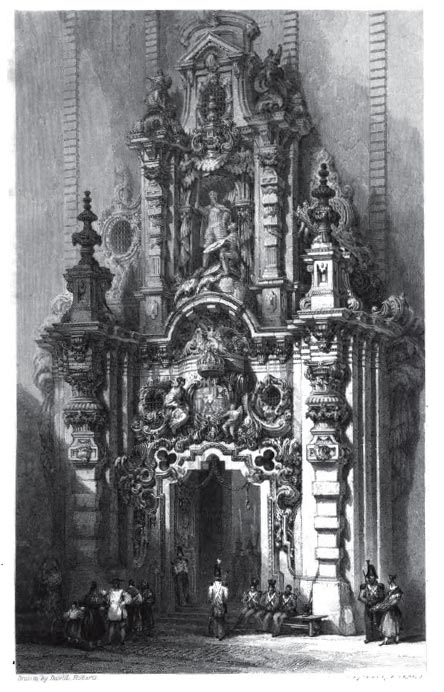
PUERTA DEL HOSPICIO. The Tourist in Spain and Morocco, by Thomas Roscoe (1838). Illustration by David Roberts.
«Above all things that Spain has to show, the scenes round the Escorial, contemplated in the soft hour which precedes twilight, are perhaps the most truly poetical, and the best calculated to leave a lasting impression on the heart»
Thomas Roscoe (The tourist in Spain: Biscay and the Castiles, 1837)
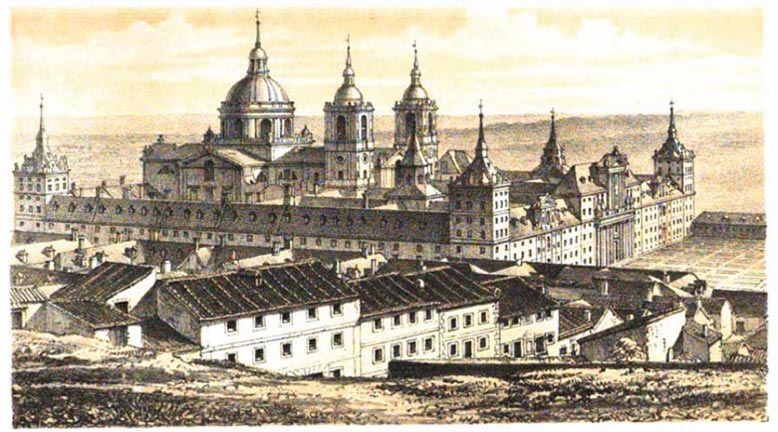
EL ESCORIAL. An autumn tour in Spain in the year 1859, by Richard Roberts (1860).


