


Galicia (2 of 2)
«Time has been when, with the single exception of Rome, it was the most celebrated resort of pilgrims in the world...»
George Borrow (The Bible in Spain, 1843)
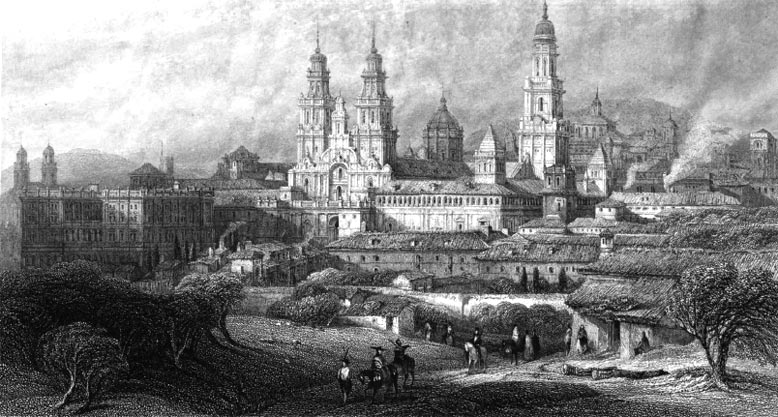
THE SEMINARY AND THE CATHEDRAL OF SANTIAGO. The tourist in Spain and Morocco, by Thomas Roscoe (1838). Illustrations by David Roberts.
Two years later, author Samuel Widdrington travels to Santiago, where he is amazed by the thriving university and the amount of degrees in science and humanities:
The establishment seems to be in a thriving condition, and I was much pleased with the professors at the head of the respective departments, from whom I received all kinds of civility and attention. The minor colleges have been suppressed and united to the principal one, and there is every appearance of its success (Vol. II, 195-196).
Moving into the 20th century, John Lomas describes all the picturesque nooks and crannies in the Galician capital and deems them are worth seeing in detail. Of these, the author highlights the unique arcaded arcades, where well-dressed people leisurely stroll. Another of these sites, which Lomas considers perfect for the painter’s palette, is the church of San Benito with the Plaza de Cervantes in front of it, next to colourful shops with women dressed in sombre woollen skirts. What leaves the greatest impression on him is its cathedral, regarded as one of the most majestic examples of religious architecture worldwide.
Widdrington’s memory of Pontevedra is linked to a rather unpleasant experience. In Pontevedra, he is subjected by the authorities to a more serious interrogation than he had previously endured and asked why he is travelling in Spain given the delicate political situation of 1844. In Vigo he has a very different experience and greatly enjoys its landscapes and people:
Vigo and the hills beyond it, that cannot be excelled; there is little in Europe so beautiful or that would better repay a landscape painter for giving a little time to the novel subjects that might be picked out from this lovely region. (…) The people of this place and immediate neighbourhood are an active, industrious, cheerful, well-looking, polished race (…) (Vol. II, 219-222).
In Galicia, Borrow also leans on clichés and mentions the story of a meiga (witch), which seems to be real. The English writer meets a foreigner who has come to Santiago in search of treasure, following the advice of a dying friend. When he finds nothing, he calls on the services of the witch and this is the story he tells:
Benedict. — Ow! a Haxweib, a witch; the Gallegos call them so in their jargon, of which I can scarcely understand a word. So I consented, and they sent for the meiga. Och! what a Weib is that meiga! I never saw such a woman; she is as large as myself, and has a face as round and red as the sun She asked me a great many questions in her Gallegan; and when I had told her all she wanted to know, she pulled out a pack of cards and laid them on the table in a particular manner, and then she said that the treasure was in the church of San Roque ; and sure enough, when I went to that church, it answered in every respect to the signs of my comrade who died in the hospital. Oh, she is a powerful Hax, that meiga; she is well known in the neighbourhood, and has done much harm to the cattle. I gave her half the dollar I had from you for her trouble (386-387).
«... this is indeed Spain — stern, flinty Spam — land emblematic of those spirits to which she has given birth»
George Borrow (The Bible in Spain, 1843)
In general Pontevedra is described positively in Borrow’s work, with praise for its beautiful buildings and the fertility of its fields. However, the author also notes signs of poverty. Even so, the region leaves an indelible mark on the author because of the beauty of the bucolic landscapes between Pontevedra and Vigo:
Pontevedra, upon the whole, is certainly entitled to the appellation of a magnificent town, some of its public edifices, especially the convents, being such as are nowhere to be found but in Spain and Italy. It is surrounded by a wall of hewn stone, and stands at the end of a creek into which the river Levroz disembogues. (…) The whole country in the neighbourhood of Pontevedra is inconceivably delicious, abounding with fruits of every description, especially grapes, which in the proper season are seen hanging from the parras in luscious luxuriance. (…) The Pontevedrans boast that their land produces two crops every year, and that whilst they are gathering in one they may be seen ploughing and sowing another. They may well be proud of their country, which is certainly a highly favoured spot (402).
Finally, an interesting paragraph by George Borrow uses the Galician coast as a symbol of the Spanish character. This rugged landscape is the first sight that greets many travellers upon arrival to the country, and serves as a metaphor for what they will encounter later on during their visit:
There is an air of stern and savage grandeur in everything around, which strongly captivates the imagination This savage coast is the first glimpse of Spain which the voyager from the north catches, or he who has ploughed his way across the wide Atlantic: and well does it seem to realize all his visions of this strange land. “Yes,” he exclaims, “this is indeed Spain — stern, flinty Spam — land emblematic of those spirits to which she has given birth. From what land but that before me could have proceeded those portentous beings who astounded the Old World and filled the New with horror and blood, Alva and Philip, Cortez and Pizarro — stern colossal spectres looming through the gloom of bygone years, like yonder granite mountains through the haze, upon the eye of the mariner. Yes, yonder is indeed Spain; flinty, indomitable Spain; land emblematic of its sons! ” (429).


