


Catalonia (2 of 2)
«Lerida is another of those Catalan cities that remind one od the saying about new wine on old bottles»
Albert F. Calvert (Catalonia and the Balearic Isles: an historical and descriptive account, 1910)
Other provinces and towns appear in these stories, such as Lérida, a frequent stop for travellers on their way to France or the Pyrenees. English adventurer Bart Kennedy travelled to Andorra by stagecoach in 1912 and describes his passage through the picturesque villages of Tárrega and Artesa. In the latter, he has to wait twenty hours until the next coach leaves for Seo de Urgel, so he takes the opportunity to stroll around and enjoy the rich history of the place. At the inn where he stayed in this town, Kennedy almost falls victim to a fraud common at the time known as “la peseta filipina” (the Philippine peseta), which consisted of returning an almost worthless foreign coin instead of the real Spanish peseta. However, having been forewarned, the author avoids the scam. Just at the border with France, Kennedy writes about having enjoyed the experience and mentions he is glad to be leaving, not because he disliked Spain, but because he was very tired after four months of travelling all over the country, often walking ten hours a day.
Lérida is mentioned in Albert Calvert’s work, which he characterises as having aged like fine wine. The city may have become more modernised, but it had aged well, and the author also describes the city as picturesque:
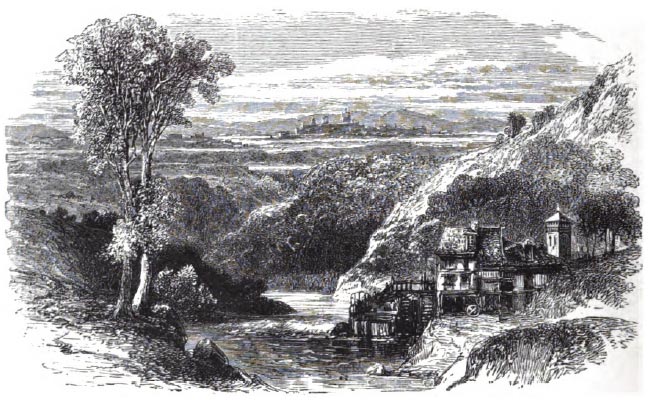
LÉRIDA. Spanish pictures drawn with pen and pencil, by Samuel Manning (1870).
Lerida is another of those Catalan cities that remind one od the saying about new wine on old bottles. Seen from afar it is clearly one of those old human hives that have existed on the same spot ever since man felt the need of a permanent abode—you have the hill-site, the walls, the towers, the flowing river, the mediaeval aspect. You observe with delight a humpbacked bridge, such as (with a total disregard for beasts of burden) our pious ancestors loved to build. And over all rises the cathedral—or, as we shall soon learn, what was the cathedral. But on a closer inspection we find that time has by no means left Lerida untouched (40).
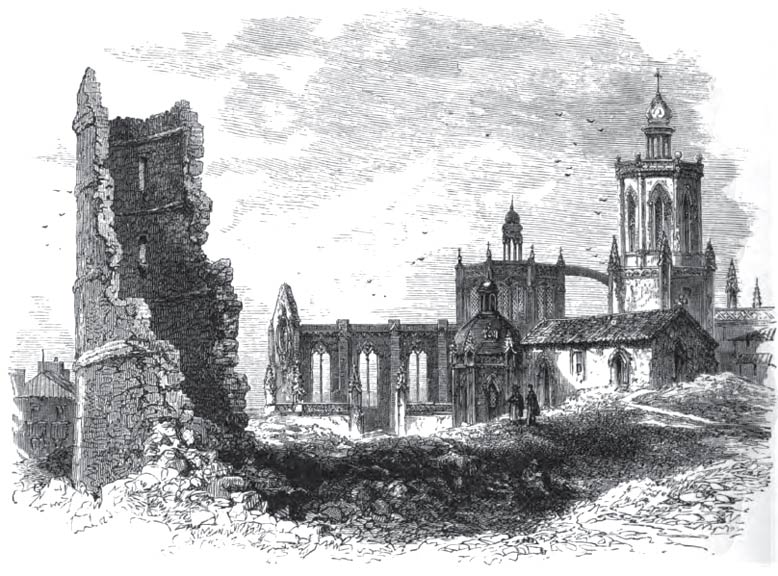
RUINS IN TARRAGONA. Spanish pictures drawn with pen and pencil, by Samuel Manning (1870).
John Lomas writes in detail about Tarragona, describing what he sees as his train traverses the landscape from Valencia to the Catalan city. He was enchanted by the picturesque streets and the glorious medieval cathedral during his visit in 1925 (213). He recommends befriending the architect of the Tarragona town hall and asking him to serve as a guide, given his great knowledge of the place. Finally, he recommends visits to Reus, Poblet, Santa Creus and Vallbona. Marguerite Purvis is also impressed by the spectacular views of Tarragona. The writer describes a pleasant stroll through the city:
Nothing can exceed the beauty of the drives and walks around Tarragona. Small carriages are to be had at the hotel, and we drove to the Roman Aqueduct, which is a short distance from the city. The view from the northern end of the Rambla is even more striking than from the Terrace, It is one of those views which, though seen but for a moment, never pass away from the memory. We looked abruptly down upon a rich plain, studded with palms ; on the left was a shelving beach, broken by creeks and sheltered by hills ; and on the rippling sea floated innumerable little fishing boats — nautilus like — with their white sails spread before the breeze (206).


