


Castile-La Mancha (2 of 2)
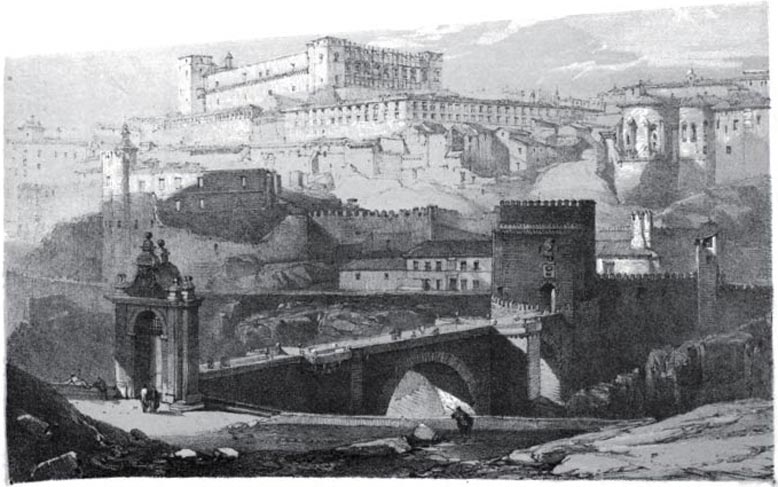
TOLEDO. Castile and Andalucia, by Lady Louisa Tenison (1853). Illustrations by Mr. John F. Lewis, based on originals by Lady Louisa Tenison and Mr. Egron Lundgren.
George Borrow was very pleased with the Castilian and Spanish hospitality after his time in the villages of Villaseca de la Sagra and Vargas, among others. The writer believes that the true Spaniard, known for kindness and hospitality, belongs to the lower class:
I experienced much grave kindness and simple hospitality from the good people of Villa Seca during my sojourn amongst them. I had at this time so won their hearts by the " formality " of my behaviour and language, that I firmly believe they would have resisted to the knife any attempt which might have been made to arrest or otherwise maltreat me. He who wishes to become acquainted with the genuine Spaniard must seek him not in seaports and large towns, but in lone and remote villages, like those of the Sagra. There he will find all that gravity of deportment and chivalry of disposition which Cervantes is said to have sneered away; and there he will hear, in everyday conversation, those grandiose expressions, which, when met with in the romances of chivalry, are scoffed at as ridiculous exaggerations (606).
During his journey through the lands of Castile-La Mancha Arthur Brookes recalls Cervantes’ work and its main character and mentions some of the references to food in Don Quixote. He provides a detailed recipe for the preparation of the famous olla quijotesca or migas (249). Thomas Roscoe also includes references to the cuisine of La Mancha, which he enjoys at an inn in Toledo. He recalled entering the inn and dining on a fine stew with just the right amount of saffron, and a delicious Valdepeñas wine to finish off the meal (The tourist in Spain: Biscay and the Castiles, p. 270).
After his visit to Ciudad Real, Alexander Mackenzie celebrates the excellent wine of Valdepeñas: it is very cheap, and given that the water was undrinkable in 1831, the author considers this beverage the best substitute when visiting the city. What pleasantly surprises him is that the Spaniards are not given to drinking, quite the contrary, and that they are not afflicted with the problem of alcoholism that he observed during his travels through England (Vol. II, 82-83).
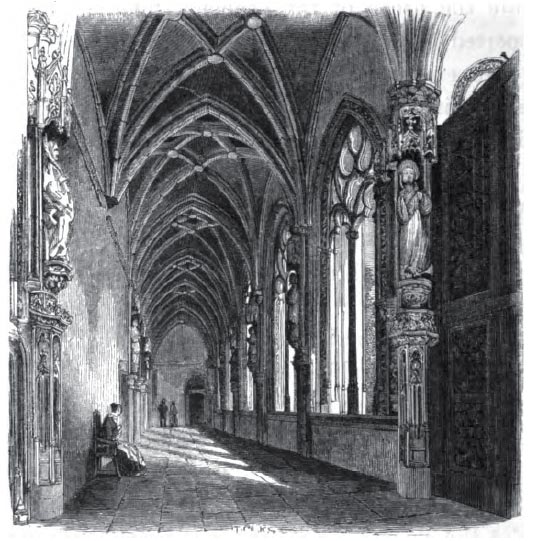
(1) CLOISTER OF SAN JUAN DE LOS REYES;
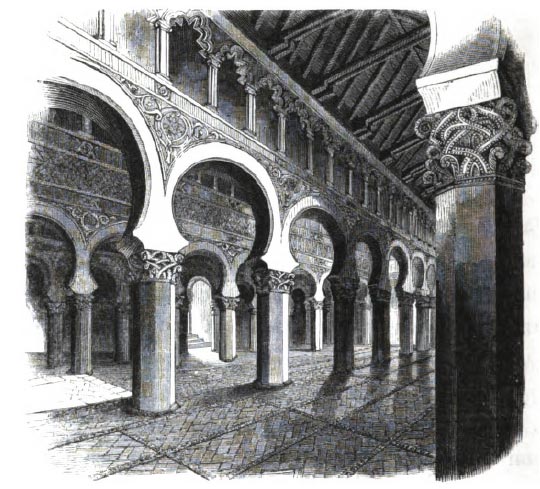
(2) INTERIOR OF SANTA MARÍA LA BLANCA;
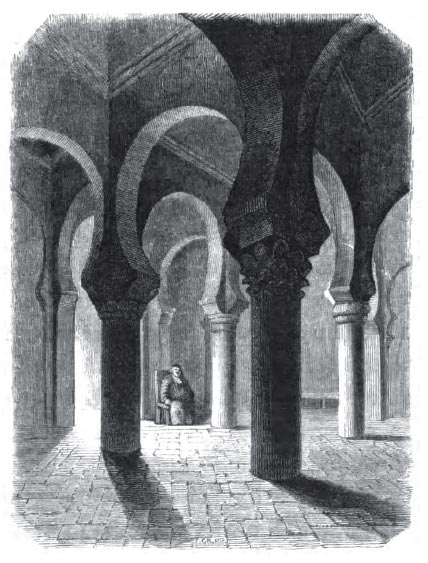
(3) INTERIOR OF THE CRISTO DE LA LUZ.
The picturesque antiquities of Spain, by N. Armstrong Wells (1846).
Other provinces are less popular and are, therefore, not featured frequently in these texts. Bart Kennedy is one of the few adventurers who travelled to Guadalajara, a visit he made at the beginning of the 20th century. He struggled to find accommodation in the city because, by his own admission, he looked somewhat untrustworthy. He eventually managed to find a place to spend the night. He was served a meal that he did not understand but found delicious, accompanied by an excellent wine. The author was surprised when the waiters left the bottle on the table, allowing him to drink as much as he wanted (190-191). He finds the people of Guadalajara handsome, beautiful, and brave-looking; they remind him of the Scots.
Almadén and its mines are also the subject of some accounts. Samuel Widdrington, as an expert in minerals, had a special interest in this place, which he visited to learn more about phosphorite, given that this new mineral fertiliser was being introduced into British agriculture in the mid-19th century. The writer arrived in this village from Ciudad Real, having heard of an inn run by a Frenchman. He had hoped for a range of comforts, including the chance for a hot bath. Instead, he found a typical inn in terrible condition, crowded with muleteers and their mules in the haystacks. Regarding the local mining industry, Widdrington made several observations about the harmful health effects of the work. He describes the organization of the mines, the outdated machinery, the excessive heat, and the poor ventilation. He concluded that these poor working conditions were due to the greed of a former local ruler:
In the olden time, some governor had expended a large sum of money in making an embankment or mound across one of the barraneos, with a magnificent road fit for an approach to the largest capital, but “Cosas de España”, ending in a mule track at a very short distance (Vol. I, 179).
Cuenca receives a very favourable overall rating from Ford, contrary to the opinion of some Spaniards who had warned the traveller that there was nothing worth seeing there. According to the British writer, Cuenca is one of the most picturesque cities in Spain, along with Ronda and Toledo. (Vol. II, 806). For his part, George Cayley comments on how cold it was in the stagecoach on the way to Cuenca, despite it being May. Having travelled the whole region on horseback, the writer expresses his satisfaction upon arriving in Cuenca and enjoying an excellent breakfast:
We were in a more hopeful state of mind now; in the sunshine, after a decent meal of poached eggs and chocolate; but still we felt prepared to be disappointed, after coming eighteen hours’ journey merely to see it (313).
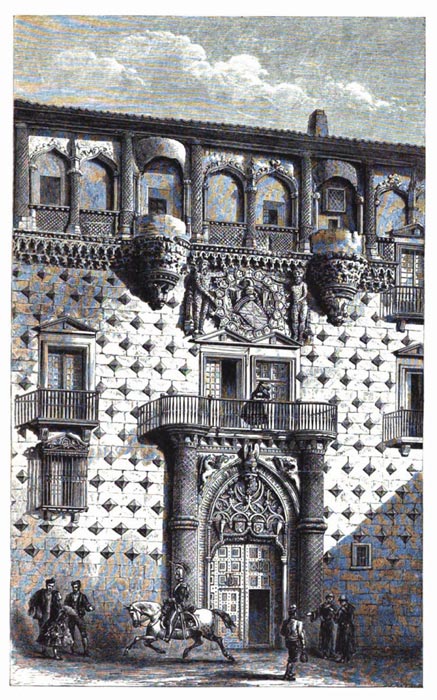
PALACE, GUADALAJARA. Impressions of Spain in 1866, by Lady Herbert (1867).
Richard Ford also wrote about Cuenca. The English author had heard very positive opinions about the city but was wary of them after having been disappointed by similar recommendations. However, the writer and his group seem to like Cuenca and its province more than they expected. Ford recounts his romance with some peasant girls in the Enchanted City:
It was a merry party, and we rode promiscuously among them, saying all the fine things we could make intelligible— and, indeed, more; for their language was a rough country dialect, and they could not keep up with our florid classical style of complimentary dialogue, which was principally modelled on Don Quixote’s conversations with princesses and shepherdesses (Manual para viajeros por España, Vol. I, 327-328).
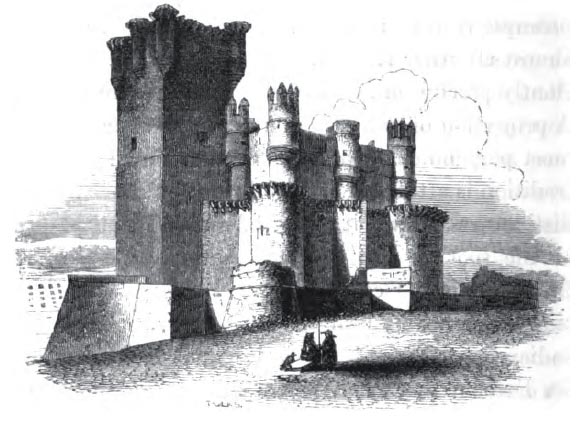
CASTLE OF GUADAMUR. The picturesque antiquities of Spain, by N. Armstrong Wells (1846).


